 by
by Updated VW T-Roc: A Bigger, More Comfortable, and More Practical Crossover
Volkswagen spent eight years relying on the original T-Roc for subcompact crossover sales in Europe, so the next generation has a lot to prove. The second-generation T-Roc has arrived, and on paper, it looks like a step forward. To see if this holds true on the road, we took this European SUV, which is not offered in the US, and compared it to its hatchback sibling, the Golf.
Exterior Design and Dimensions
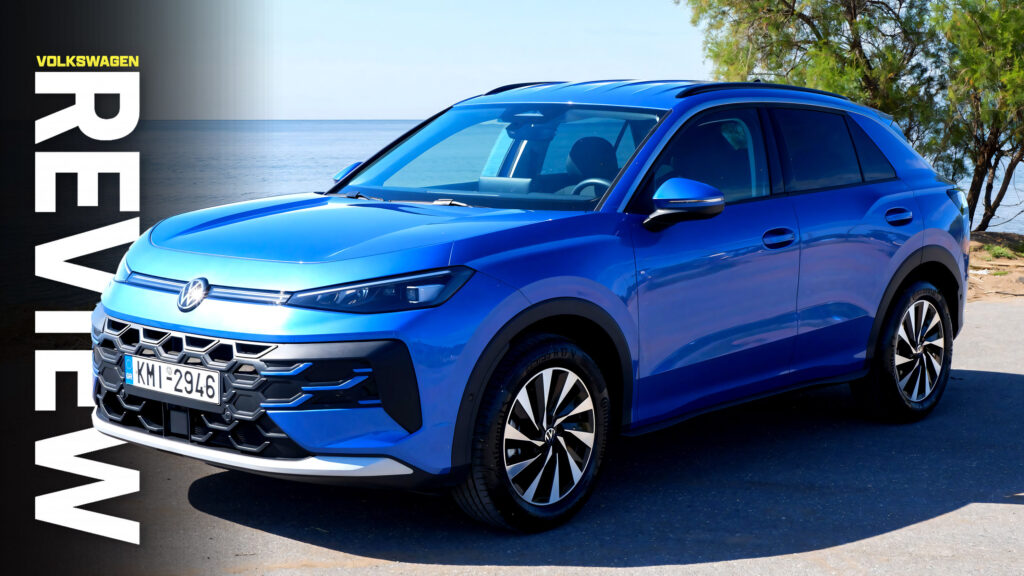
The size increase is noticeable even before you open the door. The new T-Roc is significantly larger than the 2017 original, gaining 138 mm (5.4 inches) in length, while the wheelbase has grown by 39 mm (1.54 inches). Our test car is in the Life trim with a few additional options and a more powerful 1.5-liter mild-hybrid engine under the hood.
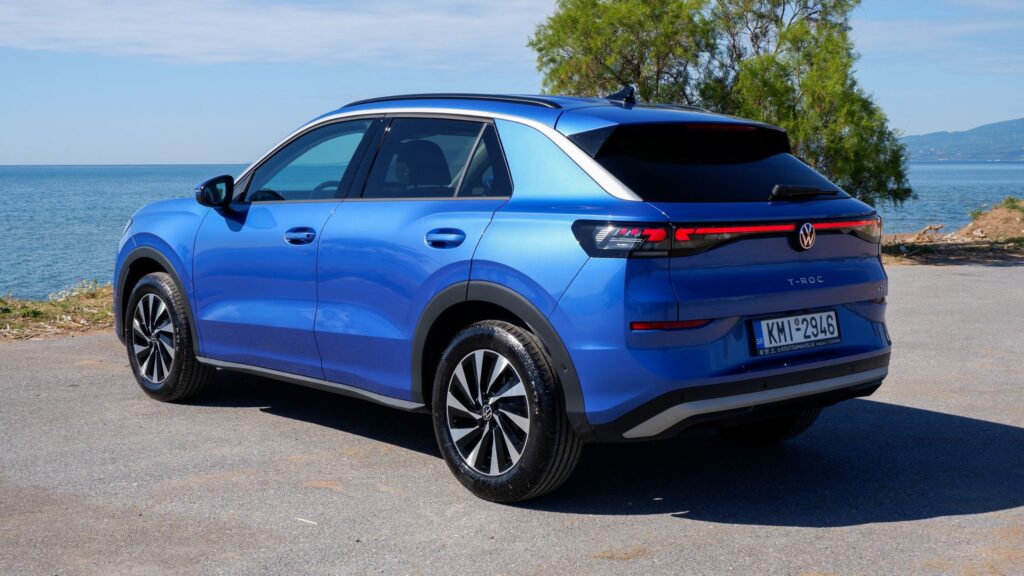
In terms of style, the aggressive headlights and bulky ‘honeycomb’ plastic trim on the front bumper look less elegant than the cleaner, more minimalist design of the previous T-Roc. Otherwise, the recipe remains unchanged: the same side glass, a decorative strip flowing into the C-pillar, and tapered rear wings. The rear has also evolved, featuring a sharply angled rear window, full-width taillights, and an illuminated logo.
Quick Facts
Interior and Features
The cabin immediately feels more spacious than before, a direct result of the longer wheelbase. The dashboard is no longer body-colored and has finally shed its hard plastic for softer fabric upholstery, which, combined with ambient lighting and a modern layout, enhances the perception of quality. However, beyond this, the materials take a step back, with hard plastics appearing that do not meet expectations for this price or segment in general.
The digital instrument cluster consists of an 8-inch display and a 12.9-inch infotainment screen. The touchscreen has crisp graphics and very responsive feedback but retains the controversial touch sliders for temperature and volume control. Fortunately, the T-Roc gets buttons on the steering wheel and a new cylindrical knob on the center console that allows for traditional adjustment of volume and drive mode selection.
Other interior features include an EV-style automatic gear selector and unconventional interior door handles. Since there is no manual transmission for the T-Roc, VW has used the extra space on the center console for wireless charging. Another useful addition is the rear ventilation vents, which are rare in this segment.
Practicality and Capacity
Rear passengers have more legroom than before, though headroom could be better. Cargo volume is 475 liters, which is 30 liters more than its predecessor and 94 liters more than the Golf.
Driving Impressions
On the road, the T-Roc exhibits familiar Volkswagen traits, starting with neutral and predictable steering. The real revelation is how much ride comfort and sound insulation have improved, bringing the T-Roc’s driving manners closer to the larger Tiguan than the smaller T-Cross. The updated MQB Evo architecture feels more refined, and the standard suspension excellently absorbs bumps without allowing body roll in corners or pitching on long waves. Overall, our test car was surprisingly comfortable, aided by the thick tire sidewalls on the smaller 17-inch wheels.
The electrified powertrain in its most powerful form at 148 hp offers more than adequate performance on the highway, but the tuning is more focused on comfort than sportiness. The execution is remarkably smooth, behaving closer to a full hybrid than a typical mild hybrid, with the internal combustion engine shutting off more often than one might expect.
Pricing and Competitors
In Greece, where we tested the car, the cheapest T-Roc Trend with the base 114-hp mild hybrid starts at €28,590. Moving to the more powerful 148-hp engine requires stepping up to the Life trim, which starts at €31,390. The flagship R-Line rises to €35,990, adding a sportier look and slightly firmer suspension.

While the 1.5 eTSI mild hybrid is the only option for now, VW has confirmed that the T-Roc lineup will soon expand with a self-charging hybrid setup in two power variants. Additionally, the company is preparing to introduce a performance-oriented T-Roc R with a turbocharged 2.0-liter engine and all-wheel drive.
The most direct competitors for the VW T-Roc are the Hyundai Kona and Toyota C-HR, both built on compact rather than subcompact architectures. Both have a price advantage over the VW: the C-HR starts at €28,300, and the Kona at €27,190 in versions with full hybrid powertrains.
Comparison with the Golf
The biggest competitor within VW’s own lineup is the proven Golf. We drove the mechanically related pair back-to-back and found the differences to be more pronounced than expected. From the first corner, it is clear that the low hatchback is the better driver’s car, feeling more planted and precise without compromising on comfort or refinement compared to the T-Roc. In terms of exterior design, most agree that the hatchback looks better than the SUV. Despite the Golf MK8 having been on sale since 2019, the 2024 update brought a sharper front end and an improved interior.
And contrary to what the dimensions suggest, the Golf’s cabin does not feel tighter than its SUV sibling’s. Nevertheless, we all know that buyers typically prefer the higher seating position and larger cargo area of an SUV over the sharper handling and sleeker looks of a traditional hatchback. Interestingly, local market dynamics do not favor the Golf. In Greece, the hatchback may have a lower starting price (Golf Essential starts at €24,980), but the math changes as you move up the lineup. In the Life trim, the Golf is only €810 cheaper than the T-Roc, and in the Style specification, it is even €1,690 more expensive with the same engine. This makes the T-Roc a very attractive choice in the VW showroom.
Verdict
Volkswagen’s update to the successful T-Roc has made it bigger, more spacious, and more refined than the original. It may have lost some of its playfulness, but it delivers exactly what buyers want in terms of everyday convenience. The new model occupies a sweet spot between Europe’s largest segments: subcompact and compact SUVs. It may not stand out in any single dynamic category, but it positions itself as a safe and smart choice that is hard to ignore, even at a slightly higher price compared to its closest rivals.
While the new T-Roc does not offer revolutionary changes, it is a very balanced and competent update. Its main advantage lies in combining SUV practicality with ride comfort and quality approaching older VW models. This makes it an ideal choice for those who value daily convenience and reliability without needing excessive sportiness. In conditions where even its own Golf cannot always offer a better price-to-space ratio, the T-Roc becomes a very logical and appealing option for the European market.