 by
by Updated Alfa Romeo Tonale: Is It Worth Its Price?
The Alfa Romeo Tonale always had a good car hidden inside. The problem was digging it out. When the model debuted, expectations were high, but it struggled to meet them, using what felt like a product of ‘design by committee.’ Sure, on paper it had many advantages: a lower entry point for Alfa fans, electrification for better fuel economy, and styling at least vaguely reminiscent of the concept.
Two years ago, we tested the PHEV hybrid version, and it was decent. It was reasonably quick, but not genuinely swift, and its price tag exceeded $60,000. For that money, you could get genuine speed in a similarly sized crossover, like the Stelvio.
Today, much has changed. Alfa has just refreshed this small vehicle. The Stelvio is noticeably aging. The hybrid Tonale PHEV has disappeared from the US market. And another important change: the price has dropped by roughly $15,000. All these factors herald positive changes, and we just spent a full week behind the wheel of the new top-tier Sport Speciale trim.
Specifications
Model: 2026 Alfa Romeo Tonale Sport Speciale
Dimensions: 4,530 mm (178.3 in) L x 1,840 mm (72.4 in) W x 1,600 mm (63.0 in) H
Wheelbase: 2,637 mm (103.8 in)
Powertrain: 2.0-liter turbocharged four-cylinder engine
Transmission: 9-speed automatic
Power: 268 hp (200 kW) and 295 lb-ft (400 Nm) of torque
0-60 mph: 6.5 seconds (0-96 km/h)*
Fuel Economy: 21 city / 29 highway / 24 combined (EPA estimate)
Cargo Volume: 27 cubic feet behind the second row
Towing Capacity: 2,000 lbs
Price: From $46,035 for hybrid / $52,730 for Tributo Italiano Edition
*Manufacturer data, **Price does not include $1,995 destination charge
No, this isn’t some Tonale Quadrifoglio. It’s not extremely fast either, and if you choose a car solely by power figures, there are alternatives with bigger numbers and louder claims. But after a week behind the wheel, I realized something strange was happening. I kept making up errands. Need milk? Alfa. Need coffee? Alfa. Need nothing? Suddenly, the long way home seemed like a fantastic idea. Read on to find out why.
Exterior: Maturing Suits It Well
The Tonale was never outright ugly. It didn’t look as close to the concept as many hoped, but it still turned heads. Alfa’s problem was creating something attractive enough without fully delivering on driver expectations for handling. For 2026, the styling changes don’t reinvent the crossover, but they refine it and add a touch of historical flair.
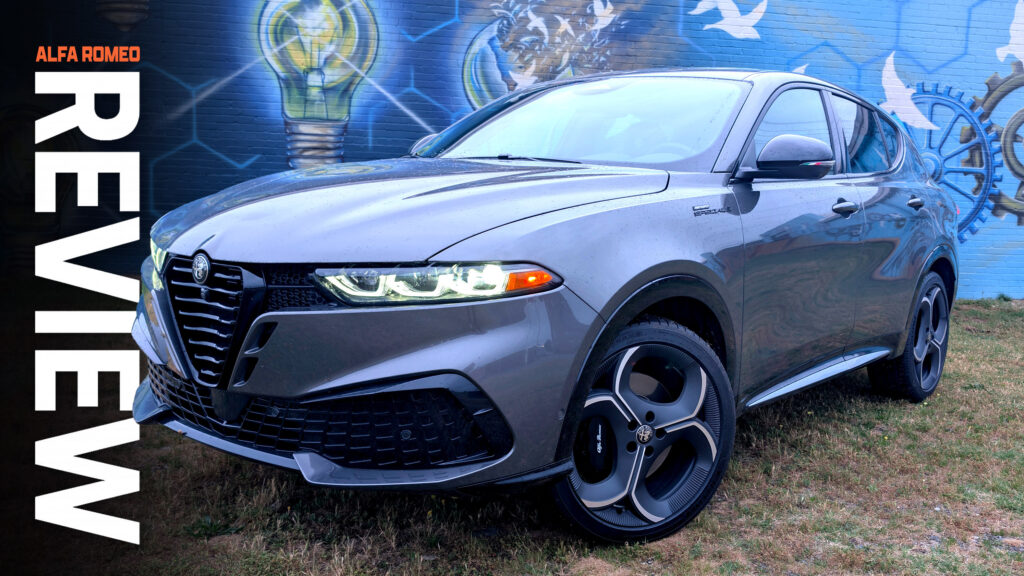
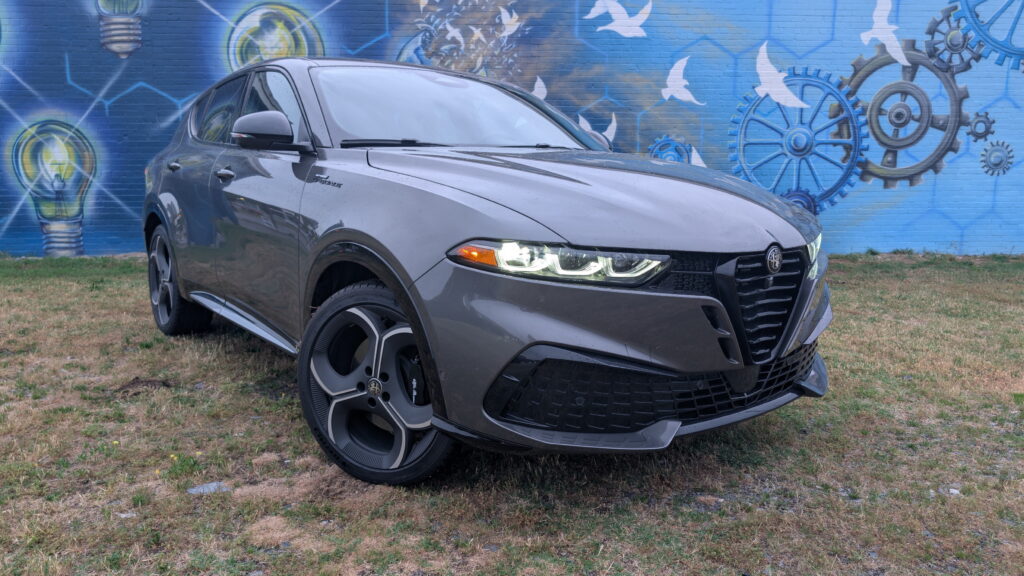
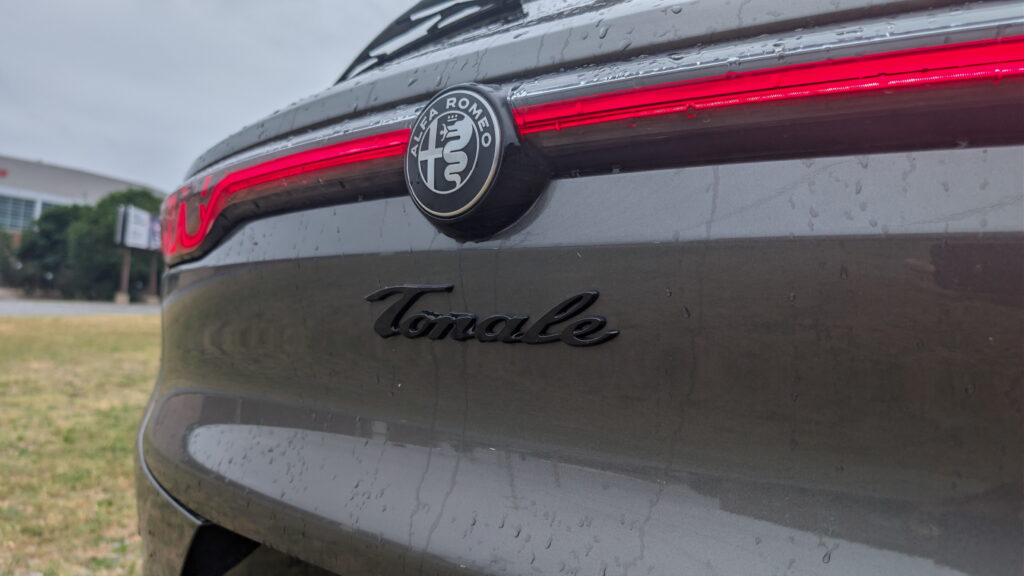
The front end looks sharper and more mature. The grille, a direct reference to the 33 Stradale supercar, has a stronger presence without being overly styled, and the updated rear lighting is particularly striking at night. It feels like Alfa is no longer trying to prove something, but rather a design team confident enough to be bolder.
The three-spoke wheels remain one of the coolest details in the segment. Alfa’s classic ‘phone dial’ wheels have become part of the brand’s identity, and on this specific car, they look almost like carbon from afar, even though they aren’t. Enthusiasts notice this.
And while buyers in this segment often prioritize practicality over emotion, the Tonale still manages to look special when you approach it in a parking lot. There are quirks too, because, well, it’s an Alfa Romeo.
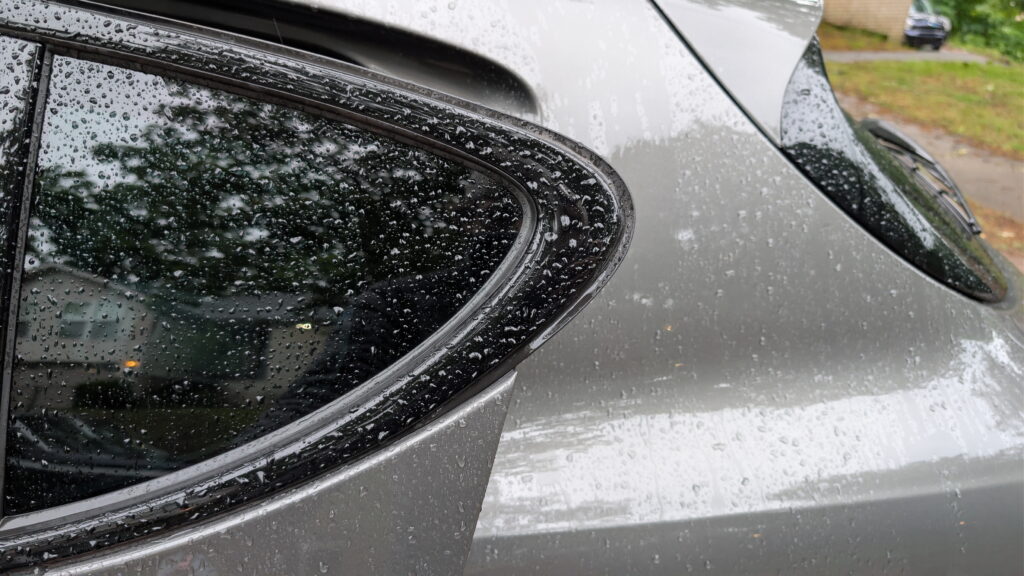
For example, the rear doors have an odd shape where the upper glass protrudes outward near the roof line. Imagine a little wing attached to the top corner of the door. If you open them carelessly, there’s a very real chance of hitting yourself and immediately wondering why nobody warned you. Ask me how I know.
Interior: Split Personality
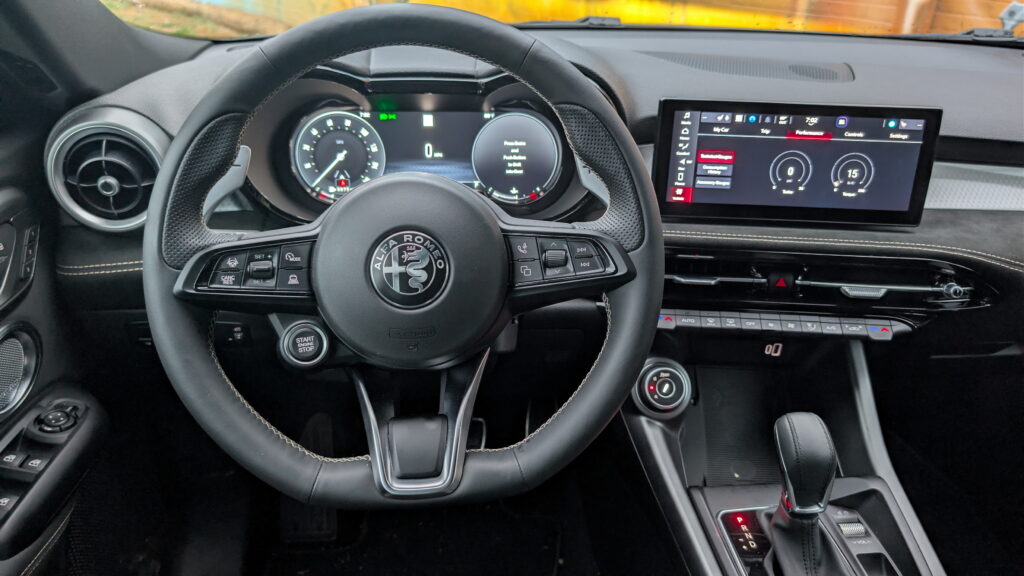
Inside, the Tonale walks a strange line. It seems to waver between premium and cheap. Let’s start with the good, because there’s plenty of it. The front seats are excellent. They are comfortable for long distances, supportive enough for spirited driving, and easy to get settled in. The cabin isn’t huge, but it’s comfortable. More importantly, it still feels special.
Huge aluminum shift paddles remain one of my favorite details in any car costing under six figures. Not fake metal. Real metal. It matters. Every time your fingers touch them, even if you’re not shifting gears, they create a sense of occasion. It’s a small thing, but it hugely impacts the overall impression.
Other details also deserve praise. Alfa has embossed its logo on the wireless charging pad. It’s subtle, but thoughtful. The physical climate controls have also been retained and deserve applause in today’s touchscreen-obsessed world. They are easy to find, easy to use, and they actually work.
Unfortunately, not all touchpoints are so successful. The steering wheel switches feel cheaper than expected. The gear selector itself lacks weight. Some plastic elements inside and on the top of the dashboard don’t exactly scream Italian luxury. But context matters. This isn’t a $70,000 SUV. In fact, that’s what makes this car interesting.
Many people, seeing the Alfa Romeo badge, assume they are looking at something much more expensive than it actually is. The Tonale still carries that premium perception, despite costing about the same as many fully loaded mainstream crossovers.
The infotainment system also feels a bit small by modern standards. Personally, I found it hard to care, as this car clearly prioritizes driving over screen size, and the system itself works perfectly fine.
Rear seat passengers might have more complaints. Legroom is acceptable at best, and the roofline slopes so aggressively that the rear seats can feel cramped. Taller passengers will notice immediately. Interestingly, Alfa has given rear passengers upholstery and materials similar to those used up front. It’s a nice touch, as many automakers treat the second row as an afterthought.
Behind the seats, you’ll find 27 cubic feet of cargo space. It’s not huge, but more than adequate for most things. Have you seen how truly spacious cars drive? The compromise is worth it. Speaking of how this thing drives…
Handling Worthy of the Badge
Alfa Romeo equips this car with a 268-hp (200 kW) 2.0-liter turbocharged four-cylinder engine producing 295 lb-ft of torque. It’s not a world record, but it’s not slow either. Technically, the PHEV hybrid is quicker, but you’d need a stopwatch to prove it. The non-hybrid version is understandably lighter, so it feels much more eager to respond to throttle inputs.
More importantly, it finally has character. The steering remains excellent. Precise, direct, and incredibly communicative for a compact crossover. The front end goes exactly where you point it, and the chassis responds instantly. The adaptive dampers also deserve praise.
They complement the car perfectly, calming the chassis without compromising comfort. Enter a corner harder, and the Tonale feels flatter and more composed. Slow down, and it remains perfectly comfortable in the city.
And then there are those shift paddles. Yes, I know we mentioned them already, but only regarding tactility. Switch to manual mode, and suddenly this thing becomes even more engaging. The transmission responds quickly, the shifts are satisfying, and those metal paddles feel wonderful in your hands.
You start downshifting just because you can. You start choosing the longer way home. You start looking for reasons to drive a little more. And it’s not because this crossover is objectively the fastest or most capable in the segment. It’s because it feels alive.
Even better, the Tonale doesn’t punish buyers at the pump for this personality. EPA estimates of around 24 mpg combined aren’t record-breaking, but they are perfectly reasonable for an all-wheel-drive compact crossover with nearly 270 horsepower.
Unfortunately, the experience isn’t perfect. At low speeds, especially during relaxed driving in residential areas or traffic, the nine-speed transmission sometimes seems completely lost. It hunts. It searches. Sometimes it seems to forget which gear it wanted to select.
All of this can feel clumsy and hesitant if you’re not driving aggressively enough to ‘wake it up.’ Step on the gas, and the problem almost disappears. Drive gently, and sometimes the transmission feels like a teenage driver checking their phone.
Competitors
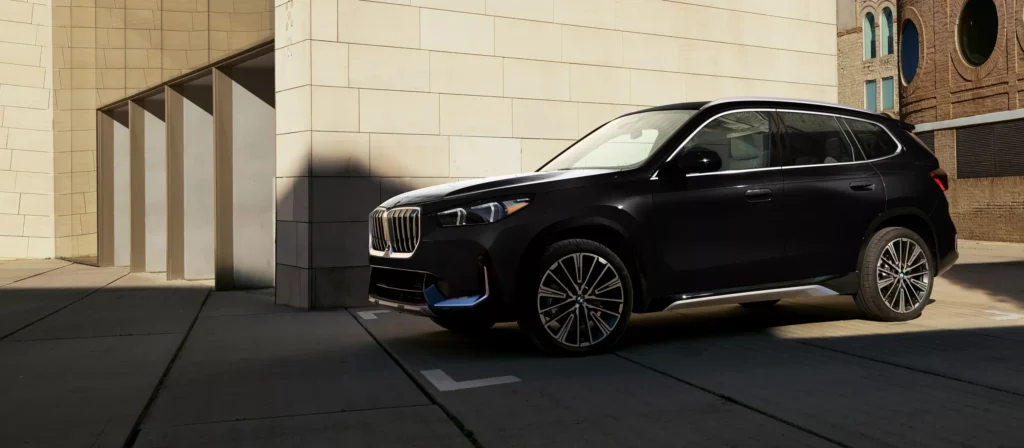
The last Tonale we tested had a price tag approaching $60,000, and at that point, the math became awkward. The larger Stelvio was nearby. German compact premium SUVs were nearby. Add a bit more, and you start approaching Porsche territory.
This Sport Speciale version completely changes that conversation. At around $45,000, Alfa Romeo has finally found the ‘sweet spot,’ and don’t forget we’re talking about the top trim. Less expensive versions can be had for around $40,000. Competitors include the BMW X1, Audi Q3, and, of course, the related Dodge Hornet.
In this context, the Tonale doesn’t feel overpriced. In fact, many buyers will likely assume it costs significantly more than it actually does. Finally, expectations are working in Alfa’s favor. Nevertheless, the X1 is a more balanced, though less appealing, choice. The Mini Countryman also lives in this segment (with an even lower starting price) and has a fun, quirky character.
Verdict
The 2026 Alfa Romeo Tonale Sport Speciale finally feels like the crossover Alfa Romeo should have built from the start. No, it’s not perfect. Some materials feel cheap. Rear seat passengers won’t enjoy spending hours back there. The transmission sometimes has an existential crisis at low speeds.
But when the road gets interesting, and you’re not carrying rear passengers, these complaints start to seem much smaller. Because underneath it all lies a crossover with excellent steering, a genuinely lively chassis, adaptive dampers, huge metal shift paddles, and enough personality to make mundane trips memorable.
The 2026 update was a true lifesaver for the Tonale. The nearly $15,000 price reduction dramatically changed the model’s positioning, moving it from the ‘expensive Italian experiment’ category into a more accessible segment where it can compete not only on image but also on value. Although the car technically isn’t revolutionary faster, its character has become much brighter thanks to the successful chassis and steering tuning. This is a case where driving emotions outweigh shortcomings in interior quality or rear seat space. For those seeking not just a means of transportation, but a way to enjoy every trip, this crossover could be a surprisingly good choice, especially compared to more pragmatic but less charismatic competitors.