 by
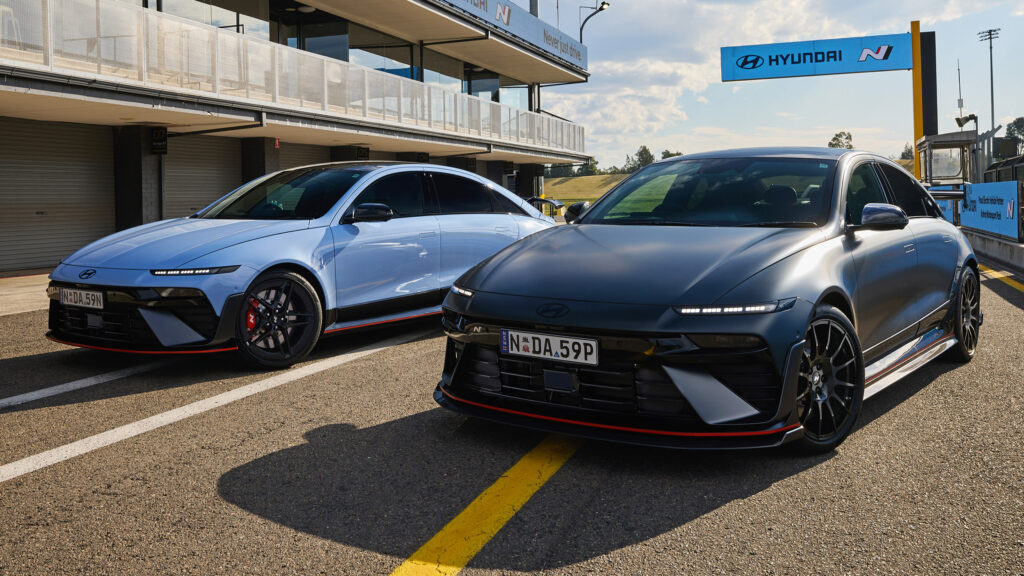
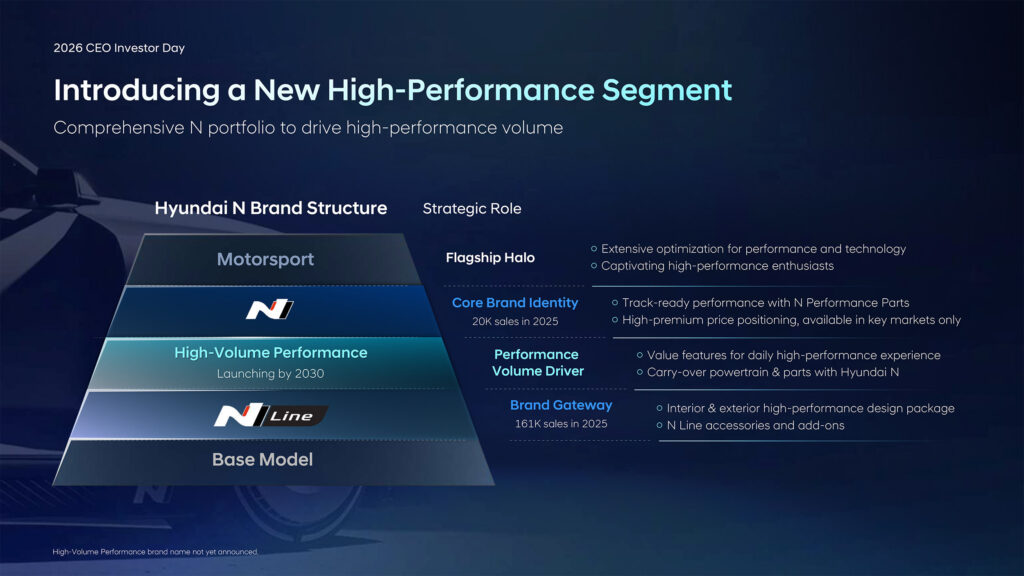
by Hyundai’s N division has already won the hearts of many enthusiasts, and the company has capitalized on this popularity by offering softer and more affordable N Line versions. Now Hyundai has officially confirmed its intention to add a third performance tier, positioned exactly between N and N Line and aimed at mass market segments.
The news was announced during Hyundai’s 2026 Investor Day event in Korea. Hyundai’s President and CEO José Muñoz stated:
“Performance is a profitable business, not just an emotional one.”
He added that Hyundai N currently covers about 30% of the performance car market, and by 2030 this share should exceed 60%. To achieve these figures, the N lineup will grow from the current five to more than seven models. They will be offered in 40 markets, and annual sales volume by 2030 should reach 100,000 cars — five times more than the 20,000 sold in 2025.
A new family of performance models
Most importantly, according to Muñoz:
“We are adding something between N and N Line: a new mass-market high-performance version that will carry over the powertrain and components from N. So a customer who wants to feel that every day on the way to work can get it without buying a track car.”
For now, the new series does not have a commercial name, but Australian publication Drive aptly dubbed it N Lite. Judging by the CEO’s comments, Hyundai engineers may take components from existing N models and repackage them with a greater focus on everyday convenience.
As for aerodynamics and design, the differences between N Line and N are already not too glaring. So the new series will most likely follow a similar path: it will be more aggressive than standard Hyundai models, but not as radical as full N versions. In terms of powertrains, a combination of electric and hybrid options is expected depending on the model.
Betting on sales growth
The CEO explained why the company decided to expand the lineup:
“Last year N sold 20,000 cars, and N Line sold 161,000. The new series sits between them, and that is where the volume is.”
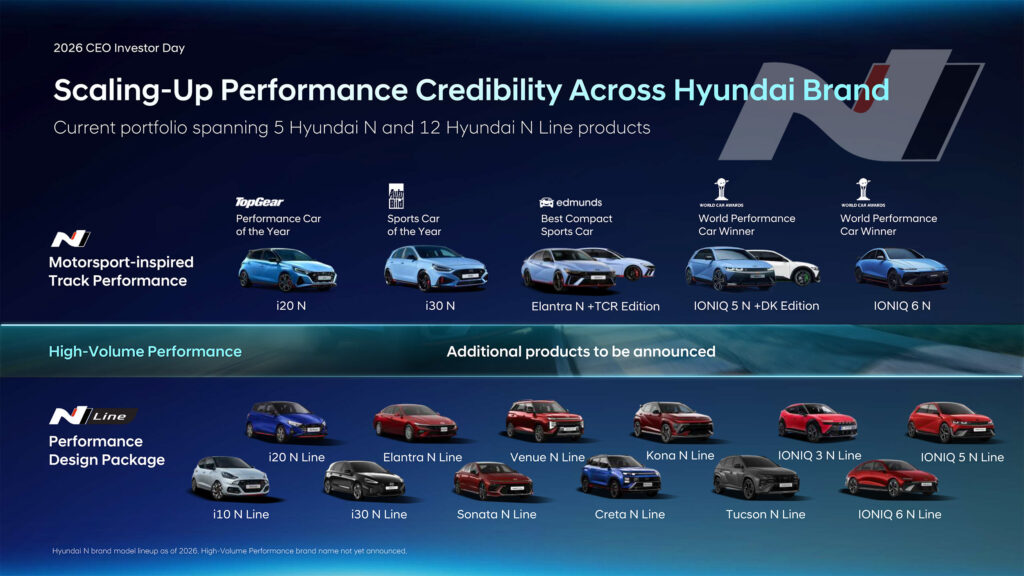
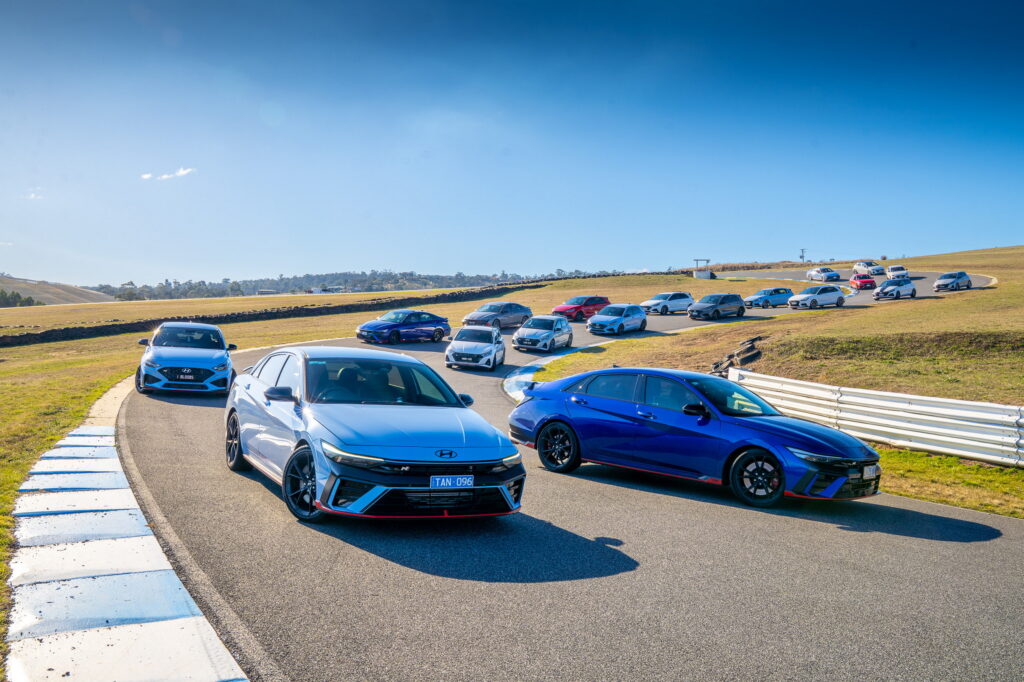
Today Hyundai has five N models and twelve N Line models worldwide. However, the hot i20 and i30 hatchbacks will soon be discontinued, and the sporty Elantra sedan is currently preparing for a generational change.
Even more new products, including a rear-wheel-drive surprise
Future new products will include an entry-level performance SUV that could replace the discontinued Kona N, as well as a still unnamed model on a new architecture with a front-mounted engine and rear- or all-wheel drive. The latter sounds quite intriguing for enthusiasts and has the greatest market coverage potential — 22%, at least according to Hyundai’s estimates. However, the chart indicates that the price will be higher than the Ioniq 5 N and Ioniq 6 N, so it should not be expected to be cheap.
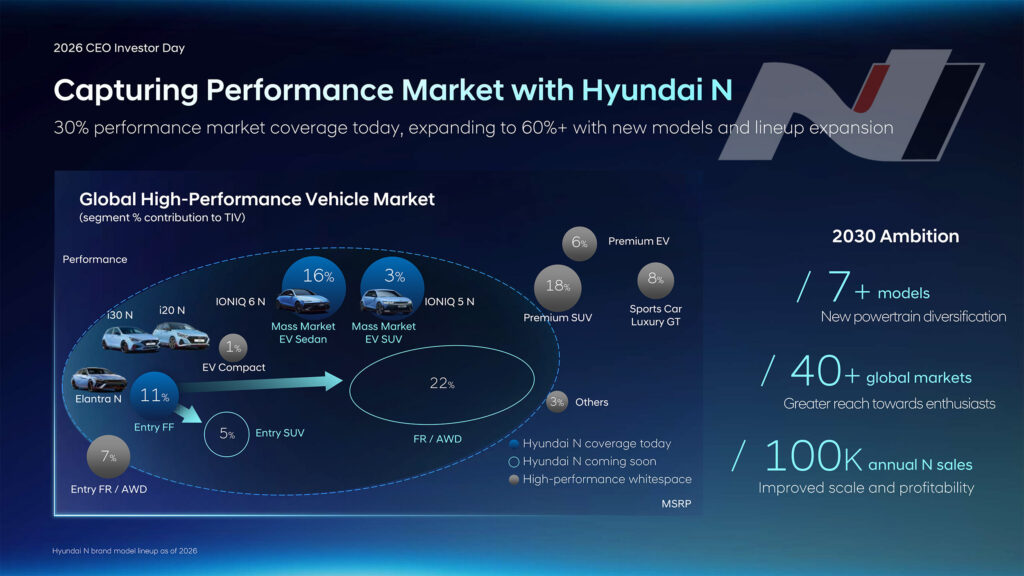
Other unoccupied high-performance niches that Hyundai could still explore include a cheaper entry-level model with rear- or all-wheel drive (7%), a compact EV (1%), a premium EV (6%), a premium SUV (18%), a luxury GT (8%), and others (3%). Among these, one can only mention rumors about the Hyundai Ioniq 3 N, which fits well into the description of a subcompact or compact EV.
In any case, Hyundai has more than one trump card up its sleeve. This could become one of the largest performance lineups among mass-market automakers.
This strategy will allow Hyundai to significantly expand the audience for whom full N models remain too expensive or practically unsuitable for daily use. Using N powertrains and components in more accessible bodies will reduce development costs, and the desired 100,000 sales per year will turn this direction into a serious part of the business. A separate rear-wheel-drive platform also indicates that Hyundai is preparing not just derivative versions, but a new technical foundation for future performance models.