 by
by Rivian bets on voice control, ignoring the trend toward physical buttons
Some automakers, such as Volkswagen, Audi, Mercedes-Benz, and Hyundai, have already yielded to customer demands and brought physical buttons back into vehicle interiors. However, Rivian does not plan to follow this path. The company is confident that its enhanced AI-powered voice assistant system is a far superior way to control vehicle functions.
During a recent conversation with Rivian’s Chief Technology Officer and co-CEO of the Rivian and Volkswagen joint venture, Wassym Bensaid, The Verge took an in-depth look at the new Rivian Assistant. This assistant, introduced for existing R1 models in mid-May, is built on a shared multimodal AI foundation and is capable of controlling primary vehicle functions, including the climate control system.
Existing Rivian R1 models, as well as the new R2, are almost entirely devoid of physical buttons. Given the brand’s commitment to its new assistant, this trend appears unlikely to change.
“I deeply believe that voice has a chance to become the primary interface in the car. I also believe that buttons can exist, but they shouldn’t be the primary way to interact with the vehicle. I think more can be done with voice because it allows for multitasking. You don’t need to fiddle with many functions,” Bensaid noted.
Are scroll wheels the solution?
“You don’t need to dive into the touchscreen to find certain functions. A great voice experience can enhance all of this, allow users to communicate with the car as if it were a person, and truly take the overall experience to the next level,” he added.
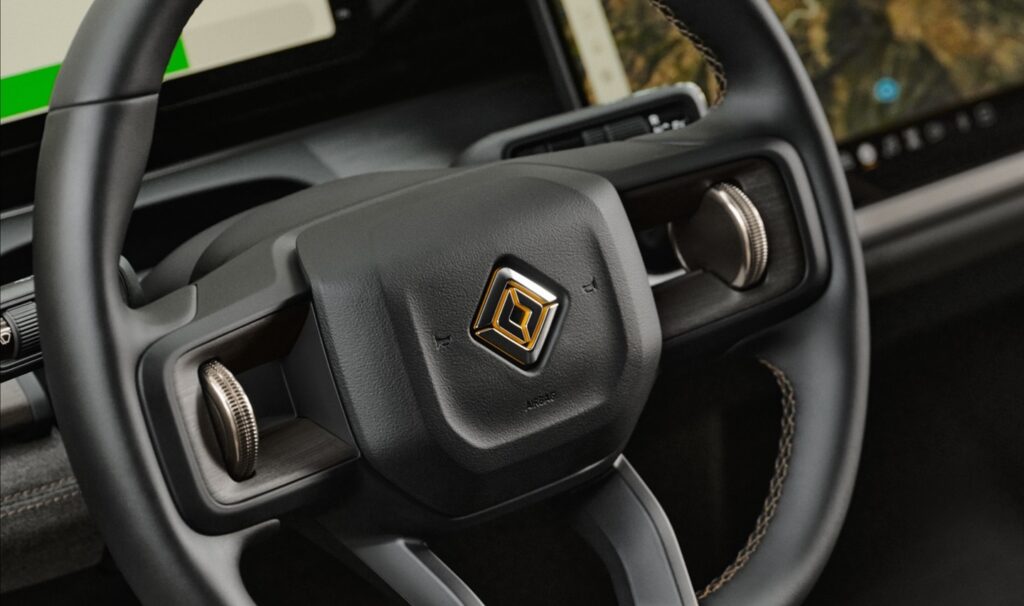
Bensaid also noted that the R2 model lacks traditional climate control buttons. Instead, large scroll wheels on the steering wheel can be used to adjust parameters, such as fan speed, while driving. While not exactly buttons, they seem like a better solution than tapping a small icon on a touchscreen to adjust the fan speed.
According to Rivian representatives, “the only reason drivers and consumers don’t interact with the car via voice is that, frankly, the technology has been broken up until now.” The key difference between the Rivian assistant and competitors’ analogs is that it uses its own Android-based infotainment system, which does not support Android Auto or Apple CarPlay. Thus, the voice assistant works seamlessly, regardless of which screen is displayed.
Rivian also notes that their approach is more conversational compared to traditional voice assistant systems. For example, you don’t need to say “Open the front trunk,” but can instead say “I have a bag in the front of the car,” and the system will automatically open the trunk. This sounds quite convenient, but many people still prefer physical buttons. What about you?
Rivian’s approach is a bold move that challenges the conventional wisdom about the necessity of physical controls. The company is betting that artificial intelligence can not only replace buttons but also offer a fundamentally new, more intuitive, and natural way to interact with the vehicle. The success of this strategy will depend on how truly flawless and convenient the new voice system proves to be in real-world conditions, as even the smartest assistant can be frustrating if it doesn’t understand commands the first time or in a noisy environment. The refusal to support Android Auto and Apple CarPlay is also a risky step that could alienate some potential buyers accustomed to their smartphone ecosystems.