 by
by Alfa Romeo delays launch of new Giulia and Stelvio due to strategy revision
Alfa Romeo has decided to delay the launch of the updated versions of the Giulia and Stelvio models, originally planned for release this year. The reason is concern over weak demand for electric vehicles, as observed by other automakers.
Instead of releasing models without considering market realities, Alfa Romeo has undertaken a radical revision of the concept. The company decided to add new powertrains, which required additional time. Although the updated sedan and crossover are based on the STLA Large platform (which is used, among others, in the Dodge Challenger and supports both internal combustion engines and electric powertrains), integration turned out to be more complex than simply installing an engine.
Redesign details
According to Autocar, the vehicles had to be redesigned to “ensure better cooling for internal combustion engines.” As part of the upgrade, the models will receive new front panels and a functional radiator grille.
Although precise details are not yet known, patent images of the Stelvio that emerged last year show the model will feature narrow headlights and a small V-shaped grille. The crossover also has large air intakes, although they appear partially closed. The design includes a streamlined body, pronounced wheel arches, plastic body cladding, and a rounded roof. The original Stelvio design also featured an angular rear window, a large spoiler, and a distinctive rear light cluster area.
Wide choice of powertrains
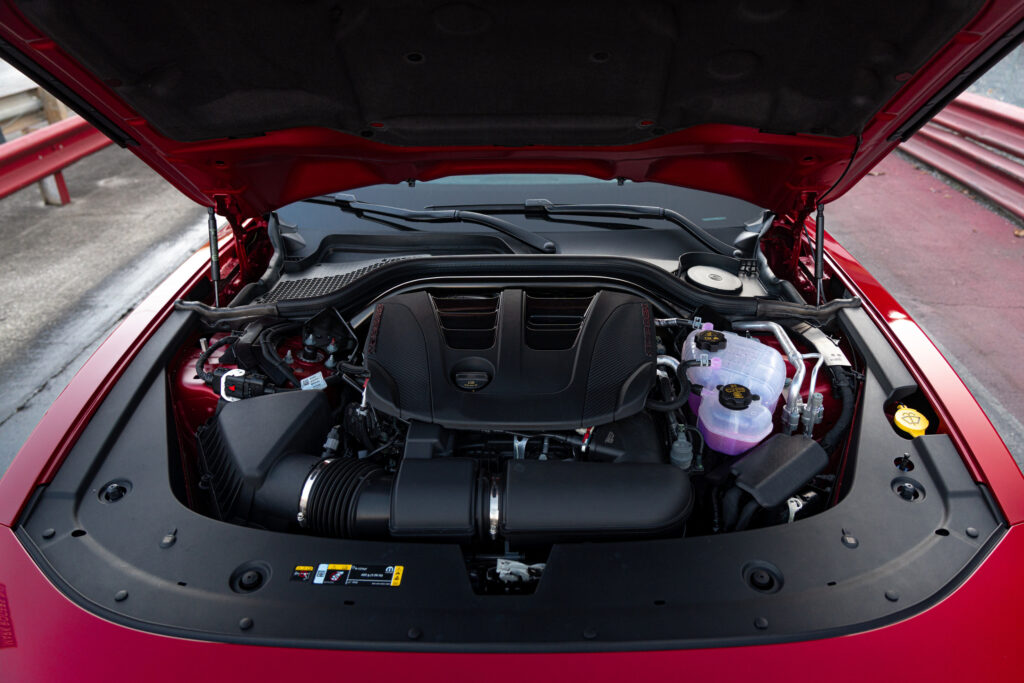
It is reported that the Giulia and Stelvio will be offered with a variety of powertrains. The lineup will likely start with turbocharged four-cylinder engines featuring mild hybrid technology. The company is also considering the use of a twin-turbo 3.0-liter inline six-cylinder engine, which is installed in the Charger Scat Pack and produces 550 hp (410 kW / 558 hp).
Customers will also be able to choose plug-in hybrid and fully electric versions. Little is known about them, but the plug-in hybrids may be similar to other Stellantis models.
Electric variants also remain a mystery, but the company previously stated that the STLA Large platform can accommodate batteries with a capacity of 101-118 kWh and electric motors ranging from 168 hp (125 kW / 170 hp) to 443 hp (330 kW / 449 hp). Although there were earlier rumors that Quadrifoglio versions might receive a three-motor powertrain with over 1000 hp (746 kW / 1014 hp), the publication refuted this idea, noting that “no model in the Stellantis stable currently produces such power.”
Nevertheless, the Maserati GranTurismo Folgore has a three-motor powertrain producing 751 hp (560 kW / 761 hp) and 995 lb-ft (1348 Nm) of torque. This allows the model to accelerate from 0 to 60 mph (0-96 km/h) in 2.6 seconds and reach a top speed of 202 mph (325 km/h).
p>Many questions remain, but Alfa Romeo seems to believe that delaying the launch was the right decision. As CEO Santo Ficili explained, “We have to consider the whole world, as the brand is global,” and not every market is ready for full electrification. He added, “We need to find a way to meet the needs of our customers,” which means having electric, plug-in hybrid, and gasoline options.
Alfa Romeo’s decision to delay the launch of the new Giulia and Stelvio demonstrates a pragmatic approach to market realities. Instead of risking models that may not find demand due to insufficient flexibility in powertrain choice, the company is choosing a path of adaptation. This allows it to offer customers a variety of options—from traditional engines to hybrids and electric vehicles—which is especially important for a global brand where the level of readiness for electric vehicles varies significantly across different regions. Such a strategy could be the key to success amid uncertainty in the automotive market.