 by
by Updates for Daihatsu minivans: safety and affordability
Daihatsu has introduced updates for its popular kei vans Hijet Cargo and Atrai, following the example of the Hijet Truck pickup. These changes, while minor, are important as they focus on enhancing safety, allowing these commercial vehicles to meet Japanese regulations and remain competitive against the recently updated Suzuki Every and Every Wagon.
Enhanced Smart Assist safety system
The key feature of the 2026 update is the improved Daihatsu Smart Assist system. This active safety system has received expanded object detection capabilities in urban conditions. The radar and camera can now recognize bicycles crossing the road, monitor oncoming vehicles in the opposite lane when turning right at intersections, and detect pedestrians crossing the road from the opposite direction during a turning maneuver.
The active safety system now detects bicycles, oncoming traffic, and pedestrians during turns.
Design and equipment
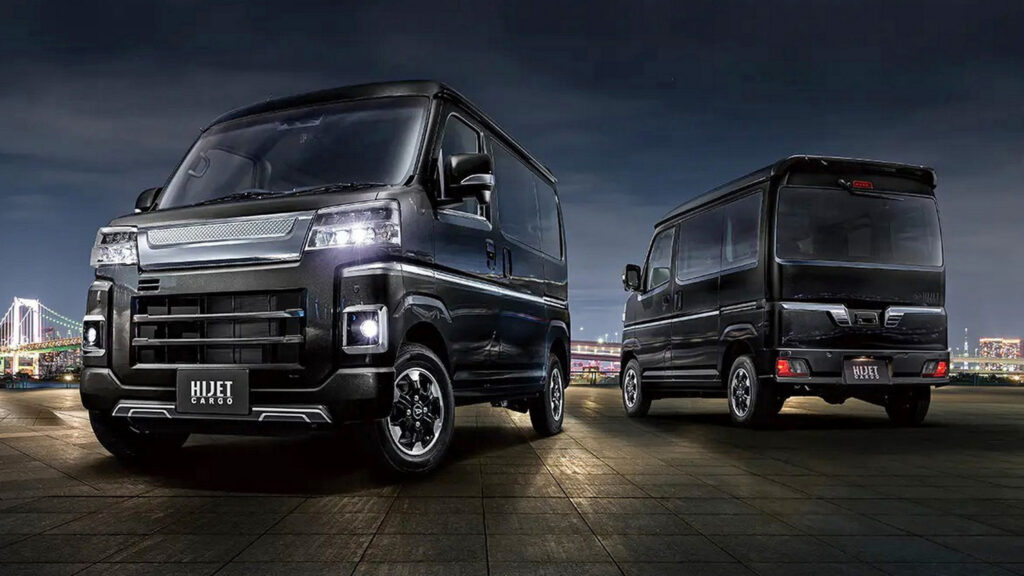
The exterior design of the Hijet Cargo and Atrai has remained unchanged since the debut of the current generation in 2021. However, more Hijet Cargo variants now come standard with LED packages, replacing the halogen lamps of cheaper models.
Daihatsu Hijet Cargo
As before, models are available as two- and four-seat vans, as well as a Sloper version with wheelchair access and a Deck Van configuration with a small rear cargo bed. Those wanting a more traditional pickup can choose the Hijet Truck in standard or extended (Jumbo) versions.
Interior and technology
Inside, the Hijet Cargo uses analog instruments, while the Atrei gets a digital instrument cluster called the “Active Multi Information Meter.” There is no standard screen, but the vans are compatible with optional 6.8-inch or 9-inch infotainment system displays.
Of course, buyers can upgrade the kei vans with various exterior and interior accessories. One of the most interesting options is a rear bed, which transforms the cabin into a mobile room.
Daihatsu Hijet Cargo
Technical specifications and prices
Under the hood, the lineup continues to offer naturally aspirated and turbocharged versions of the mid-mounted 660cc engine, producing 46 hp (34 kW) and 63 hp (47 kW) respectively. Depending on the trim, the engines are paired with a five-speed manual transmission or a CVT. Drive can be rear-wheel or all-wheel drive, via an electronically controlled 4WD system.
As for prices, the updated lineup starts from ¥1,155,000 ($7,200) for the base Hijet Cargo Special with rear-wheel drive and a manual transmission. This is slightly more expensive than the recently updated Hijet Truck, which starts at ¥1,094,500 ($6,900).
At the other end of the spectrum, the high-end Atrai RS with a turbo engine and all-wheel drive costs ¥2,013,000 ($12,600), while the Atrai Deck Van is even more expensive at ¥2,255,000 ($14,100). Daihatsu also offers fully electric versions of the e-Hijet Cargo and e-Atrai, though they are significantly more expensive than their gasoline counterparts, starting from ¥3,146,000 ($19,700).
Daihatsu Atrai
Thus, the update makes these compact and practical vehicles even safer, while retaining their main advantage — an extremely low price. This allows them to successfully compete with other kei vans in the Japanese market, where practicality and economy are often decisive factors. It is worth noting that although electric versions are significantly more expensive, they offer an alternative for those seeking to reduce emissions, especially in urban delivery conditions.