 by
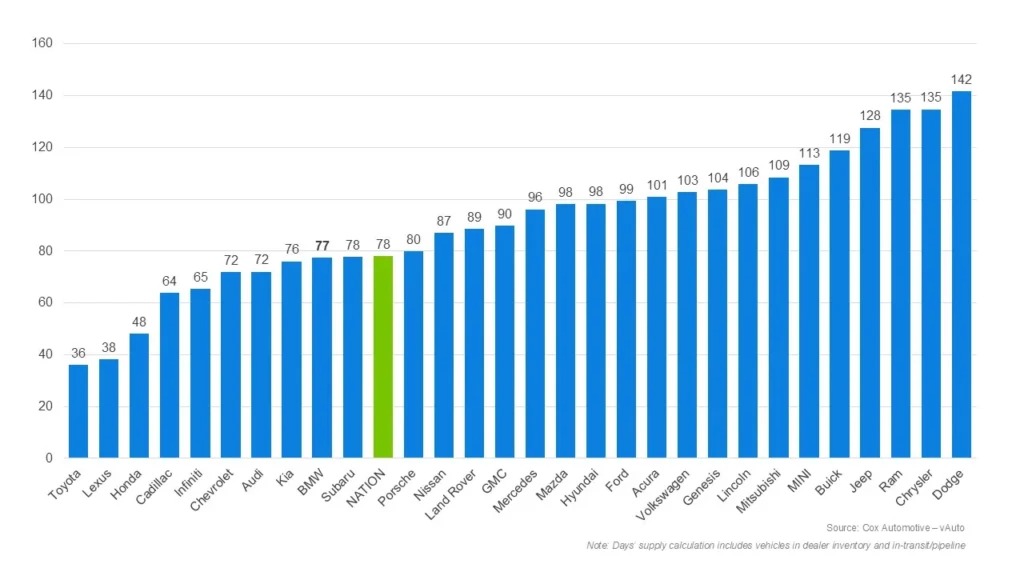
by Stellantis again suffers from an excess of cars: Dodge leads with 142 days of inventory
The American automotive market uses the “days of inventory” metric to assess sales efficiency, and the latest data indicates serious problems for the Stellantis concern. After some successes in 2025, when the company managed to reduce excess inventory, the situation has worsened again. Four Stellantis brands — Chrysler, Jeep, Ram, and Dodge — again have significantly more cars than they can sell, with Dodge leading this anti-ranking.
Detailed inventory analysis by brand
According to Cox Automotive data for the end of April, the industry average in the US is 78 days of inventory, just one day less than in March and significantly below the peak of 95 days in January and February. The overall trend for the market is positive, but Stellantis is not moving in this direction.
The worst situation is at Dodge — 142 days of inventory. Almost keeping pace are Chrysler and Ram with 135 days, and Jeep has 128 days. Among other non-Stellantis brands, Buick has the biggest surplus inventory problems — 119 days. Also above average are Mini (113), Mitsubishi (109), Lincoln (106), and Genesis (104).
Market leaders: Toyota and Lexus
As in previous months, some manufacturers are showing significantly better results. Toyota has only 36 days of inventory, and Lexus has 38 days. Also operating below the average are Honda (48), Cadillac (64), Infiniti (65), Chevrolet (72), Audi (72), Kia (76), BMW (77), and Subaru (78). In March, Porsche was also below average with 78 days, but in April this figure rose to 80.
Prices and sales: the big picture
Cox Automotive data also shows that the average price of a new car in April rose by 0.9% to $49,025. This likely impacted total sales volume, which fell from 1.115 million in March to 1.093 million in April.
Inventory and price dynamics over the past year
| Month | Inventory | Days of Supply | Sales | Average Price |
| April 2025 | 2,641,748 | 67.9 | 1,167,187 | $48,406 |
| May 2025 | 2,560,104 | 73.6 | 1,078,445 | $48,739 |
| June 2025 | 2,816,717 | 83.5 | 1,012,492 | $48,673 |
| July 2025 | 2,707,559 | 76.7 | 1,094,241 | $48,496 |
| August 2025 | 2,730,357 | 74.7 | 1,133,566 | $48,566 |
| September 2025 | 2,855,668 | 86.5 | 990,819 | $49,057 |
| October 2025 | 3,005,433 | 89.6 | 1,039,591 | $49,193 |
| November 2025 | 3,053,128 | 90.1 | 1,017,139 | $49,454 |
| December 2025 | 2,967,543 | 85.5 | 1,076,180 | $50,351 |
| January 2026 | 2,741,173 | 93.6 | 904,431 | $49,591 |
| February 2026 | 2,854,721 | 96.2 | 829,864 | $48,856 |
| March 2026 | 2,890,423 | 80.3 | 1,115,416 | $48,605 |
| April 2026 | 2,857,903 | 78.4 | 1,093,116 | $49,025 |
The excess inventory situation at Stellantis is concerning as it may indicate problems with demand for these brands’ products or inefficient production management. At the same time, the rise in average car prices, despite declining sales, suggests that manufacturers are trying to compensate for lower sales volumes by increasing prices. This could lead to a further decrease in demand, especially in the context of high inflation and economic uncertainty. For Stellantis, this means the need for urgent measures, such as price reductions or sales incentives, to avoid an even greater build-up of inventory and financial losses.