 by
by The author of the material, being an engineer-designer by education, participated in the development of the concept of an affordable and compact teardrop-shaped living trailer.
Engineering Approach to Camping
Although the author has been writing about cars for over a decade, his engineering education allowed him to take a direct part in this project. Initially, the idea came from a client who later left the project. However, the team, which included Vasilis Spandagos, Thanos Pappas, and Irini Tsavara, continued the work and brought the concept to a detailed, refined state, ready for further prototyping and, ideally, series production.
Philosophy of Accessibility and Compactness
The main goal was to make camping more attractive and accessible to a wide range of people with a limited budget. The design is also conceived as highly adaptive, with a long list of options that can add a sense of hotel-like comfort amidst nature.
No less important was the requirement for compact dimensions allowing parking in a standard parking space, and low weight for towing by compact hatchbacks and crossovers, which predominate on European roads.
Design Features and Construction
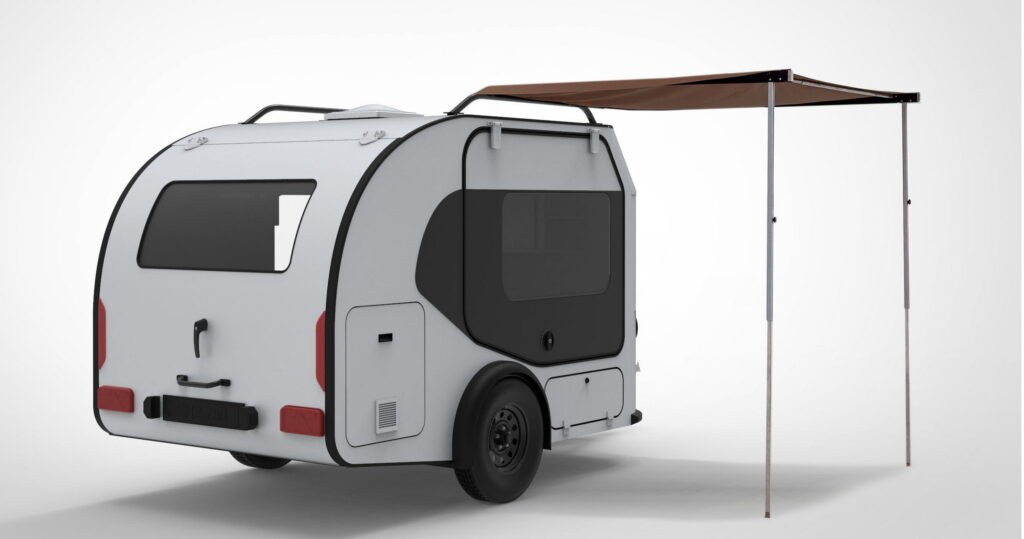
The decision to use an aluminum body significantly influenced the design. To reduce cost and avoid expensive press molds, the panels are made flat or with a single bend. Despite these limitations, the designers added decor, reflective elements, and relief for a better appearance and aerodynamics.
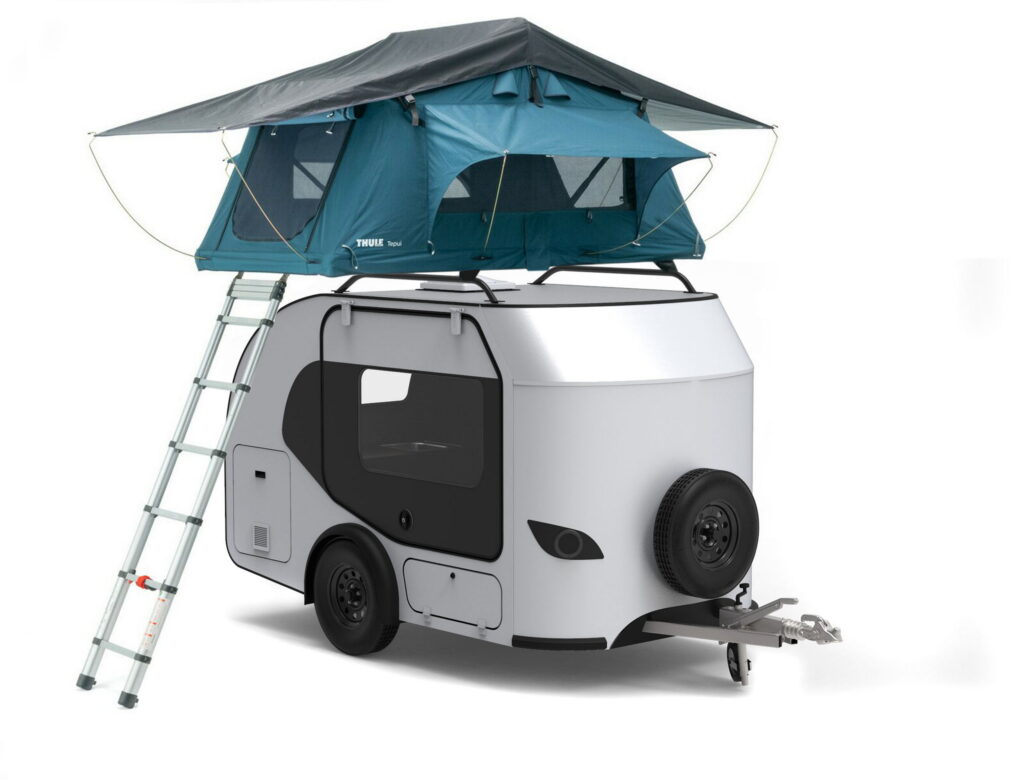
Details such as extended fenders, external hinges, functional roof rails, black steel wheels, and a spare tire give the trailer a more robust and sporty look.
Interior Space and Comfort
The trailer’s dimensions are 2921 mm in length, 1747 mm in width, and 1850 mm in height. This small footprint makes it maneuverable on narrow roads, easy to park, and convenient to store. The ground clearance, as well as the approach and departure angles, are comparable to a crossover.
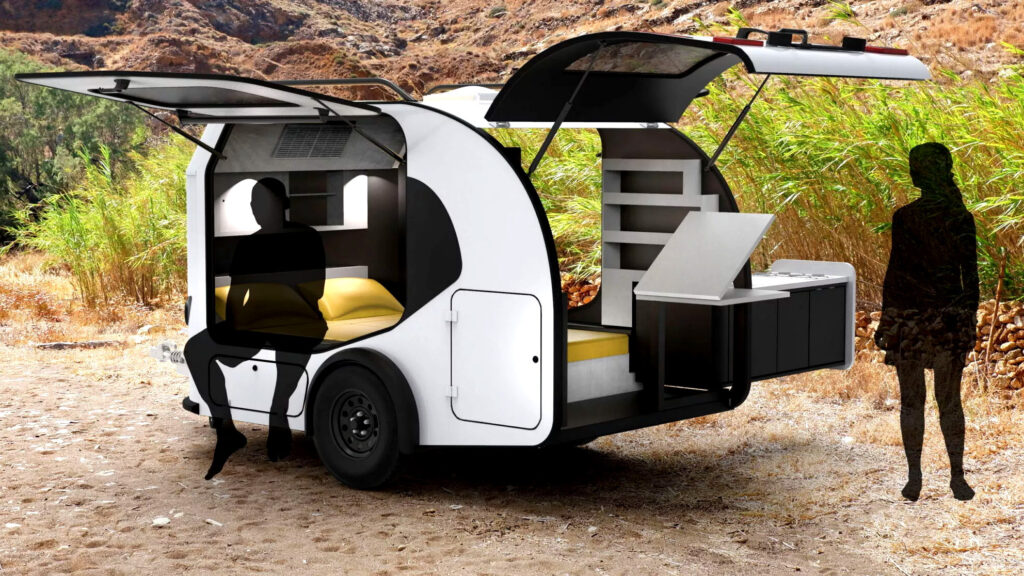
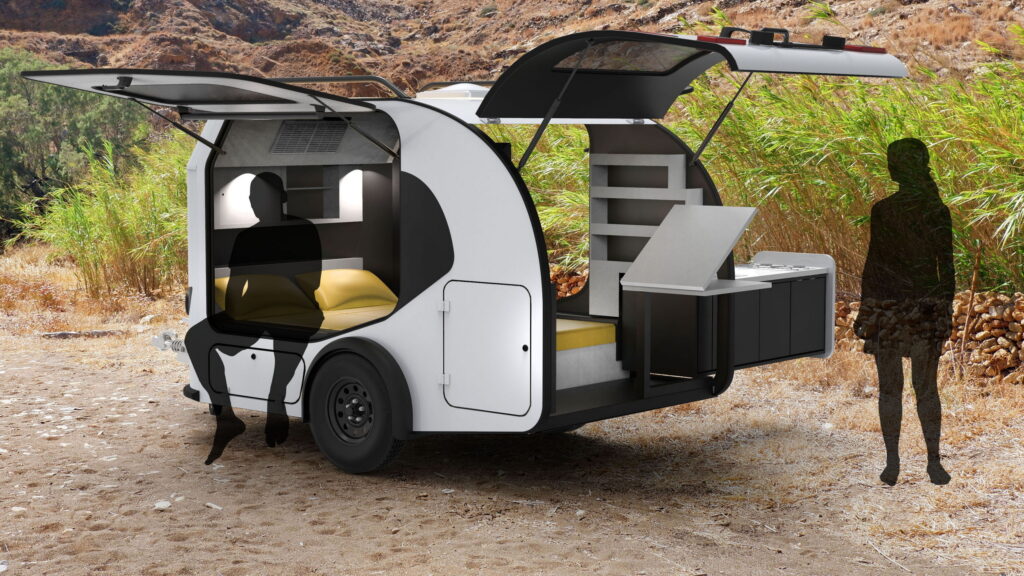
Access inside is provided by two large side doors with windows and a rear hatch. All of them open upwards, creating a sense of unity with the surroundings. In case of bad weather, the insulated aluminum body and reliable locks provide a safe and protected place to rest.
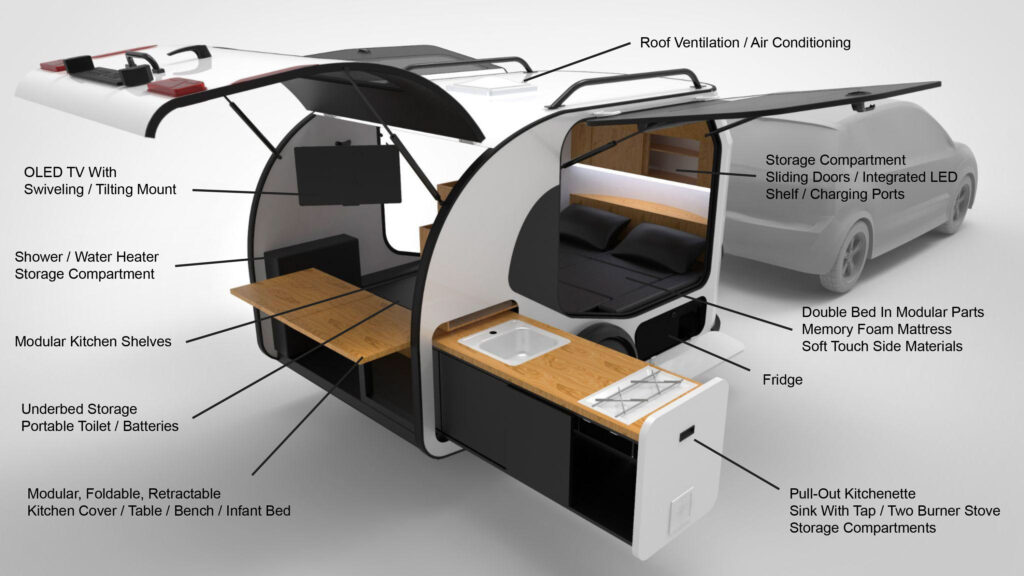
The cabin can accommodate a double bed for two adults, and there is additional space for a child or pet on the rear bench. Luggage compartments are located under the bed and along the front and side walls.
The memory foam mattress is divided into removable sections, providing access to the storage underneath and allowing the bed to be converted into a sofa. Soft wall upholstery and cushions complement the setting, turning the compact space into a truly comfortable area for relaxation and sleep.
Wooden niches on the front wall are intended for clothes, books, and small items. They can be equipped with lamps, sliding doors, and USB sockets. Optional LED ceiling lighting creates a cozy atmosphere at night, bringing the feeling closer to a boutique cottage rather than a basic tent.
Innovative Kitchen Area
One of the key features of the concept is the rear kitchen. Unlike similar solutions, it is accessible both from inside and outside thanks to a sliding mechanism. This also means it can be easily slid aside to open access to the cabin through the rear hatch. The sliding module contains a two-burner gas stove, a sink with a tap, water tanks, and space for dishes.
Furthermore, above the kitchen is a folding and removable bench that can serve as a dining table, a mobile workspace, or even a small bed for a baby, toddler, or pet.
Depending on the configuration, the equipment list can include modern amenities. An OLED screen on a swivel mount allows content to be viewed both inside and outside the trailer, and portable Bluetooth speakers provide sound.
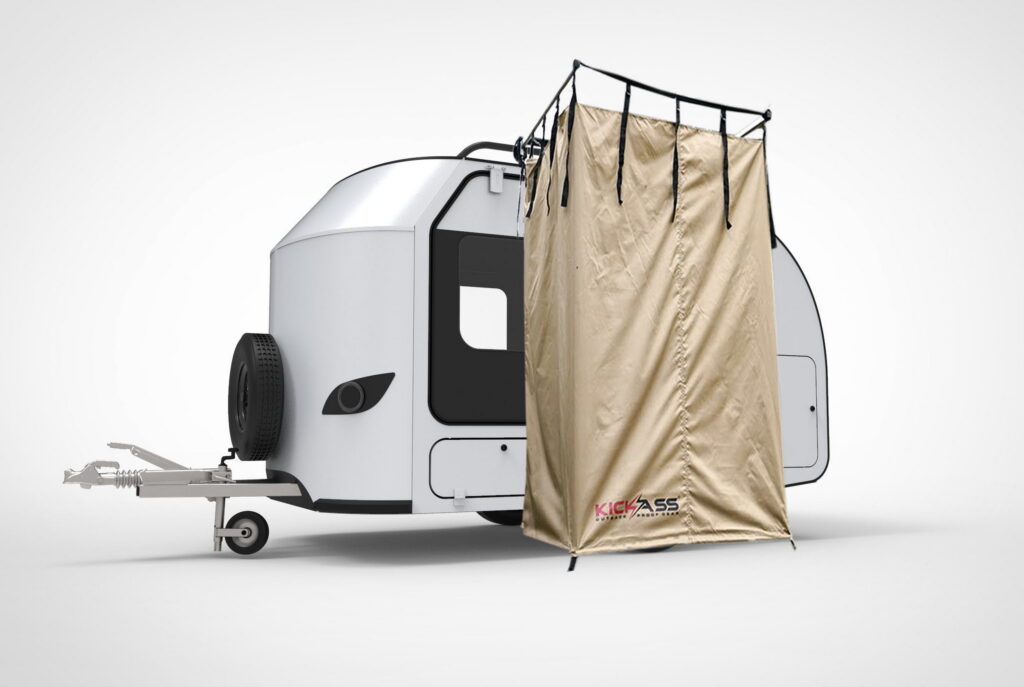
Also planned are a pull-out refrigerator on the left, roof ventilation with an optional air conditioner, a portable toilet that hides under the mattress, and a hot shower system for outdoor use.
Solar panels can be installed on the roof to charge batteries and increase autonomy. Alternatively, a tent module for two additional people can be placed on the roof, increasing the total capacity to five. A folding awning expands the shaded area, which is partially created by the upward-opening doors.
Production Prospects
Currently, this living trailer exists only in digital form. However, it was conceived from the very beginning with an orientation towards low production cost and could theoretically be manufactured by a small team. The next step should be the creation of a full-scale prototype for testing and refinement before a potential launch into series production.
The final price will depend on the scale of production, choice of materials, and selected options. The goal is a starting price of around $10,000 USD, which could rise to approximately $15,000 for a fully equipped version as shown in the renders. This would allow the product to be offered cheaper than most competitors and align with the main idea—to make compact camping accessible to more people.
Similar projects demonstrate the growing demand for mobility and autonomy combined with environmental friendliness and affordability. The success of such a concept on the market will depend not only on the final price and quality but also on the manufacturer’s ability to create supporting infrastructure and a community around the product, which is an important component of modern camping culture. The development of technologies and materials undoubtedly opens up new opportunities for such compact and smart solutions for active recreation.