 by
by New Nürburgring record from Xiaomi
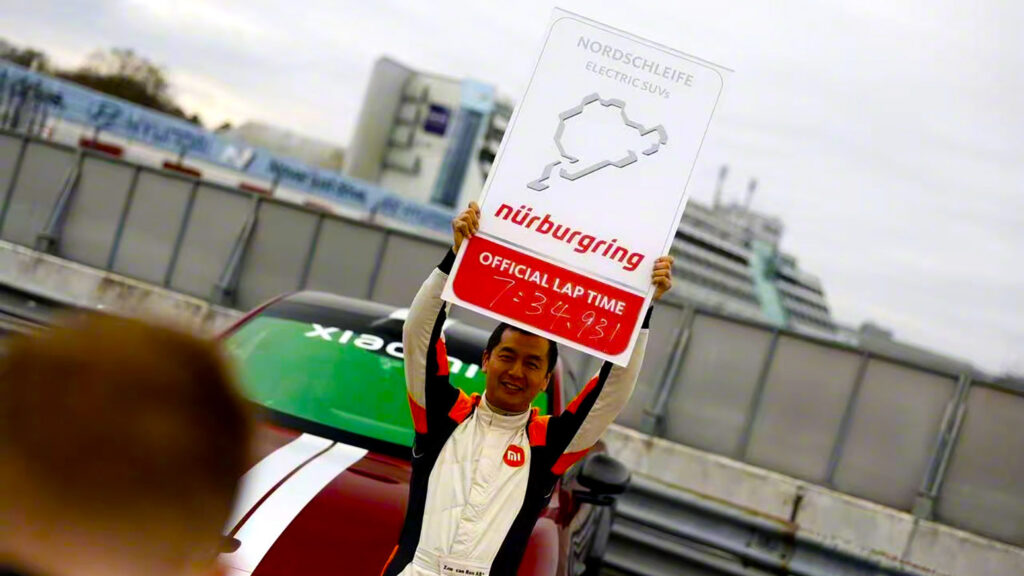
Xiaomi continues to snatch Nürburgring records from European competitors. After the SU7 Ultra sedan set a record among four-door cars at the end of 2024, and then lost it to the Porsche Taycan Turbo GT Manthey, the Chinese manufacturer returned to set the absolute record among production SUVs.
How the record was set
At the wheel of the new YU7 GT was the company’s chief test driver, Ren Zhoucan. The car completed the Nordschleife in 7:34.931. This time allowed it to beat the record of the Audi RS Q8 (7:36.698), which had previously taken the lead from the Porsche Cayenne Turbo GT Coupe (7:38.925).
Features of the record car
As with most record runs at the Nürburgring, there are certain caveats. The YU7 GT that set the time was not the standard version you can buy at a Xiaomi dealer. The Chinese manufacturer states that the car was equipped with an optional “Track Professional Package,” reminiscent of the Manthey upgrade packages that Porsche uses for its record cars.
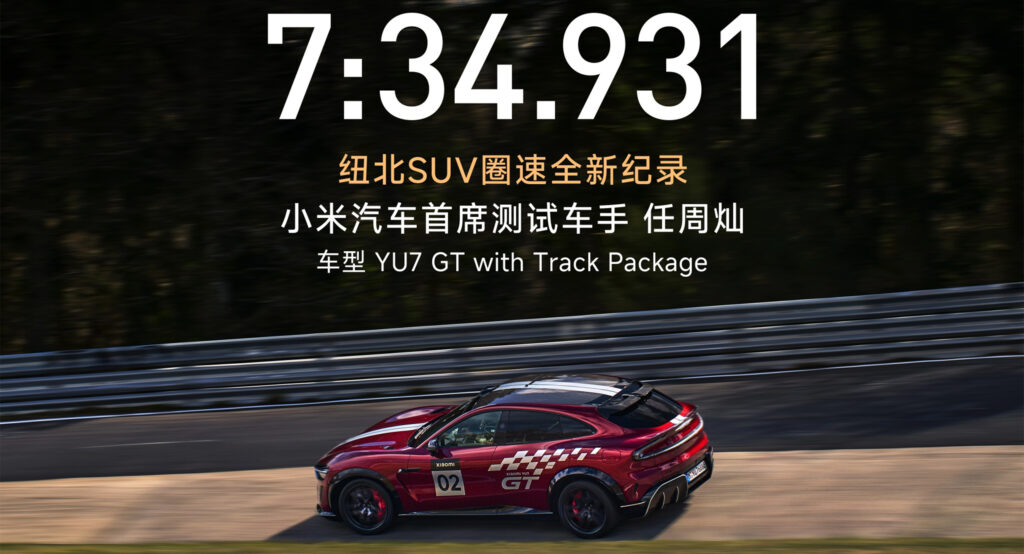
Xiaomi has revealed some of the components of this package. It includes semi-slicks measuring 265 mm wide at the front and 325 mm at the rear, as well as widened rear wheel arches. But that’s not all.
“At the request of the Nürburgring, we performed safety modifications inside the car, including a full roll cage, racing bucket seats, and six-point harnesses. We also removed some of the interior trim to compensate for the added weight of the roll cage. This is a production car that has passed official certification and testing at the Nürburgring.”
Video from the interior confirms this: a roll cage is installed, the rear seats are removed, and the driver sits in a lightweight racing bucket. It is worth noting that the previous record holder in this category, the RS Q8, also had a mandatory roll cage and a lightweight driver’s seat, with the rear row removed for the run.
Technical specifications
Xiaomi introduced the YU7 GT to the world last month at the Beijing Auto Show. While it is not as extreme as the SU7 Ultra, it still offers power and performance that were once only available in multi-million dollar hypercars and were previously unthinkable for a luxury SUV.
The car is equipped with a 101.7 kWh battery that powers a 386 hp electric motor on the front wheels and a 604 hp motor on the rear, totaling 990 hp. Official 0-100 km/h acceleration figures are not yet available, but it is expected to leave most performance SUVs sold in the West behind.
The secret to the YU7 GT’s success on the track also lies in its sophisticated suspension, which offers adjustment for compression, rebound, and ride height. This setup was specifically honed at the Nürburgring.
This record demonstrates that Chinese electric vehicle manufacturers are not just catching up, but are already surpassing traditional giants in creating high-performance cars. Although the use of a special package for the record sparks debate, the very fact that a production SUV is capable of such results points to a colossal technological leap. It also underscores a paradigm shift: German brands are no longer the only ones dictating the rules of speed and handling in the SUV segment; ambitious players from China, leveraging the advantages of electric powertrains, are now doing so as well.