 by
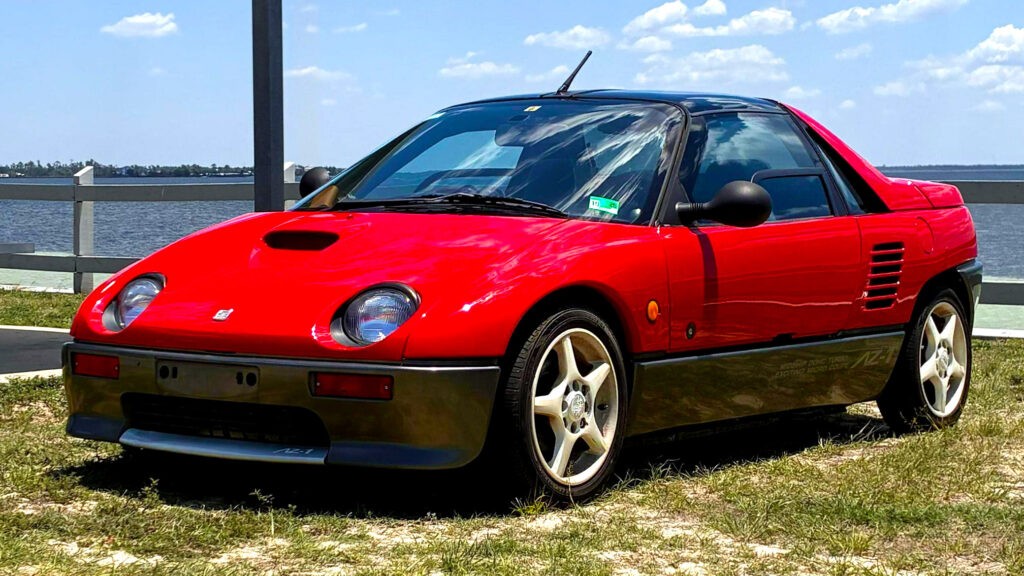
by At a recent auction in the United States, a Japanese Mazda Autozam AZ1 was sold, a true rarity for the American market. Its compact size and engine displacement of 657 cc were limited by kei car regulations. The bidding has ended, but this microcar with gull-wing doors still found a new owner for $23,500.
A surprising price
If someone told you they paid $23,500 for a car with only 63 horsepower (64 PS), you might think they misplaced a decimal point. But when you see the Autozam AZ1 with its doors up, those 63 horses seem like 600, and the price looks entirely reasonable.
History and features
This 1992 Autozam AZ-1 recently changed hands on the Cars & Bids platform for $23,500, proving that one of Japan’s quirkiest sports cars remains one of its most desirable. And, unlike many collector sports cars, the AZ-1 doesn’t rely on massive power to win hearts.
Quite the opposite. The AZ-1 arrived in 1992, during one of the strangest periods in Japanese automotive history. Manufacturers competed to create the most interesting cars while adhering to strict kei car regulations that limited size, engine displacement, and power. The result was a golden era that gave us cars like the Honda Beat, Suzuki Cappuccino, and this tiny wedge-shaped Mazda.
Photos: Cars&Bids
Officially sold through the now-defunct Mazda Autozam sub-brand and assembled by Suzuki, the AZ-1 looked like a miniature exotic car. Its dramatic gull-wing doors, low profile, and mid-engine layout gave it proportions inspired by Italian supercars, not economy cars. The effect was close to a kei supercar — a scaled-down exotic built to Japan’s strictest class rules.
Technical specifications
Under the rear hatch lies a turbocharged three-cylinder engine displacing 657 cc, producing 63 hp and 63 lb-ft (85 Nm) of torque. This number was no coincidence — it was the maximum power allowed by kei car regulations at the time, so engineers squeezed every legal horsepower out of the tiny turbo-triple.
Not fast, but the feeling is
Performance wasn’t supercar-like: the sprint to 60 mph (96 km/h) took about 10 seconds. But thanks to a weight of only 1,587 lbs (720 kg), a five-speed manual transmission, and a rear-mounted engine, the AZ-1 earned a reputation as a very agile car.
This example had a mileage of around 33,400 miles (54,000 km) and several modifications, including 14-inch wheels, a Mazdaspeed steering wheel in terrible condition, auxiliary gauges and a shift knob, as well as a Sony head unit.
Rarity and collectible value
Fewer than 4,400 units were sold before production ended in 1995, making the AZ-1 quite rare even in Japan. However, a look at auction sites like Bring a Trailer shows that quite a few of these cars have been imported to the US, where they were never officially sold. Would you take such a car over a Miata?
Photos: Cars&Bids
This sale highlights that the market for collectible Japanese cars continues to grow, and even small, low-power models can command significant money. For enthusiasts who appreciate unique design and history, the AZ-1 is not just a car, but a true artifact from an era when Japanese manufacturers created the most creative machines within strict limitations. Its rarity and character make it attractive to collectors seeking something unusual, even if it’s not the fastest car in the world.