 by
by Incredible range from a small battery
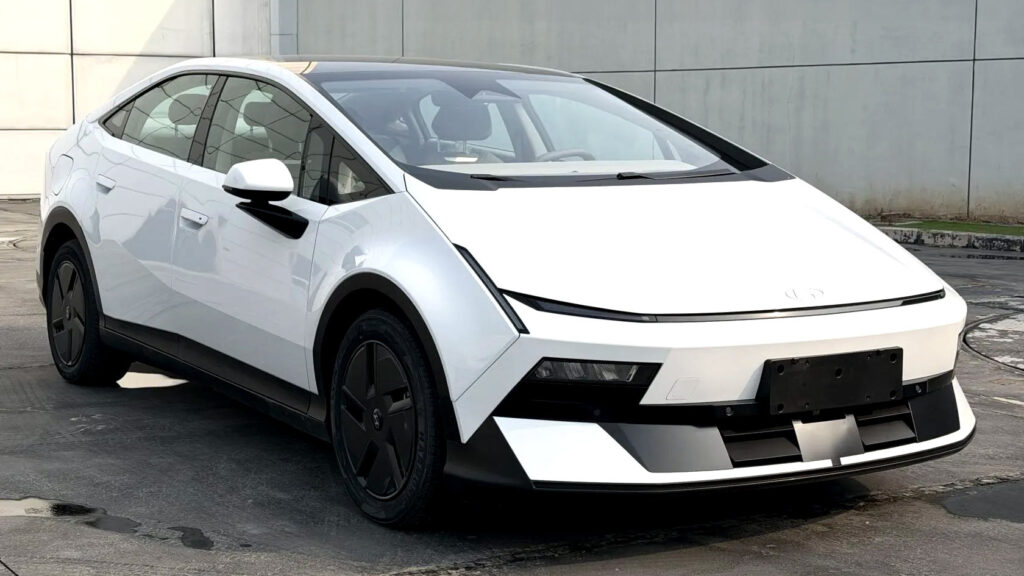
The Hyundai Ioniq V, presented in China, impresses with its design and technical characteristics. According to new data, this tall electric sedan with a wedge-shaped body can travel up to 404 miles (650 km) on a single charge. This is made possible by the use of relatively small battery packs.
Two battery and motor options
When Hyundai first showed the Ioniq V in April, details of the powertrain remained almost unknown. Fresh data from China’s Ministry of Industry and Information Technology (MIIT) confirmed that the car will be offered with two LFP battery options: 53.5 kWh and 66.8 kWh. Both options are quite modest for a vehicle of this size.
The base car with a 53.5 kWh battery and a single 188 hp electric motor is capable of traveling between 323 and 336 miles (520-540 km) under the optimistic Chinese CLTC cycle. In real-world conditions, this figure is likely to be closer to 250 miles (400 km).
More powerful version for long journeys
For those planning to use the Ioniq V for long trips, a version with a 66.8 kWh battery and a more powerful 225 hp motor is provided. It claims a range of 385 to 404 miles (620-650 km) under the CLTC cycle. The expected real-world figure, accounting for road conditions, will be around 311 miles (500 km). The car’s weight in this configuration can reach 3985 lbs (1808 kg).
New details and prospects
MIIT documents also indicate the existence of a version with an extended range, although Hyundai has not yet disclosed details. There is no official information on charging speed, but the car uses an 800-volt architecture, which in other Ioniq models supports power up to 250 kW. Prices have not yet been announced, but customer deliveries are expected to begin later this year. It is not yet known whether the Ioniq V will come outside of China, but there is a possibility it will appear in markets such as Australia.
Overall, the Ioniq V demonstrates an interesting approach by Hyundai to creating an electric vehicle with an emphasis on efficiency rather than huge batteries. The use of LFP batteries, which are cheaper and safer, helps reduce the car’s cost, but the real-world range is likely to be significantly more modest than the stated Chinese figures. This makes the Ioniq V an interesting option for city and suburban trips, but it may be less attractive for long-distance travel without frequent recharging. The emergence of an extended-range version indicates that the company is considering different customer needs, but the key question remains the car’s real-world efficiency in conditions different from idealized test cycles.