 by
by Global Electric Vehicle Market: Growth Slows, North America Loses Buyers
Global demand for electric vehicles (EVs) and plug-in hybrids (PHEVs) continues to grow, but the pace of this growth is minimal. A sharp rise in Europe barely offsets the decline in almost all other regions, including China. The situation is particularly noticeable in North America, where buyers have significantly reduced their activity. The total global sales increase since the beginning of the year is only 0.9%, indicating a limited margin of safety in the market.
May Results and Overall Statistics
According to analysts at Benchmark Mineral Intelligence, approximately 1.8 million electric vehicles and plug-in hybrids were sold worldwide in May 2026. This is 7% more than in April and 3% more compared to May last year. Summing up the indicators since the beginning of the year, the total number of cars sold reaches about 7.5 million units, which is only 0.9% ahead of the same period in 2025.
Charles Lester, data manager at Benchmark Mineral Intelligence, noted that regional indicators remain extremely uneven, and policy changes and local market conditions continue to shape demand.
Europe: Growth Leader Thanks to Chinese Cars
Europe has become a key driver of growth. Sales here rose by 23% year-on-year, reaching approximately 420,000 units in May. The total sales volume since the beginning of the year is about 2 million, which is 26% more than in January-May 2025. Analysts attribute this to electric vehicle purchase incentive programs and higher fuel prices.
A significant share of this growth comes from Chinese-made electric vehicles. In 2025, they accounted for 19% of European EV sales, and this share continues to grow in 2026, despite EU tariffs. In the UK, Chinese EVs and PHEVs occupy about 32% of the market. In Germany, this figure reaches 14%, which is a strong result given the traditional loyalty of local buyers to German brands. For comparison, in France it is 10%.
Global EV and PHEV Sales Table
Source: Benchmark Mineral Intelligence
| Region | Sales for May ’26 | Year-on-Year Change | Month-on-Month Change | Sales Since Start of Year | Change Since Start of Year |
| China | 990,000 | -9% | 11% | 3.9 million | -15% |
| Europe | 420,000 | 23% | 2% | 2 million | 26% |
| North America | 120,000 | -26% | 3% | 0.58 million | -25% |
| Other Regions | 250,000 | 80% | 4% | 1.1 million | 89% |
| World | 1.8 million | 3% | 7% | 7.5 million | 0.9% |
China: Decline, but with Signs of Recovery
The situation in China is less optimistic. Although it remains the largest single market for new EVs and PHEVs, annual sales fell by 9% to approximately 990,000 units in May. Sales since the beginning of the year also decreased by 15% to 3.9 million compared to the same period last year. A positive note is that May figures rose by 11% compared to April, indicating the beginning of a market recovery.
Despite weaker domestic demand, Chinese exports of new energy vehicles (NEVs) reached a record level of nearly 450,000 units in May, driven by BYD, Chery, and Geely. Analysts also note that demand for batteries is holding up better than car sales, as buyers increasingly choose larger electric vehicles with larger batteries.
North America: Catastrophic Decline
The worst situation is observed in North America. The cancellation of the federal tax credit for electric vehicles in the US last year and the subsequent retreat of many traditional brands from EVs have led to weak demand. In May, approximately 120,000 relevant cars were sold in the region, which is 26% less than last year. Over the first five months of 2026, sales fell by 25% to 580,000 units. The analysis does not break down total North American sales by country.
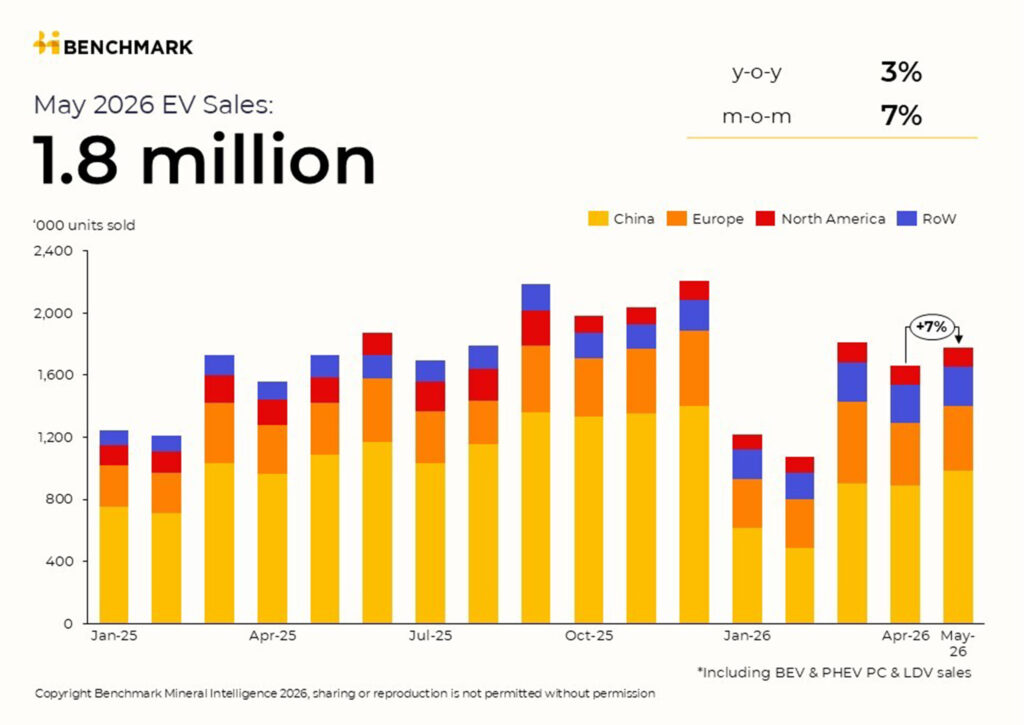
In other regions of the world, excluding China and North America, sales also increased by about 80% year-on-year to around 250,000 units. Sales of EVs and PHEVs since the beginning of the year also rose by 89% to 1.1 million.
Overall, the global electric vehicle market shows signs of stagnation, despite strong growth in Europe and other regions. Declines in China and North America, which are the two largest markets, create serious pressure on the overall dynamics. The cancellation of incentives in the US and the shift in automaker priorities in the region have led to a significant reduction in demand. At the same time, the growing share of Chinese brands in Europe indicates a change in the competitive landscape, where Chinese manufacturers are actively offsetting weak domestic demand with exports. Further developments will depend on the recovery of the Chinese market, incentive policies in various countries, and the ability of automakers to adapt to new conditions.