 by
by New Ferrari patent: hypercar of the future
As environmental regulations and fuel efficiency requirements change more and more frequently, it is hard to say for sure what powertrains supercars and hypercars will have tomorrow. Aerodynamics, however, will definitely remain a key factor. A recently filed Ferrari patent shows how seriously the company plans to work with airflow in its next-generation cars.
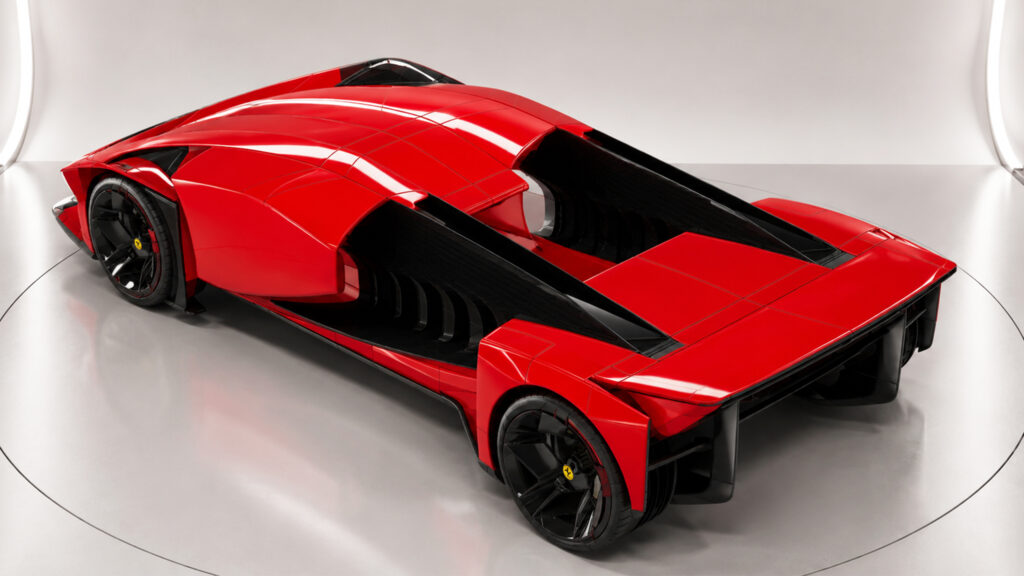
Ferrari filed this intriguing application with the United States Patent and Trademark Office (USPTO). The images show a radical mid-engined hypercar unlike any model Ferrari currently makes or has made before.
Incidentally, Ferrari has already patented a V12 with oval pistons and unusual shared connecting rods.
The front of the car is low and sharp, slightly reminiscent of the classic Testarossa. The rear looks particularly radical: it has louvres and vents inspired by Formula 1 cars. Although it is quite possible this car will influence future Ferrari models, as CarBuzz notes, the active aerodynamic components are most likely to reach the market rather than the car itself.
Active aerodynamics at the rear
The most interesting part is hidden at the back. In addition to a huge diffuser, the car is equipped with a retractable rear wing and an LED strip. In normal driving mode, this element sits under the wing but can extend outward—much like the wing on the new McLaren W1. In other words, it turns the hypercar into an active long-tail vehicle.
It is impossible to predict how such a system will develop in the coming years, but the patent also includes images of the Purosangue. The crossover is shown with new active aerodynamic components that could reach the market in the near future.
Active aerodynamics for the Purosangue
In the case of the Purosangue, the rear lights can tilt toward the ground, improving the efficiency of a small lip spoiler at the rear. This is a rather unexpected solution for an SUV, but it fits perfectly with the overall logic of active aerodynamics development.
As with other similar patents, there are no guarantees that the depicted components will necessarily go into production. Even if they do, it is unknown exactly when. Still, it is nice to know that the Prancing Horse does not plan to stop innovating.
Prospects for production models
Such patent applications do not always turn into real technologies, but they clearly show the direction of the company’s research. Ferrari has long used active aerodynamics in its top models, so new ideas could become the foundation for future hypercars and even crossovers. Particularly interesting is that the manufacturer is considering integrating aerodynamic solutions into the Purosangue—this means that even practical models will get technologies borrowed from racing. Therefore, we should expect that in the next generation of road-going Ferraris, handling and downforce will be no less important than engine power.