 by
by New Mazda patents: sports car with butterfly doors and no rotor
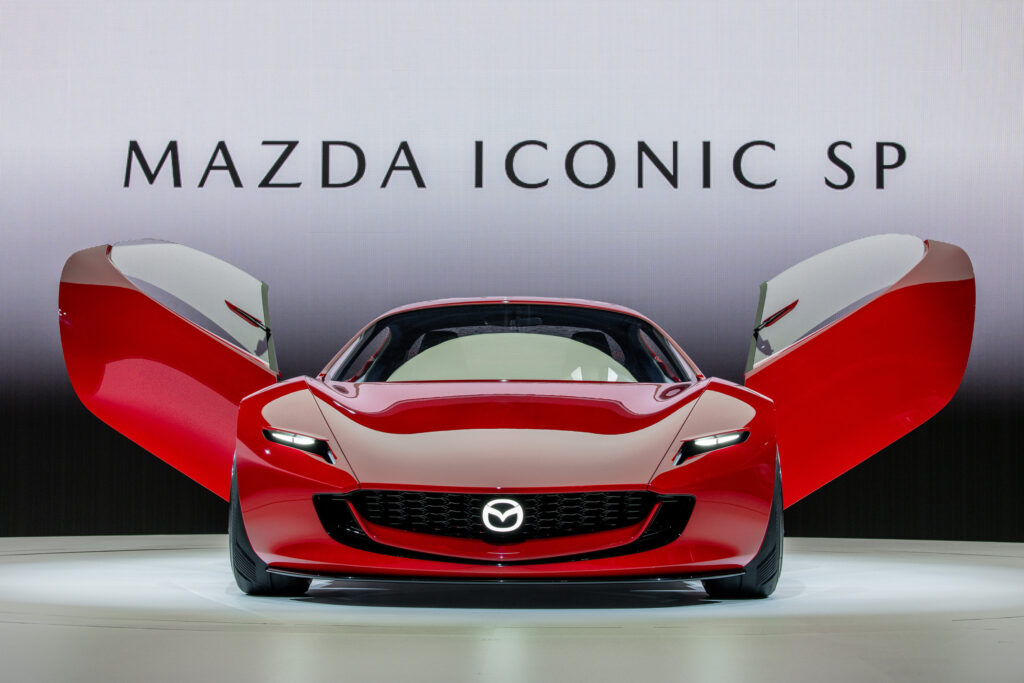
Two patents filed by Mazda have recently appeared online. Neither of them indicates the name of the car being described. However, what they show is a small front-engine, rear-wheel-drive convertible with butterfly doors. This narrows down the list of possible candidates to two models.
Patent drawings and technical solutions
The drawings, first spotted by Carbuzz, show an open-top car equipped with a longitudinally mounted four-cylinder engine. The first patent focuses on the door hinge pillar of an unspecified vehicle, illustrating how a front-engine, rear-wheel-drive car could use butterfly doors.
The document describes how Mazda engineers could move the front pillars closer to the suspension towers to maximize chassis rigidity. The Japanese firm has never fitted butterfly doors to a production car but appears serious about doing so. The document describes this design as “swing-up side doors,” where the rear part opens outward and upward, like scissors or a butterfly.
The same patent indicates “reinforcement assemblies” that could be added to the car, helping to transfer loads from suspension mounts to a reinforced pillar. This might be necessary for such hinges to work on a car with a soft top. It also describes a “front panel frame” — a stamped metal reinforcement that connects the front corners of the chassis to the bulkhead of the engine compartment to further increase rigidity without significantly adding weight.
Safety structure and powertrain
The second patent covers the car’s structure for absorbing impacts and how external forces might affect it. It describes directing impact loads through the engine compartment bulkhead, side sills, and to the rear of the car for better passenger protection. Most interestingly, the drawings depict a longitudinal four-cylinder engine and a traditional transmission tunnel. Neither was present in the striking Iconic SP concept, as it was introduced as a car with a rotary range extender.
What is Mazda planning?
All of this has led to speculation that Mazda might radically change the next-generation MX-5 or, perhaps, put the Iconic SP into production with a four-cylinder engine. Since the MX-5 has always been focused on lightness and affordability, it would be strange for Mazda to pursue complex engineering solutions to create new doors for it. Therefore, there is a suspicion that these doors are intended for the Iconic SP.
There is also a small chance that Mazda is developing a single architecture for both cars, and what is shown in these patents is a shared platform rather than a separate model.
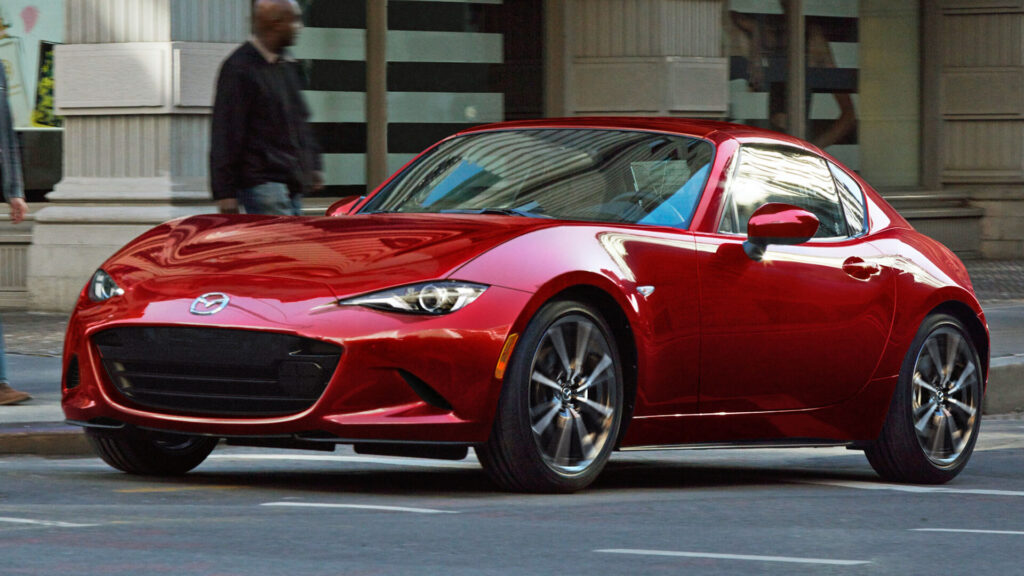
These patents indicate that Mazda continues to invest in developing new sports cars, despite the general trend toward electrification. The company appears to be looking for ways to combine traditional values (lightness, rear-wheel drive, gasoline engine) with modern technology and design. Abandoning the rotary engine in favor of a conventional four-cylinder could be justified by the desire to reduce costs and simplify the design for mass production. At the same time, the use of butterfly doors suggests that the new model could have a more exotic image than the standard MX-5. Thus, we are likely witnessing the birth of two different, but technically related, models that can satisfy both conservative fans of classic roadsters and those seeking a more spectacular vehicle.