 by
by Dacia Striker: New compact estate with crossover features
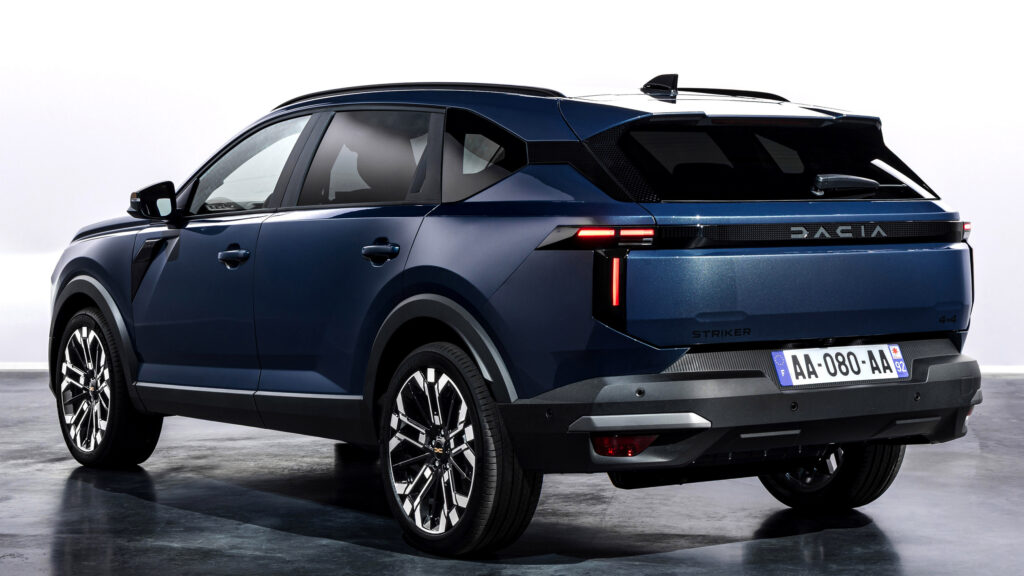
Dacia has released new images and details about the all-new Striker, following the official preview of the car in March. It is Dacia’s second model in the compact segment alongside the Bigster crossover. The Striker is a raised estate with electrified powertrains, built around affordability and practicality. Instead of choosing one niche, Dacia claims that the Striker is simultaneously an SUV, a saloon, and an estate.
The brand positions the Striker as a car that offers “the best of all three worlds,” combining “the high driving position and off-road capability of an SUV, the versatility and practicality of an estate, and the efficiency and performance of a saloon.”
Design and dimensions
The model features a raised estate stance with robust stylistic elements integrated into its sculpted bodywork. The design language develops the theme already seen on the Duster and Bigster crossovers, adding new elements such as T-shaped LEDs in the headlights and taillights.
The Striker is the longest model in the Dacia lineup, measuring 4.62 meters in length, which is 50 mm longer than the Bigster. Its roof height of 1.53 meters is lower than most SUVs, helping it achieve an impressive drag coefficient of 0.29 Cd. Ground clearance remains generous: 190 mm for the standard model and up to 200 mm for the all-wheel drive variant.
Depending on the configuration, wheels are available in 17, 18, or 19-inch diameters. The trim level lineup ranges from the entry-level Essential through the mid-range Expression to the flagship Extreme and Journey trims, which are shown in the official images.
Trims and interior
The Extreme trim is aimed at outdoor enthusiasts, featuring scratch-resistant recycled Starkle material for the cladding, along with Copper Brown accents, washable upholstery, and rubber floor mats. The Journey trim, on the other hand, leans more toward comfort for long family trips, with standard equipment including power driver’s seat, heated front seats and steering wheel, wireless charging, navigation, and a power tailgate.
The dashboard resembles that of the Duster and Bigster, but the Striker gets its own unique trim elements. A 7-inch digital instrument cluster and a 10.1-inch infotainment system are standard across the lineup, as are a rearview camera, rear parking sensors, and a suite of ADAS features that can be deactivated using a dedicated “My Safety” button. Optical reflection technology also projects key information from the digital instrument cluster as a floating 3D image.
The interior has a two-row, five-seat layout, distinguishing it from the smaller, three-row Jogger. Boot volume is 600 liters, featuring an Easy Fold system for the rear bench and a reversible three-module boot floor that can divide the space into compartments. If more space is needed, Dacia offers a 480-liter roof box as an option, along with the YouClip accessory mounting system. The model is also available with a panoramic glass roof.
Powertrains
Like the rest of the Dacia lineup, the Striker is based on the CMF-B architecture. At launch, it is available with two self-charging hybrid powertrain options.
The Hybrid 155 version (front-wheel drive) combines a naturally aspirated 1.8-liter four-cylinder engine producing 109 hp with a 49 hp electric motor, a starter-generator, a 1.4 kWh lithium-ion battery, and a clutchless automatic transmission with four gears for the internal combustion engine and two for electric mode. Dacia claims the hybrid relies on electric power for starting and up to 80% of city driving.
The other option is the Hybrid 150 4×4, which offers all-wheel drive. It uses a mild hybrid turbocharged 1.2-liter engine producing 140 hp, paired with a six-speed dual-clutch automated manual transmission, plus a disconnecting 31 hp rear electric motor with its own two-speed automatic transmission. The driver has five modes: Auto, Eco, Snow, Mud/Sand, and Off-Road, as well as a hill descent assist system.
Whether the Striker will become available with other powertrains in the future remains to be seen, following the example of the Duster and Bigster, which can be ordered with bi-fuel petrol/LPG engines and mild hybrids.
Price and market positioning
The market launch of the Dacia Striker in Europe and the UK is expected to begin soon. The manufacturer promises a starting price of under €25,000, aiming to shake up the compact segment. With no direct competitors in this price range, the Striker will seek to win over buyers of subcompact crossovers and compact hatchbacks.
The new Dacia Striker is an interesting attempt to combine the practicality of an estate, the high driving position of a crossover, and the efficiency of hybrid technology at an affordable price. Its main advantage is the lack of direct competitors in this price segment, which could make it very attractive to families looking for a spacious and economical car. The choice between front-wheel drive and all-wheel drive hybrid versions allows it to meet different needs, from city driving to light off-roading. At the same time, whether the Striker can compete with more prestigious, but also more expensive, models remains to be seen. Its success will largely depend on how effectively Dacia can communicate the idea of “the best of three worlds” in one car to buyers.