 by
by Key Changes in the Updated VW Caddy
Update: After an exterior teaser in April, VW has now detailed the revamped interior of the updated Caddy and opened pre-orders for the small van in Europe.
Exterior Styling and Design
Six years after the debut of the fifth generation, the Volkswagen Caddy receives a mid-lifecycle update that is largely focused on digital enhancement. The exterior changes are restrained, but the updated cabin brings the small van closer to the rest of the VW lineup.
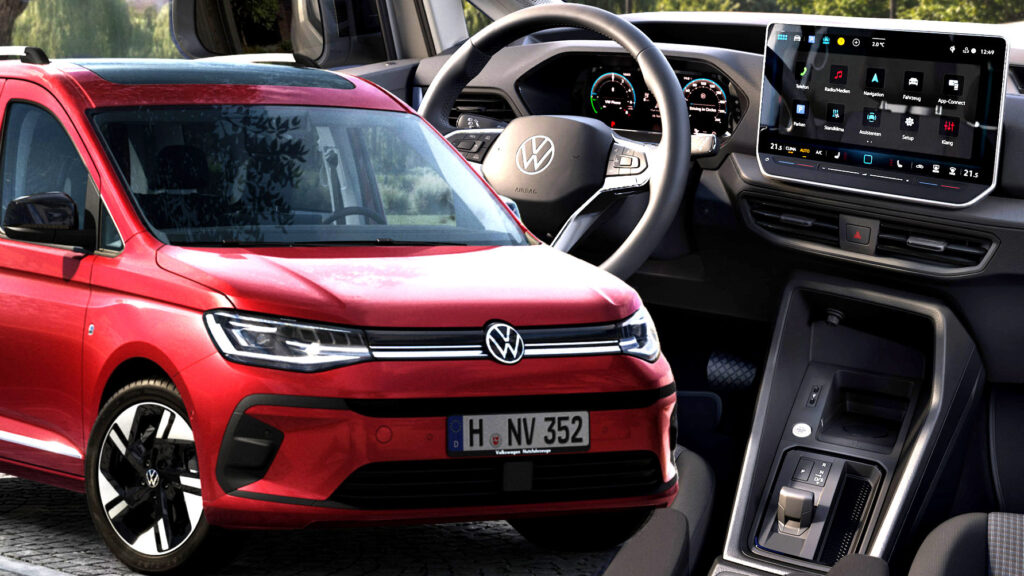
Visually, the Caddy gets a redesigned front bumper that replaces the previous honeycomb pattern with more conventional air intakes. The Cargo version emphasizes practicality with plenty of unpainted plastic, while the passenger versions Life, Style, and California feature color-matched bodywork with black accents.
The headlights and the LED strip connecting them to the VW emblem remain unchanged. In profile, the design is nearly identical, apart from new wheel designs ranging from 16 to 18 inches and an expanded color palette with four new metallic shades (Reed Green, Sunset Red, Grenadilla Black, and Grey-Brown).
Interior and Infotainment
Inside, the central element is the larger 12.9-inch infotainment display, borrowed from the Golf and T-Roc. It offers simpler and more intuitive menus with customizable touch controls, but retains the controversial touch sliders instead of physical climate control buttons, similar to the ID.3 Neo and ID. Polo.
At least the touch sliders are now backlit, making them easier to use. Additionally, the Digital Cockpit Pro and wireless charging are now standard across the entire lineup, including the utilitarian Caddy Cargo. The steering wheel also comes from the Golf with physical push buttons.
Other interior updates include redesigned seat covers and door inserts, as well as dual USB-C ports up front. Finally, passenger versions and the taxi-oriented Flexible LCV get tie-down straps and hooks on the B-pillars.
Versions and Modifications
The Caddy remains available in two wheelbase options, with two, five, or seven seats depending on the configuration. The most practical version for professionals is the Caddy Cargo Maxi with a maximum volume of 3,100 liters.
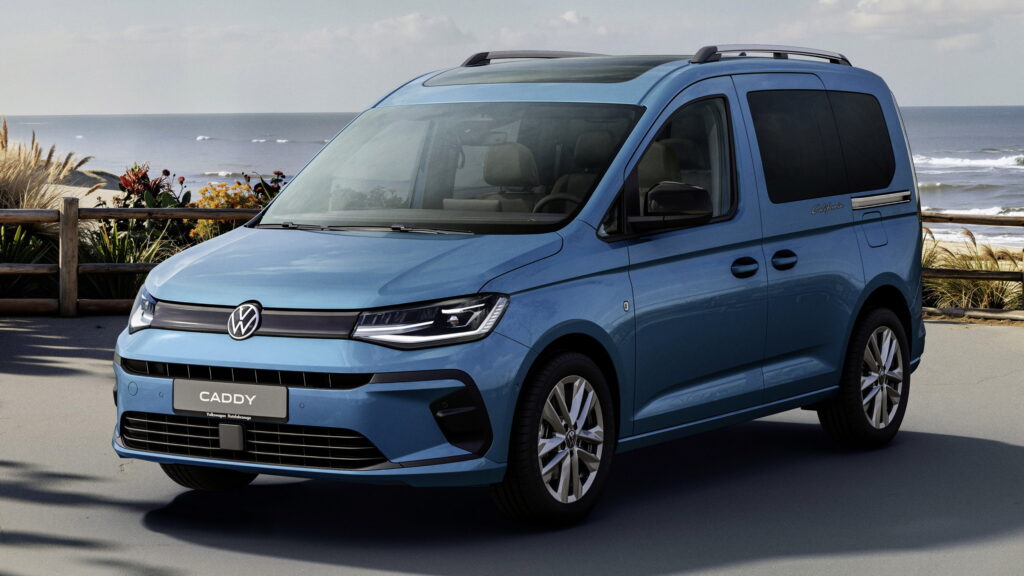
The most interesting member of the lineup remains the Caddy California, designed for camping. It is also available in two lengths: 4.5 m or 4.85 m. This “micro-camper,” as VW calls it, features concave springs under the mattress of the removable bed and an optional panoramic glass roof, as well as an optional mini-kitchen.
Powertrains and Prices
The engine lineup is expected to be carried over with petrol, diesel, and plug-in hybrid options. The eHybrid version was introduced last year with a combined output of 148 hp and a 19.7 kWh battery, providing an electric-only range of 122 km and a total range of over 620 km.
Production of the Caddy will remain at the plant in Poznań, Germany, and VW is already accepting pre-orders. On the domestic market, the Caddy Cargo starts at €26,480 before tax, while the passenger version Caddy starts at €34,200 including taxes.
Since the debut of the original model in 2003, VW has sold 2.9 million units of the Caddy across five generations. Competitors include the mechanically related Ford Transit/Tourneo Connect, the twins Renault Kangoo/Nissan Townstar, as well as the quintet Citroen Berlingo, Peugeot Partner, Fiat Doblo, Opel Combo, and Toyota ProAce City.

The Caddy update demonstrates VW’s ambition to unify the digital experience across the entire lineup, even in commercial models. While the exterior changes are minimal, the adoption of the modern infotainment system from the Golf significantly enhances the model’s appeal for those who use the van for both work and leisure. The retention of the hybrid version with a decent electric-only range makes the Caddy competitive in a segment where electrification is becoming increasingly important. At the same time, the removal of physical climate control buttons in favor of touch sliders may draw criticism from practical users who value ease of operation while driving.