 by
by Chinese automakers received a record $11.4 billion in subsidies in 2024
It’s no secret that Beijing has been funding its automotive industry for years. However, the scale of this support is staggering. The Chinese government has been investing in domestic manufacturers for decades, helping companies like Chery, BYD, and Geely become major players on the global stage and turning China into the world’s largest car producer. The numbers behind these efforts are worth a detailed look.
OECD detailed report: comparison with other regions
A detailed report by the Organisation for Economic Co-operation and Development (OECD) analyzed 15 industrial sectors receiving subsidies from the Chinese government and compared them with similar indicators in other countries. In some sectors, Chinese companies received up to eight times more state subsidies than their competitors.
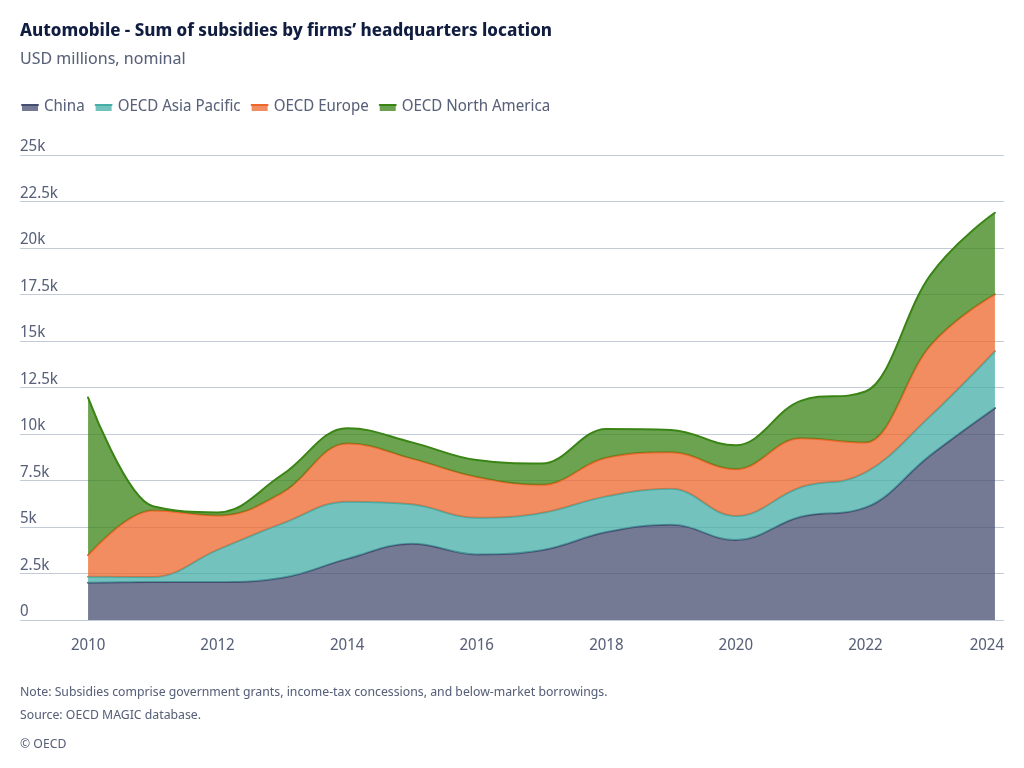
The data is based on a study of 525 large corporations worldwide from 2005 to 2024. Annual reports, financial documents, and other key materials were analyzed. In 2019, Chinese automakers received state grants, tax breaks, and loans at below-market rates totaling $5.122 billion. For comparison, the average in the Asia-Pacific region was $1.93 billion, in Europe – $1.95 billion, and in North America – $1.2 billion.
Post-pandemic surge and uneven competition
Subsidies to Chinese companies surged after the COVID-19 pandemic. By 2024, they reached $11.394 billion, while for Asia-Pacific firms this figure stood at $3.05 billion. Europe and North America also increased support – to $3.06 and $4.38 billion respectively – but both regions remained far behind China. The only time North American companies approached Chinese levels was during the bailout packages for GM and Chrysler during the global financial crisis.
According to the OECD, the volume of support for Chinese automakers was twice as large in absolute terms and four times as large in relative terms compared to support for competitors from OECD countries.
OECD warning: “doping” in industry
The organization notes that tracking such state support helps identify factors with the “potential to disrupt international markets,” where companies are forced to compete on an uneven playing field. The OECD compares the industrial subsidies received by firms to “doping in sports.” And automobiles are just part of the story. In most of the 14 other sectors studied by the OECD, Chinese firms again ranked first in the volume of state support.
The OECD also warned that persistent subsidy gaps could over time impact innovation, fair competition, and global trade.
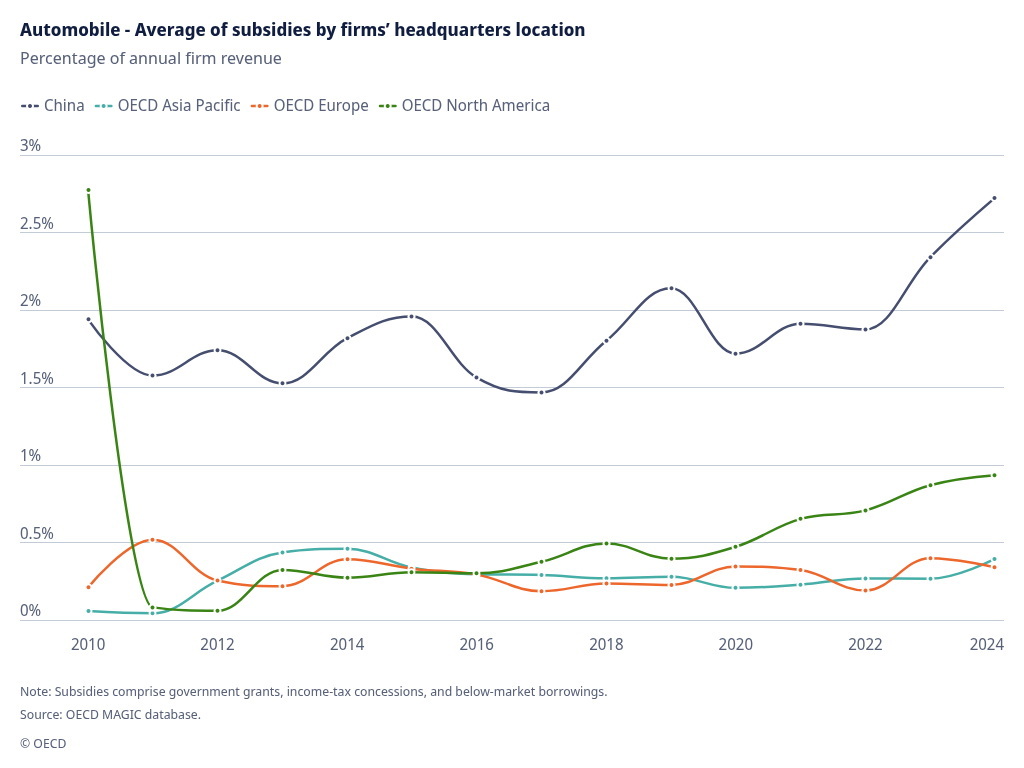
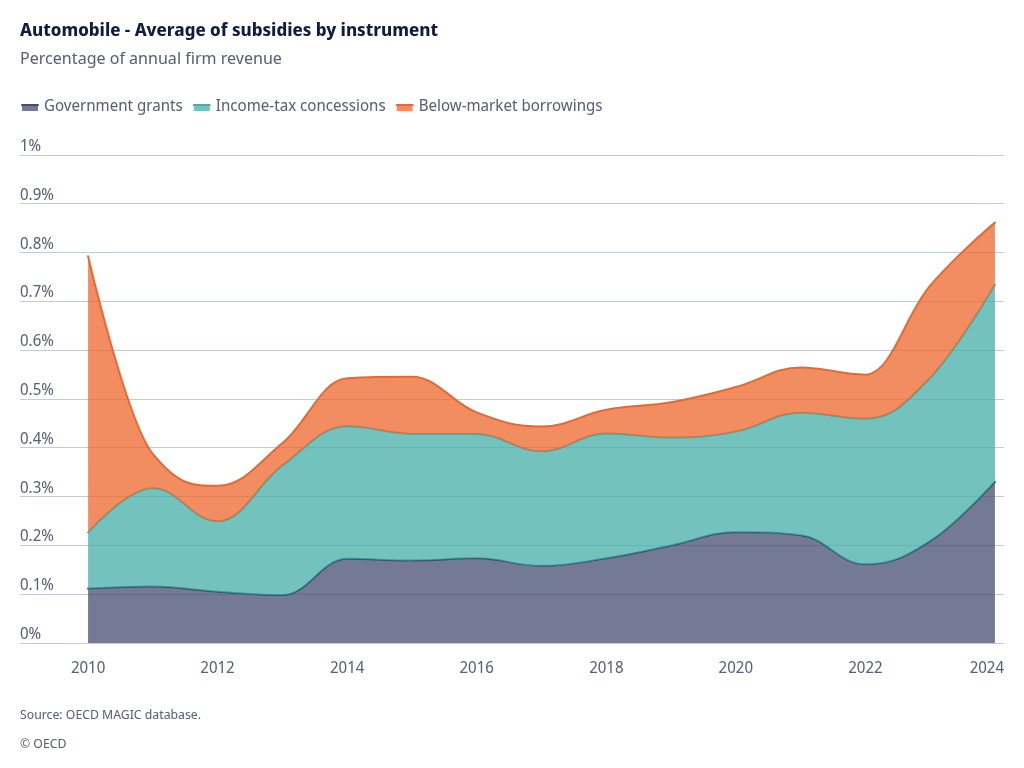
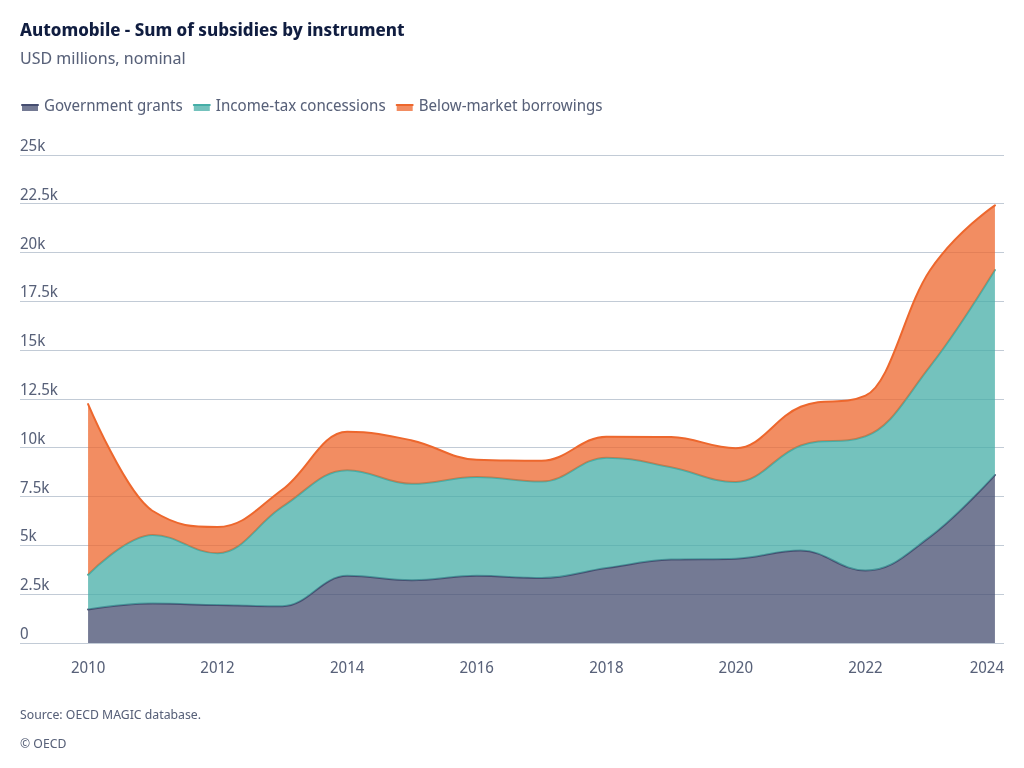
Such a level of state support poses significant challenges for the global automotive industry. While subsidies have helped China become a leader in electric vehicle production and innovative technologies, they also raise concerns about fair competition. Other countries, notably the US and Europe, have already begun implementing their own support programs, trying to close the gap, but as OECD data shows, this is not yet enough. Further growth in subsidies could lead to trade disputes and a revision of global rules of the game, affecting prices, consumer choice, and the future of the automotive industry as a whole.