 by
by Updated Skoda Enyaq: Is It Worth Considering Against Its Younger Sibling?
Four years ago, Skoda introduced the fully electric Enyaq. Built on the MEB platform from the VW Group, which also underpins the VW ID.4, ID.6, and Audi Q4 e-tron, it has become a truly important model for the brand.
This crossover has consistently been popular in Europe, ending 2025 as the seventh best-selling electric vehicle in the region with 79,600 deliveries. Part of its appeal lies in offering something different, targeting buyers who want a bit of style in a package that still looks like a conventional SUV, rather than flaunting its electric nature like VW’s ID lineup does.
The electric SUV segment has become significantly more active since the Enyaq’s debut, so it received a facelift last year, and we recently had our first chance to test it. It has proven itself to be an attractive proposition, but it is overshadowed by the smaller and cheaper Elroq.
Fast Facts
Model: 2026 Skoda Enyaq 60 Select
Starting Price: AU$54,990 ($39,900) including on-road costs
Dimensions: 4658 x 1879 x 1622 mm
Wheelbase: 2766 mm
Curb Weight: 1902 kg
Powertrain: Single electric motor / 59 kWh battery
Power: 201 hp (150 kW) / 310 Nm
0-100 km/h: ~8 seconds
Transmission: Single-speed
Efficiency: 14.6 kWh/100 km per test results
On Sale: Now
Design: Almost a Twin of the Elroq
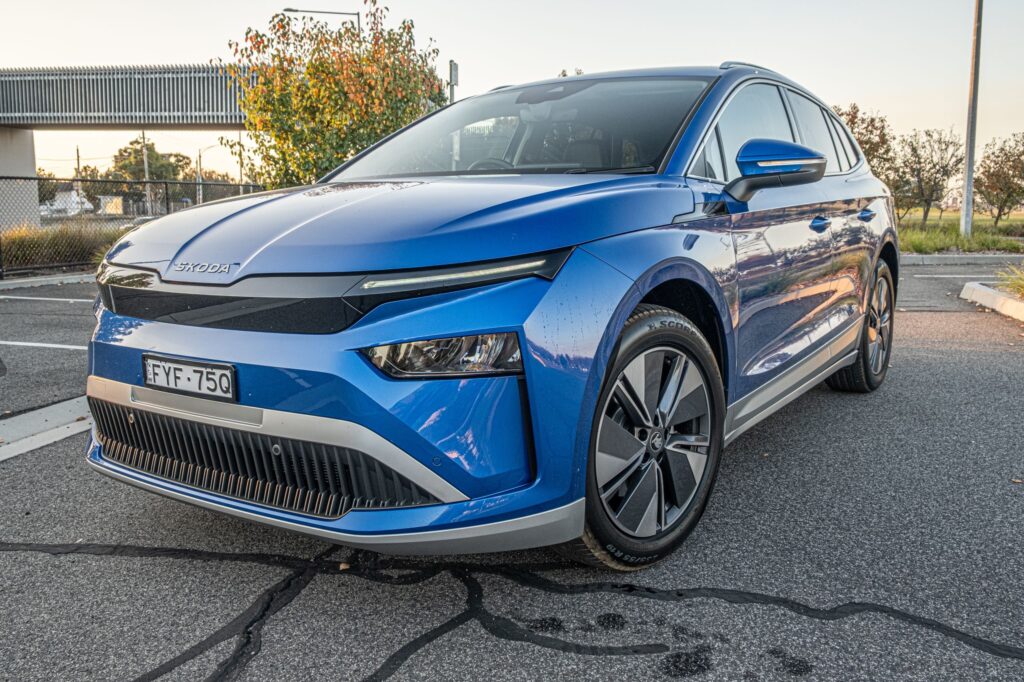
While the original Enyaq stood out from the rest of the Skoda lineup, the same cannot be said for the new model. In fact, when I picked up the keys to the test car, having just returned the Elroq, I wondered if I had mixed up my bookings and ordered a second Elroq. From the front, they look almost identical.
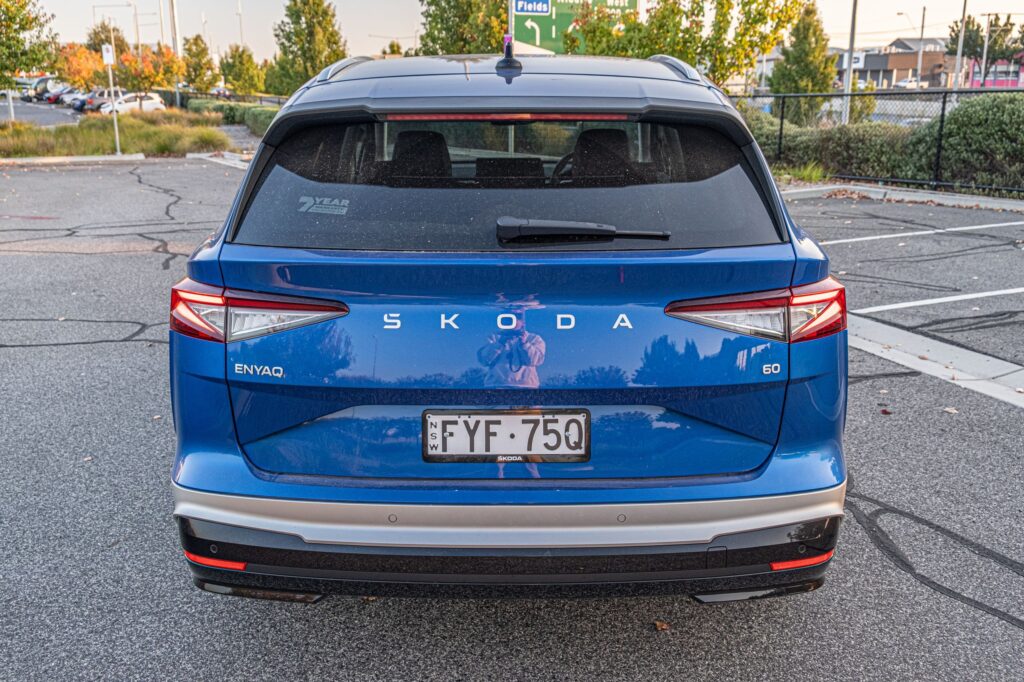
Skoda has updated the Enyaq with a “Modern Solid” front end, which includes new split headlights, attractive daytime running lights, and darkened radiator grilles. They are also quite easy to confuse from the rear due to nearly identical taillights and a very similar black-and-silver bumper. The key difference is that the Enyaq is longer and has significantly more volume in the rear doors and tail.
Like the original, the Enyaq is offered with several different battery packs depending on the market. In Australia, we tested it in the base 60 Select trim, which uses a 59 kWh battery and starts at AU$54,990 ($39,600), which is AU$5,000 ($3,600) more expensive than the Elroq. Two versions with 84 kWh batteries are also offered, known as the 85 Sportline and RS, priced from AU$63,990 ($46,000) and AU$79,990 ($57,500) respectively.
Interior: Spacious and Comfortable
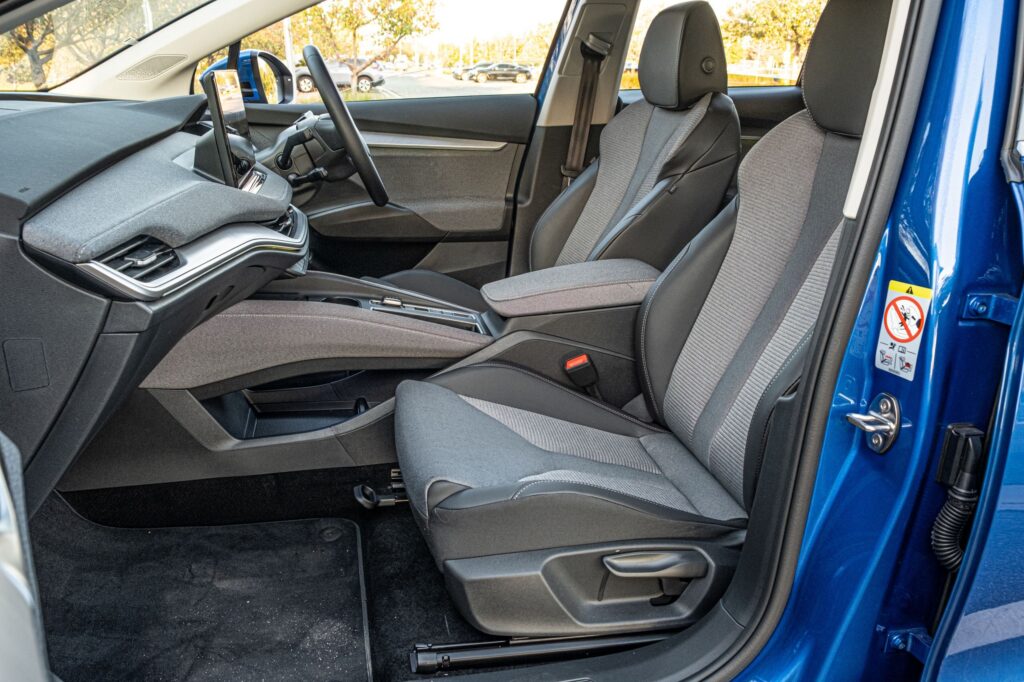
Inside, the updated Enyaq is mostly the same as before the facelift, which is not a bad thing at all. The basic interior design still looks fresh and modern, as well as very spacious.
Like the smaller Elroq, all Enyaq models now come with a new two-spoke leather-wrapped steering wheel, replacing the more traditional three-spoke one. Other than that, it is mostly the same.
In the center of the dashboard is a 13-inch infotainment display. The software, very similar to what you find in other VW Group products, remains user-friendly, although not as advanced as some competitors, especially Chinese models. On the positive side, it takes very little time to get used to.
Most functions are located on the screen, including climate control and all important vehicle settings. Alongside this screen is a small digital instrument cluster. Both wireless Apple CarPlay and Android Auto worked flawlessly during our testing of the Enyaq 60 Select.
The base model we tested used the same dark gray fabric as the cheapest available Elroq model. The interior is largely identical to the Elroq. While this is not surprising given how closely related they are, it would have been nice if Skoda had made an effort to differentiate them a bit more. Even the Kia EV3 and EV5 interiors, though they share some details, are more distinct from each other than the two Skodas.
Behind the wheel, the Enyaq doesn’t feel bigger than the Elroq, which is good. There is plenty of space, customizable ambient lighting, and an eight-speaker audio system.
At the rear, the longer and taller roofline compared to the Elroq helps increase space. It is certainly not the most luxurious rear seat experience among electric SUVs in this price range, but it is perfectly acceptable. On the floor, where the transmission tunnel would normally be, there is a removable black plastic compartment that adds practicality for storing small devices like phones and cables. Other than that, nothing remarkable.
Driving Dynamics: Europeans Still Know How
In the five and a half years since the Skoda Enyaq launched, the electric vehicle space has evolved, and evolved quickly. Does the Skoda drive like an old EV, or does it still manage to feel fresh and modern?
The 59 kWh battery powers a rear electric motor producing 150 kW (201 hp) and 310 Nm of torque. This is just the right amount of power for an SUV of this class, providing enough punch for quick overtakes and highway driving without rapidly draining the battery.
Skoda claims the average consumption of the Enyaq 60 Select will be 16.6 kWh/100 km on a mixed cycle, giving a claimed WLTP range of 410 km (255 miles). To my surprise, over a week I achieved an average consumption of 14.6 kWh/100 km, which was better than the 16 kWh/100 km I got on the smaller Elroq with the same battery and motor. I drove mostly in B mode, which maximizes regenerative braking, improving efficiency.
Like other MEB-based models from the VW Group, the single-motor Enyaq is rear-wheel drive, while some competitors have front-wheel drive. Most owners will likely never notice the difference between front and rear drive, and will be more concerned with their kids not fighting in the back seats.
On the road, rear-wheel drive eliminates the Enyaq’s tendency for front-wheel spin on start or when accelerating out of corners, as models like the Kia EV5 do. Overall grip is excellent, and the Enyaq doesn’t feel clumsy when driving quickly through a mountain pass.
Does it feel significantly different to drive compared to the Elroq? No, not really, nor should it, especially given it has only a 1 mm longer wheelbase and weighs only 14 kg more. However, after spending two weeks with this pair, I wondered if Skoda might have been better off simply merging these two models, as they are so similar.
Future Updates: Worth Waiting For
Like the Elroq, the Enyaq is not a technology giant like some competitors. This may deter younger buyers who want their EV to be an extension of their daily life, offering excellent digital connectivity. However, things are about to become a bit more attractive.
In the coming months, the Enyaq, along with its younger sibling, will receive a new infotainment system based on Android Automotive. Along with this system will come a long-awaited Skoda smartphone app, which will allow owners to connect directly to their cars, set navigation destinations, and importantly, use the phone as a digital key. Skoda has also indicated that the Elroq 60 and Enyaq 60 models will receive a new lithium-ion battery pack.
As we discovered with the Elroq, the Enyaq 60 does not have a one-pedal driving mode, which seems an obvious shortcoming for such a vehicle. Later this year, one-pedal driving mode will be added to the electric SUV. Like Hyundai and Kia, Skoda will also add steering wheel paddles to control the level of regeneration. The Enyaq’s practicality will also soon be enhanced by the addition of a 21-liter front trunk. Currently, there is no storage space under the hood. It is a shame that it took Skoda nearly six years to add it.
As for ride comfort, the Enyaq 60 Select is pleasant, given its weight of 1948 kg. It certainly doesn’t set new standards for smoothness, but you wouldn’t expect that from an SUV in this price range.
Verdict
The minor updates made to the facelifted version of the Skoda Enyaq have helped keep it fresh. Overall, it is a bit more basic than we would like, and the price rises sharply when buyers opt for the 85 Sportline or RS models. In Australia, there would likely be room for a second, better-equipped version with the 59 kWh battery.
As sales in Europe show, the Enyaq is well-received by buyers, and we see no reason why the current version would be different, as it more than adequately handles most driving tasks, though it is not particularly advanced. However, those contemplating a purchase would be wise to exercise a little patience and wait for the 2027 model, as the updates being prepared for it will significantly enhance its appeal. It is just a shame these refinements were not made at the launch of the updated model.
Overall, the Skoda Enyaq remains a worthy, albeit somewhat conservative, choice in the world of electric vehicles. Its main advantages are a proven platform, a spacious interior, and a familiar, unobtrusive design. However, given the rapid progress of competitors and the upcoming updates to the model itself, potential buyers should carefully consider whether it is better to wait for the 2027 version, which promises to address key shortcomings such as the lack of one-pedal mode and a digital key. This makes the current offering a bit of a compromise, especially against the younger and cheaper Elroq, which offers almost the same for less money.