 by
by Pros: Design, exceptional ride smoothness, handling, equipment. Cons: Rear legroom, limited highway range.
Many automakers turn to their own history, but often create clumsy imitations. Renault is one of the few that does it successfully. The R5 E-Tech is one of the most desirable electric subcompacts in Europe, so we took the keys for a week to find out if it suits everyday life.
The production version arrived in 2024, three years after the concept, with a retro-futuristic style referencing the original R5 from 1972. The French subcompact serves as a zero-emission alternative to the similarly sized Clio and as a successor to the aging Zoe, slotting slightly above the recently launched Twingo E-Tech.
None of this will come to America. Renault left the US decades ago, and the R5 was built for European prices, streets, and tastes, with no plans to cross the Atlantic. So consider this a look at a charming little electric hatchback that America would probably love but can’t have.
Design and First Impression
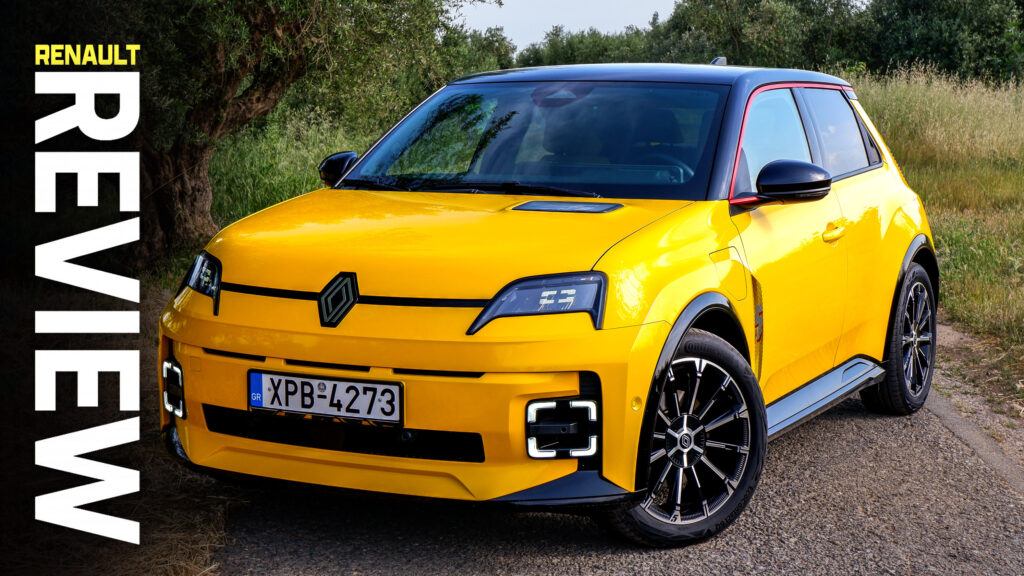
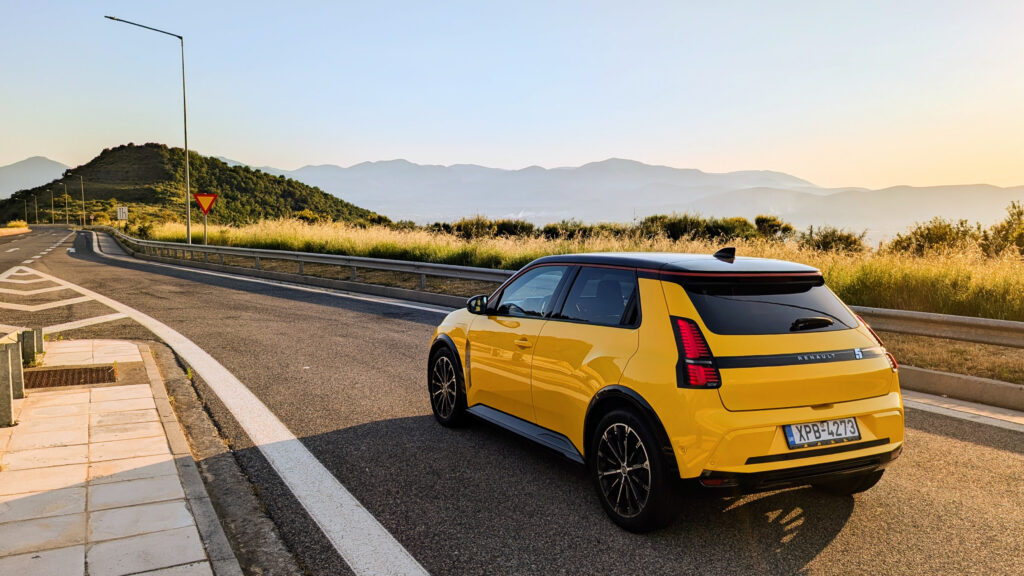
Our press car is the top-spec Iconic trim, finished in a vibrant but optional shade of Pop Yellow with a sparkle effect, which undoubtedly suits the new R5 best. The bright color is paired with a Diamond Black roof, a red accent stripe along the side, and 18-inch Chrono alloy wheels, though I would choose the Techno wheels if given the choice. The Iconic trim is also the only way to get the more powerful 148 hp electric motor and the larger 52 kWh battery pack.
Quick Facts:
*Manufacturer data
Photo: Thanos Pappas for Carscoops
Exterior design is a matter of taste, but everyone I spoke to had positive comments about the R5’s styling, which attracted more attention than most press cars I have tested. Aside from the exotic color, my favorite details are the vertical LED taillights with a three-dimensional finish, the sculpted fenders, and the rally-style daytime running lights on the front bumper.
The result is a car with a sporty, playful character that is genuinely hard to miss in a market saturated with lookalike crossovers.
I was also impressed by the small protrusion on the hood — a clear nod to the ventilation intakes of the classic 5 model, which also serves a functional purpose. When you approach the car, the 5 emblem illuminates in segments, showing the battery charge level even before you open the door.
Interior and Technology
The interior is packed with technology, especially in the flagship Iconic trim. A somewhat bulky digital instrument cluster sits high and includes a 10.3-inch digital display that changes colors depending on the driving mode, and a sharp 10.1-inch touchscreen slightly angled towards the driver.
Renault’s OpenR infotainment system based on Google has intuitive menus and connects seamlessly to a smartphone. More importantly, it is complemented by a row of physical climate control buttons on the center console. The only ergonomic flaw is the volume buttons, which are awkwardly located at the top of the screen, although there is a dedicated steering column stalk for more convenient control.
Another slightly annoying point: the voice assistant “Reno” based on ChatGPT kept interrupting conversations with the front passenger at inappropriate times, reminiscent of the animated paperclip from old Windows Office.
Buttons on the steering wheel control most functions, including the Multi Sense button for switching driving modes (Eco, Comfort, Sport, Perso). The gear selector only has Drive and Reverse positions, leaving parking aside. Equipment is quite generous: heated seats and steering wheel, wireless charging, and a full set of ADAS systems, including an automatic parking function that works flawlessly.
Photo: Thanos Pappas for Carscoops
As for materials, Renault’s color and trim department did a good job creating a youthful environment. The yellow recycled textile on the seats and front doors is a nice touch combined with eco-leather and yellow stitching, which is also present on the passenger side of the dashboard.
Regarding practicality, the rear seats of the 3922 mm long hatchback may feel tight for tall passengers if they are sitting behind a tall driver. Legroom and headroom are less than in the Fiat Grande Panda, though acceptable for a city car. Trunk volume is 326 liters, slightly above the segment average. Do not look for a front trunk, as all the space under the hood is occupied by the electric motor.
Ride Quality and On-Road Behavior
On the road, the Renault 5 E-Tech clearly exceeds expectations. The real surprise is the balanced chassis with a sophisticated multi-link rear suspension that provides ride smoothness characteristic of much larger cars.
Photo: Thanos Pappas for Carscoops
The suspension absorbs potholes well in the city and makes the car a comfortable cruiser on the highway, where you appreciate the exceptional sound insulation. At the same time, it is firm enough to stay flat and composed on a winding road. The stable seating position and low center of gravity combine with direct and informative steering, which is rare among modern electric vehicles.
The front electric motor delivers up to 148 hp, which feels like the right power for the car’s size and positioning, making you wonder if the Alpine A290 is really necessary. Although the R5 is far from Tesla speed with a 0-100 km/h time of 8 seconds, power delivery is more practical and natural, especially for those transitioning from an internal combustion engine car.
Photo: Thanos Pappas for Carscoops
In the city, it is useful to use the B function with regenerative braking whenever you take your foot off the accelerator. I wanted to complain about the lack of a one-pedal driving mode, although it has recently been added to the Techno and Iconic trims with the more powerful motor. However, this feature will not be offered as an update for existing owners.
Range and Charging
The 52 kWh battery pack offers a claimed WLTP range of up to 410 km, which sounds much better than the 300 km of the smaller 40 kWh pack. In real life, in urban conditions, you can easily achieve and even exceed 400 km, where the electric car is surprisingly efficient.
On the highway, you should probably expect around 250 km depending on conditions and speed.
Photo: Thanos Pappas for Carscoops
During my test, I made a 240 km highway trip without stopping to charge. The air conditioning was on, speed was around 120 km/h, and I arrived at my destination with 10% battery charge and 40 km of remaining range.
However, the return trip was different. Although I drove at a similar speed and even used Eco mode, which limits power and reduces top speed to 115 km/h, I was forced to stop along the way because the estimated range was insufficient. Fortunately, I found a fast charging station, so it only took about 15 minutes to get back to a safe charge level.
The R5 supports fast charging at 100 kW, allowing the battery to charge from 15% to 80% in 30 minutes. Using a standard 11 kW wall box, a full charge takes about 4.5 hours. Additionally, the model has V2L functionality with a special adapter.
Prices and Competitors
Photo: Thanos Pappas for Carscoops
In Greece, where we conducted the test, the R5 E-Tech lineup starts with the Evolution trim at €26,900, or €22,400 after applying local EV subsidies. It is worth noting that prices include VAT (value-added tax), which for EVs is a reduced rate of 13% instead of the standard 24%, as well as delivery costs.
The base trim is generous, but the entry-level car comes only with the smaller 40 kWh battery and the 118 hp motor. Moving up to the mid-level Tecno trim, you can get the 52 kWh battery paired with the 148 hp motor for €33,200. The flagship Iconic trim with the full feature list costs €35,200 before subsidies.
Overall, the cheapest R5 E-Tech is almost on par with the more budget-friendly and family-oriented Fiat Grande Panda Electric, while the higher trims are priced similarly to the base Mini Cooper E. Other players in the subcompact segment include the Peugeot e-208, Opel Corsa-e, Lancia Ypsilon Elettrica, and Citroen e-C3.
Nevertheless, the biggest competitors for the French EV are the upcoming VW ID.Polo and Hyundai Ioniq 3, expected on European roads in the coming months. The R5 also faces strong internal competition from the new Renault Clio Full Hybrid E-Tech, especially for buyers without access to a home charging station.
Notably absent from this list are the United States. In Greece, the high-spec R5 competes in price with the base Mini Cooper E — a car Americans can buy. The Renault standing next to it for the same money is more characterful of the two, but it is precisely the one they cannot purchase.
Conclusion
After a week with the Renault 5 E-Tech, I felt just as excited as I did on the day I first got the keys. This small hatchback successfully combines a sporty, playful character with genuine everyday usability.
Beyond its stunning exterior, the R5 is a compelling candidate for the ideal second car, excelling as a refined city dweller while remaining equally capable for weekend getaways, comfortable highway trips, and spirited drives on twisty back roads.
While it may not offer the most interior space in its segment, and the desirable top trim comes at a premium price, the R5 is a car that never fails to bring a smile to your face, making you feel a few years younger.
Photos and video: Thanos Pappas for Carscoops
Interestingly, Renault has managed to create not just another electric car, but a truly emotional product that evokes nostalgia while meeting modern requirements. Despite some compromises, such as limited rear space and range dependency on driving style, the R5 E-Tech offers a rare combination of style, driving enjoyment, and practicality that could be a key success factor in the fast-growing European segment. The absence of this model in the US market only underscores the difference in automotive preferences and manufacturer strategies on both sides of the Atlantic.