 by
by Disastrous crash test result for the Toyota Starlet
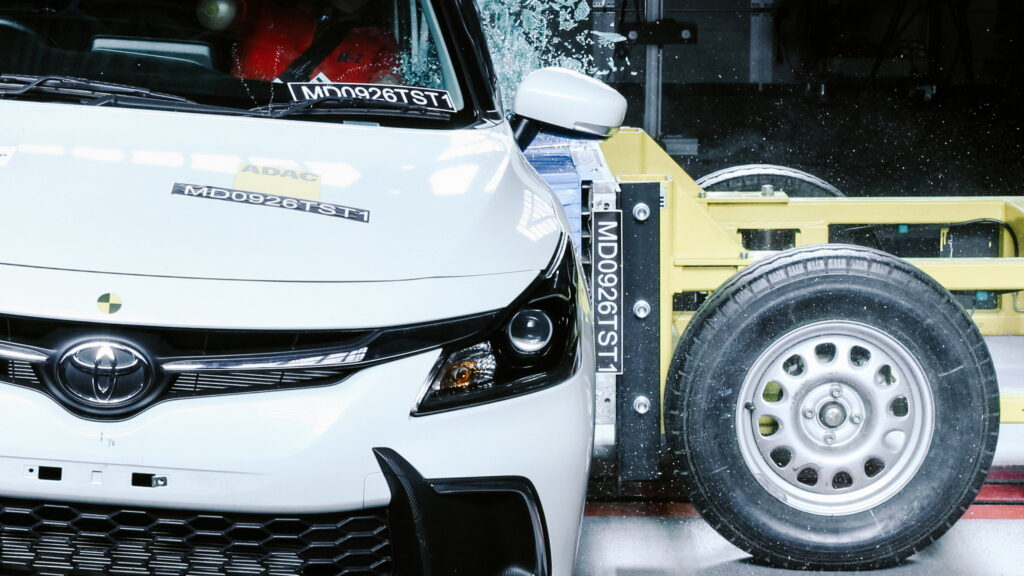
Toyota’s safety reputation took a hit in Johannesburg this month. The Toyota Starlet, one of the most popular hatchbacks in South Africa, scored zero stars for adult occupant protection in the latest round of Global NCAP testing, highlighting the dangers of rebranding.
What is this car?
The vehicle tested was the previous base version of the Starlet, manufactured in India as a nearly identical copy of the Suzuki Baleno. The differences boil down to modified bumpers, a different shape for the rear door, and a different engine catalog. Under the hood, it is the same car with a different badge.
Crash test details
Despite having electronic stability control (ESC) and dual front airbags as standard equipment, the Starlet demonstrated serious structural deficiencies during the impact. According to Global NCAP, both the footwell area and the overall body shell integrity proved unstable and “unable to withstand further loadings.”
The side impact test turned into a disaster: the lack of side airbags led to poor head and chest protection, while abdomen protection was rated as adequate. The results were so poor that Global NCAP completely refrained from conducting the pole side impact test.
Child protection and expert comments
While the model scored zero points for adult protection, it achieved 29.33 points for child protection, earning it three stars. Nevertheless, the head of the three-year-old child dummy contacted the interior trim during the frontal crash test and sustained impact during the side collision.
Richard Woods, Global NCAP’s Secretary General, said: “This is a shocking zero-star result from Toyota. The Starlet, one of the most popular cars sold in South Africa, had an unstable body shell as well as poor head and chest protection, which is a serious cause for concern.”
Toyota’s reaction: Is the test already outdated?
Toyota South Africa is not leaving this result unanswered. The company stated that the tested vehicle is “an outdated model that does not represent the Starlet currently available on the South African market.” This is true as far as it goes, although the question arises of how many such outdated models are still on the roads.
The current version of the Starlet is equipped with side, head, and curtain airbags as standard. Global NCAP has already anonymously purchased one such vehicle and plans to conduct a retest. Until those results are released, the zero stars remain the official rating.
This situation underscores how important up-to-date vehicle safety data is, especially in emerging markets. While Toyota has taken steps to improve safety in the new model, the Starlet incident serves as a reminder of the risks associated with rebranding and using outdated platforms. Consumers should carefully check crash test results for the specific version of the car they plan to buy, rather than relying solely on brand reputation. The anticipation of the Global NCAP retest will be a key moment for restoring trust in this model.