 by
by When Toyota announced the replacement of entire engines in thousands of pickups and SUVs equipped with its twin-turbo V6, many owners reacted with skepticism. The manufacturer explained it was due to metal debris left during production, but some doubted whether such contamination could completely destroy a modern motor. Now, a detailed teardown by Dave’s Auto Center provides compelling evidence that Toyota’s explanation was not just corporate PR.
Why metal debris is so dangerous
Metal particles in an engine are always bad. However, decades ago, when manufacturing tolerances were not as tight as they are today, some engines could withstand a certain amount of debris without catastrophic consequences. Modern automakers intentionally make tolerances minimal to increase engine efficiency. Of course, this also means there is less space between bearings and other key components if debris gets in.
What the engine teardown showed
The teardown by Dave’s Auto Center perfectly demonstrates this problem. At the center of the video is the infamous Toyota V35A-FTS twin-turbo V6 engine, which is installed in the Toyota Tundra, Toyota Sequoia, and Lexus LX 600. According to the shop, the seized engine arrived for inspection and potential rebuilding. Instead, during disassembly, signs of extensive contamination were quickly found.
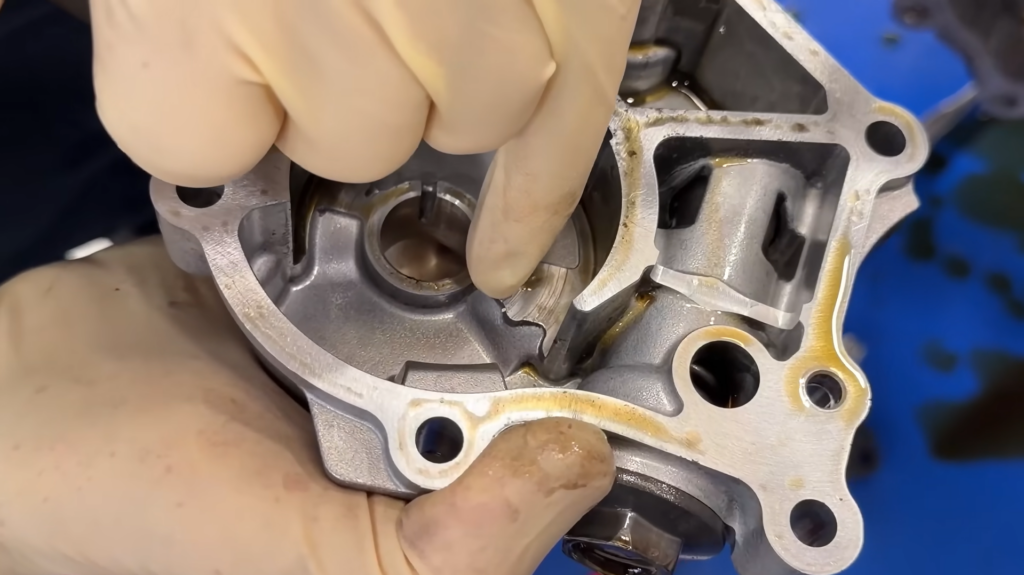
When the front cover and oil pump were removed, mechanics found metal debris throughout the lubrication system. The oil pump housing had visible scratches, and particles were found in the passages feeding the valve timing mechanism, camshafts, hydraulic lash adjusters, and other oil-lubricated components.
Extent of the damage
The shop repeatedly emphasized how little contamination is enough to create a problem. Engine bearing clearances are often measured in thousandths of an inch, so particles that seem insignificant to the naked eye can cause serious damage once they enter the lubrication system. In the case of this engine, the situation only worsened as the shop delved deeper into the disassembly.
The cylinder walls had deep scratches, several bearings had spun, and the crankshaft could no longer rotate. More debris was found throughout the engine, including in the piston cooling oil jets designed to cool the piston crowns.
Mechanics’ conclusion
The most telling finding came after inspecting the bottom end of the engine. The mechanic stated that the engine’s main bearings were so damaged that repairing the original block would likely require expensive machining operations, making replacement the more practical option.
Of course, this teardown represents just one failed engine, not a comprehensive study of all recalled V35A-FTS units. Nevertheless, it is one of the most detailed looks at what happens when contamination enters a modern engine. If nothing else, these findings suggest that Toyota’s initial explanation may have been much closer to reality than many initially believed.
This incident highlights how vulnerable modern high-tech engines have become due to extremely tight tolerances. Even minor manufacturing defects that might have gone unnoticed in the past now lead to catastrophic failures. For owners, this means that while engine replacement is a drastic measure, it may be the only reliable solution, as attempts to repair a severely damaged block are often economically unfeasible and technically complex. It also serves as a reminder of the importance of strict quality control at all stages of production, especially for such complex assemblies.