by
by 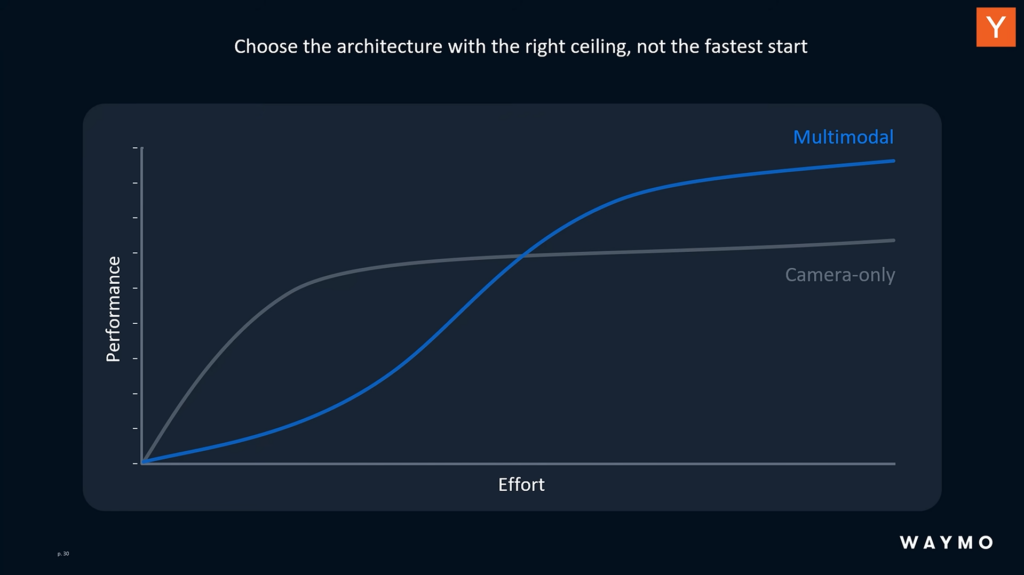
Humans drive using two cameras mounted in their heads and motors in their arms and legs. That doesn’t mean cameras alone are enough to make a car fully autonomous. Waymo co-CEO Dmitri Dolgov says camera-only systems hit a safety ceiling long before they reach the level needed to operate without anyone behind the wheel.
Dolgov made the comments during a talk at Y Combinator’s Startup School. He never mentioned Tesla by name, but the target was obvious. Tesla has built its autonomous-driving strategy around cameras while dismissing lidar and, more recently, radar and ultrasonic sensors. Elon Musk famously wrote off lidar back in 2019, calling it “a fool’s errand” and declaring that “anyone relying on lidar is doomed.” He dismissed it as “expensive and unnecessary.”
“Humans of course can drive with just eyes,” Dolgov said. “If the goal were to just approximately match human performance or to build an assist product, that’s a very reasonable way to go.”
Where the Camera-Only Ceiling Kicks In
If we could turn every driver into a sharper version of themselves overnight, one that never got distracted or bored, we’d all sign up. The problem comes when the goal is full autonomy and “strongly superhuman performance.” In that case, Dolgov argues, “weak sensing just leads to a safety curve that flattens out way too early.”
Read: Waymo Quietly Moves Ahead Of Tesla In The Race For Robotaxis
Waymo uses cameras, lidar, and radar together. Cameras provide high-resolution color information. Lidar maps the three-dimensional world and radar measures velocity directly. The latter two can also continue working in darkness, glare, fog, rain, and snow.
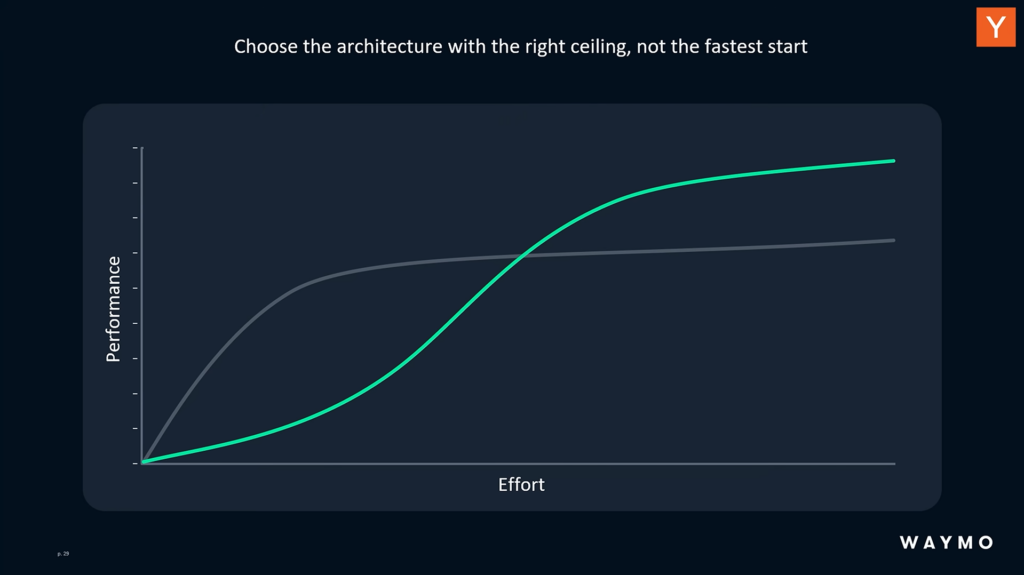
Dolgov says those sensors are not simply backups for one another. Each uses a separate processing system before the data is fused into a more complete picture of the environment. As Electrek noted in its coverage, he pointed to several examples from Waymo’s testing. In one, lidar could identify a pedestrian during a Phoenix dust storm when the cameras could barely see anything.
The Exponential Ladder Of Nines
That kind of redundancy becomes increasingly important as reliability improves. Dolgov described autonomy as an “exponential ladder of nines,” where each additional nine of reliability requires roughly ten times more work than the last. A system that works 99% of the time might look impressive in a demonstration. In the real world, that same system would produce hundreds if not thousands of crashes if it were implemented at scale.
Tesla may still prove its critics wrong. Sometimes, a simpler solution is the best one. But Waymo’s argument is becoming harder to ignore. The technology that produces the best early demo may not be the technology capable of delivering truly driverless safety. At this point, only time will tell.