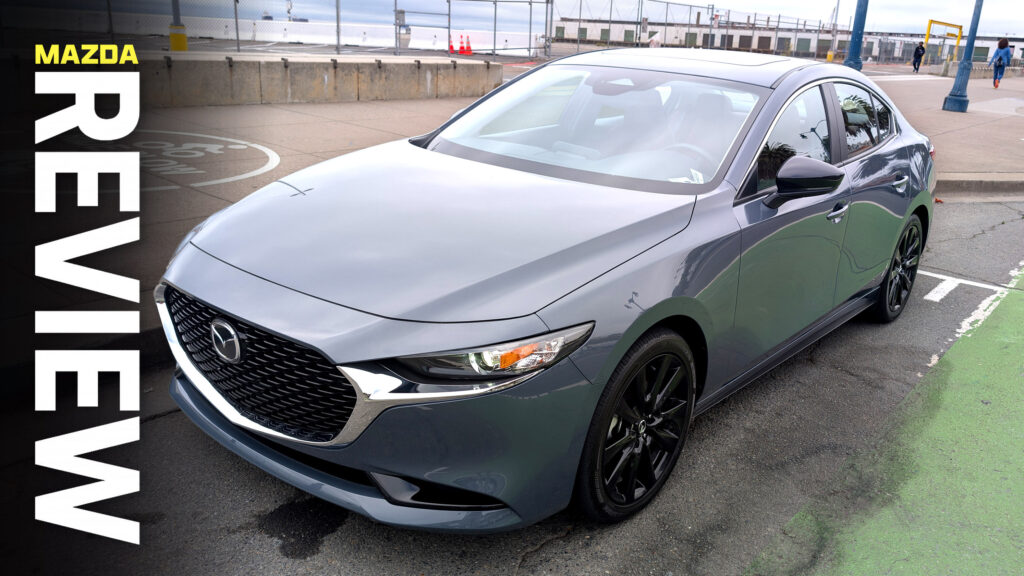
 by
by CONS ›› Cramped second row, no manual option, pricing
There’s a funny thing that happens when you spend enough time around new cars. Your definition of what a car “needs” starts getting completely out of whack. Three hundred horsepower? That’s barely quick anymore. Three rows? Better have them just in case. All-wheel drive? Obviously. A 14-inch touchscreen? Sure. And apparently everyone needs enough ground clearance to traverse the Rubicon Trail on their way to Costco. Then you spend a week driving something like the Mazda3 sedan around San Francisco and realize how ridiculous some of that is.
Because in a dense city, the things that actually make a car good become painfully obvious. It needs to be small enough that you don’t dread parking it. Snappy enough to exploit a gap in traffic. Comfortable enough to sit in for an hour. Efficient enough that you’re not constantly visiting a gas station. Practical enough to carry people and their stuff. And ideally, it should be enjoyable when you finally find a road with more than 300 feet between intersections.
Quick Facts
| › Model: | 2026 Mazda3 Sedan |
| › Starting Price: | $32,520 as tested |
| › Dimensions: | 183.5 x 70.7 W x 56.9 in H (4,660 x 1,795 x 1,445 mm) |
| › Wheelbase: | 107.3 in (2,725 mm) |
| › Curb Weight: | 3,240 lbs (1,470 kg) |
| › Powertrain: | 2.5-liter naturally aspirated four-cylinder / AWD |
| › Output: | 186 hp (139 kW) / 186 lb-ft (252 Nm) |
| › Transmission: | Six-speed automatic |
| › Efficiency: | 26 city / 34 highway / 29 combined mpg EPA |
| › On Sale: | Now |
SWIPE
The naturally aspirated Mazda3 does all of that. In fact, after roughly 200 miles of driving around San Francisco and the surrounding area, I kept coming back to the same thought. How much more car do most people actually need?
Styling: Still One Of Mazda’s Best Designs
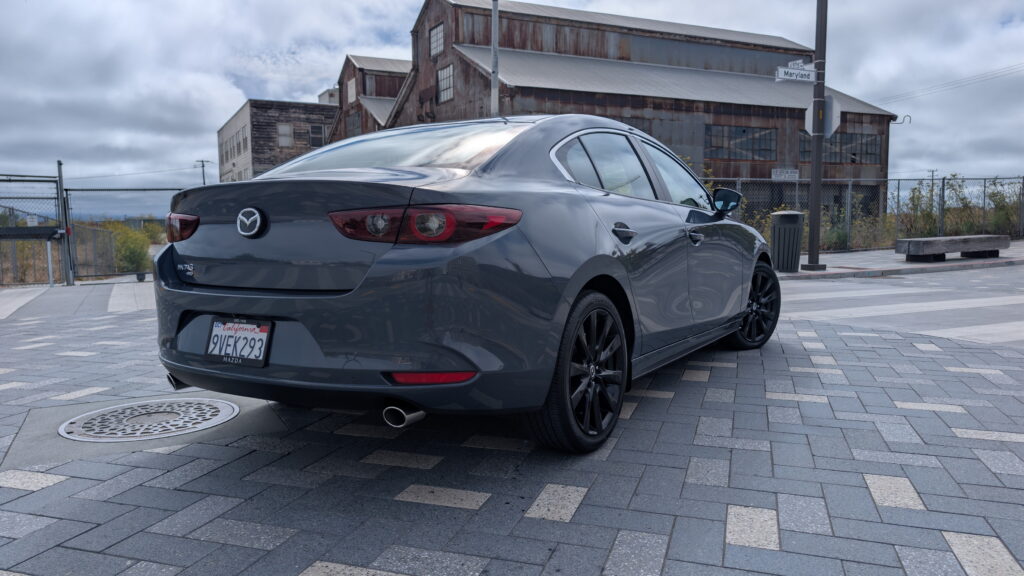
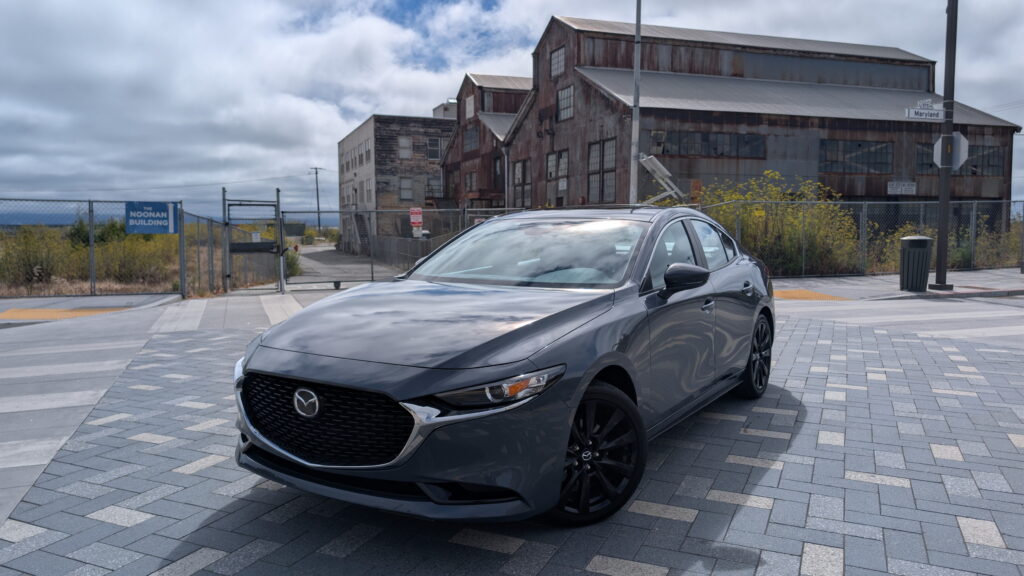
It’s easy to forget just how old the current Mazda3 design is. This generation arrived for the 2019 model year, which means the basic shape has now been staring back at us for the better part of a decade. It doesn’t look it.
That’s especially impressive because compact cars tend to age quickly. Designers pile on creases, fake vents, oversized grilles, strange lighting signatures, and whatever other styling trend happens to be fashionable when the car launches. Five years later, those same flourishes can make the whole thing look like a product of its time. Mazda largely avoided that.
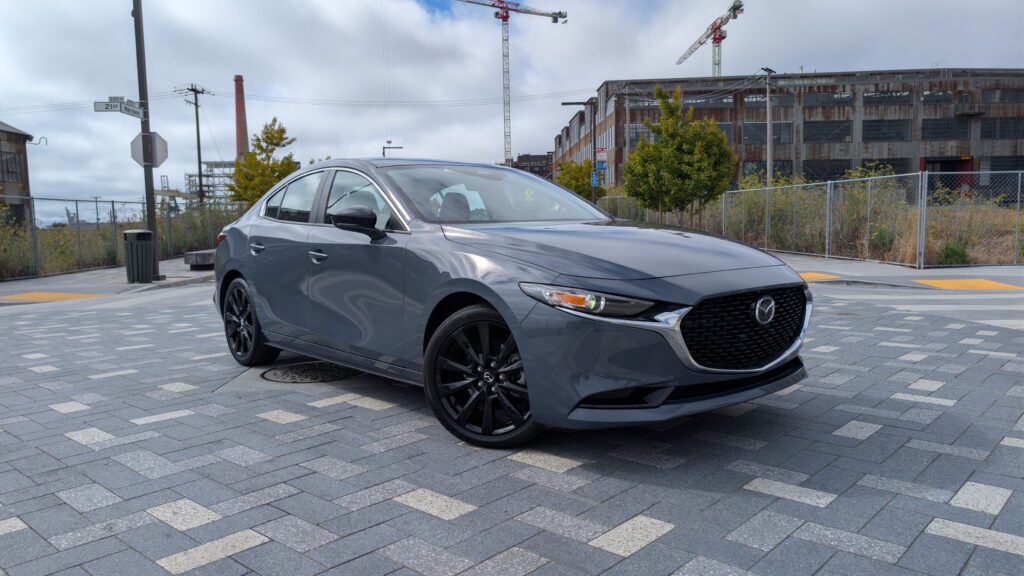
The sedan isn’t as dramatic as its hatchback sibling, but arguably that’s part of the appeal. There’s less visual weight over the rear axle, and the traditional three-box proportions make the whole thing look clean and classy.
Photos: Stephen Rivers for Carscoops
More: The Mazdaspeed AZ-1 Is The Kei Supercar Collectors Call The Holy Grail
Not in the sense that anyone is going to confuse it with a $70,000 luxury sedan. More like someone cared about the proportions before worrying about how many styling elements they could squeeze onto the bodywork.
Driving around San Francisco reinforced that impression. Against a backdrop of new crossovers, delivery vans, Teslas, Waymos and SUVs seemingly designed to occupy an entire ZIP code, the Mazda3 looked refreshingly tidy. And that’s before considering how useful those dimensions become.
X Factor: Cities Make Small Cars Great Again
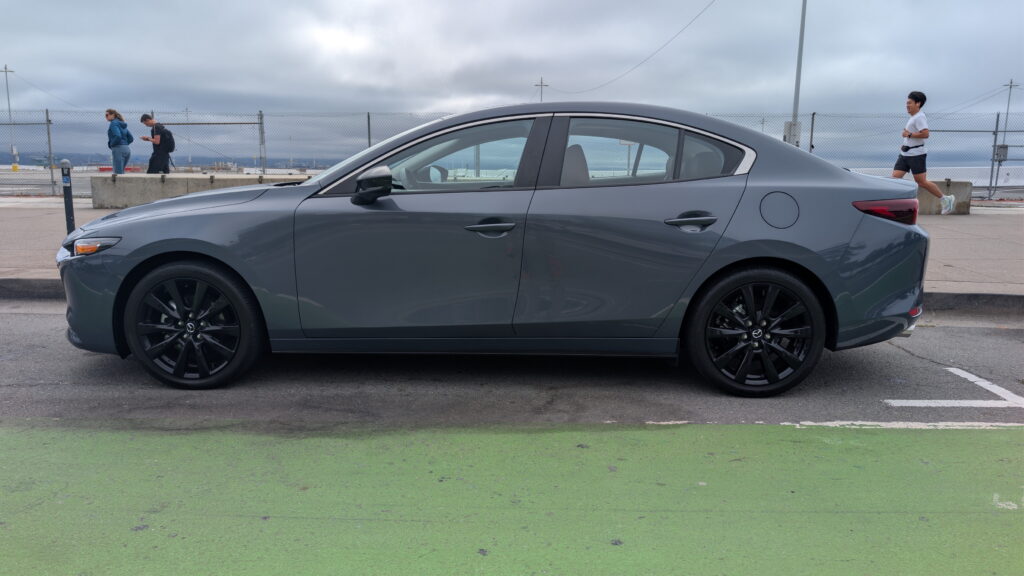
American buyers have spent years moving away from compact sedans and into crossovers, and it’s not difficult to understand why. Crossovers offer more cargo capacity, easier ingress and egress, and usually better rear-seat space. Spend enough time in a genuinely dense city, though, and suddenly being small becomes a luxury. San Francisco is particularly good at demonstrating this.
Streets narrow unexpectedly. Parked vehicles eat into already limited space. Delivery trucks stop wherever physics allows. Cyclists appear out of nowhere. Someone inevitably decides that right now is the perfect time to double park. Hills create sightlines that occasionally consist of little more than sky. And parking spaces frequently look like they were designed for vehicles from an era when an original Mini was considered normal-sized transportation. The Mazda3 is fantastic here.
Its footprint means you can put it in places where a full-size SUV would be annoying. Changing lanes requires less planning. Getting around an obstruction is easier. Tight turns aren’t an event. Finding a parking space doesn’t immediately become stressful. That’s not something you’ll find prominently advertised on a specification sheet, but after several days it becomes one of the car’s defining advantages. And importantly, Mazda didn’t achieve that by making the 3 feel disposable.
A Cabin That Still Punches Above Its Weight
Photos: Stephen Rivers for Carscoops
That distinction matters because cheap small cars can occasionally remind you of exactly what you’ve sacrificed. The Mazda doesn’t. As with the hatchback, the interior walks an unusually convincing line between mainstream and premium. The dashboard is low and clean, the controls feel thoughtfully arranged, and Mazda hasn’t succumbed to the belief that every physical control should be replaced with a glowing rectangle. It’s not a luxury car.
That’s worth saying plainly because “luxury-like” gets thrown around far too casually these days. There are materials and little details that separate a Mazda3 from something carrying a genuinely premium badge. But premium? Absolutely. The difference is subtle but important. Everything you regularly interact with feels like Mazda spent some time considering how it should work rather than merely asking what it should cost. The only blemish is the comically bad piano black trim everywhere.
The front seats remain a particular highlight. They’re comfortable and supportive without squeezing occupants unnecessarily. Mazda’s rotary infotainment controller also continues to make more sense to me than most touchscreen-only systems. There is a brief learning curve, but once familiar, operating it while moving requires far less visual attention than poking repeatedly at a screen. That becomes especially relevant somewhere like San Francisco.
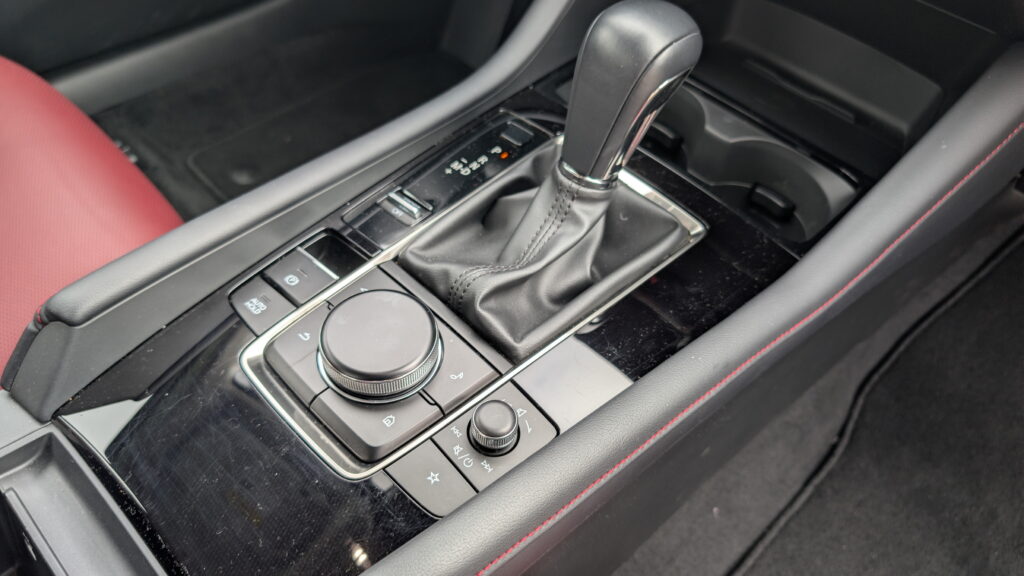
When traffic, pedestrians, cyclists, intersections, and navigation instructions are all competing for your attention, I don’t particularly want the climate controls or infotainment system demanding some of it too. There are limitations. Rear-seat space isn’t particularly generous, especially with a tall driver up front. Four adults can fit, but nobody is buying a Mazda3 sedan because they regularly transport an NBA starting lineup. For normal use, however, it works. And that’s becoming something of a theme here.
The sedan also makes a surprisingly strong argument for the increasingly forgotten concept of a trunk. Yes, a crossover has a larger opening. Yes, a hatchback offers more flexibility when you need to carry bulky objects. But the Mazda3 sedan’s cargo area is impressively useful considering how little space the car occupies on the road.
Photos: Stephen Rivers for Carscoops
For luggage, groceries, backpacks, camera equipment, and other stuff people actually carry on a normal week, there’s plenty of room. Better yet, everything is separated from the passenger compartment. That’s hardly revolutionary, but it raises another question about our obsession with larger vehicles. How frequently do you actually use all that extra space? If you’re transporting three children, two dogs and a week’s worth of camping equipment every weekend, obviously this isn’t the car for you. If most trips involve one or two people and occasionally four? This is probably enough.
Driving Impressions: You Don’t NEED The Turbo
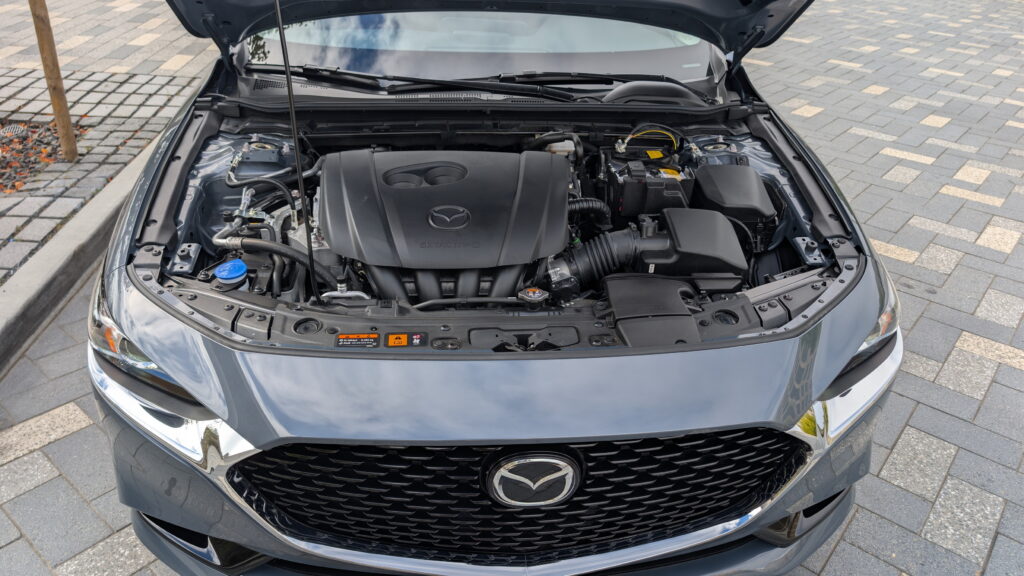
This was perhaps the biggest surprise for me because I’d already spent significant time in the turbocharged Mazda3 hatchback. That car makes a compelling argument for enthusiasts. Its 2.5-liter turbocharged engine gives the chassis the straight-line performance to back up its excellent steering and body control. It’s legitimately quick, too. The naturally aspirated sedan isn’t.
And after a few days in San Francisco, I somewhat bemoan the reality that I didn’t really care. Acceleration is somewhere around average for the segment, perhaps a little better in terms of how it actually feels from behind the wheel. More importantly, the power delivery is wonderfully linear. Push the accelerator and the car responds predictably. There’s no waiting for a turbocharger to wake up, no giant lump of torque suddenly arriving, and no need for the transmission to perform three calculations before anything happens. Around town, that’s valuable.
Read: Big Changes Coming To Mazda’s Large SUVs After Sales Sputter
At 25, 35 or 45 mph, the Mazda feels alert. You see a gap, squeeze the accelerator, and it moves. It isn’t violently fast, but it rarely feels caught asleep. That’s arguably far more important in a city than shaving two seconds off a 0-60 mph time.
Driving the turbo had made me wonder what Mazda could accomplish with this chassis if it went all-in and resurrected the Mazdaspeed3. The naturally aspirated sedan caused almost the opposite reaction. Maybe this chassis doesn’t need more power to be worthwhile because the bones are still excellent. The steering is better than average, full stop. Weight builds naturally, the front end responds accurately, and there’s enough communication coming back through the wheel that you understand what the tires are doing. Again, San Francisco makes this matter.
The brakes are less noteworthy. They’re perfectly normal. Pedal response is predictable, stopping power is adequate, and there isn’t much else to say. Frankly, that’s fine. Not every component needs to be extraordinary. That’s actually the broader appeal of the Mazda3. Fuel economy isn’t extraordinary either. There are hybrids that’ll embarrass the Mazda at a gas pump, and anyone whose singular priority is stretching a gallon as far as possible should probably be looking elsewhere. Across roughly 200 miles of mixed city and highway driving around San Francisco, I averaged about 30 mpg. Considering the environment, I’ll take it.
This wasn’t a carefully orchestrated economy run. It involved traffic, hills, freeway driving, frequent stops, and normal use of the accelerator. Could a Prius do substantially better? Absolutely. But again, we’re talking about compromise.
Competition
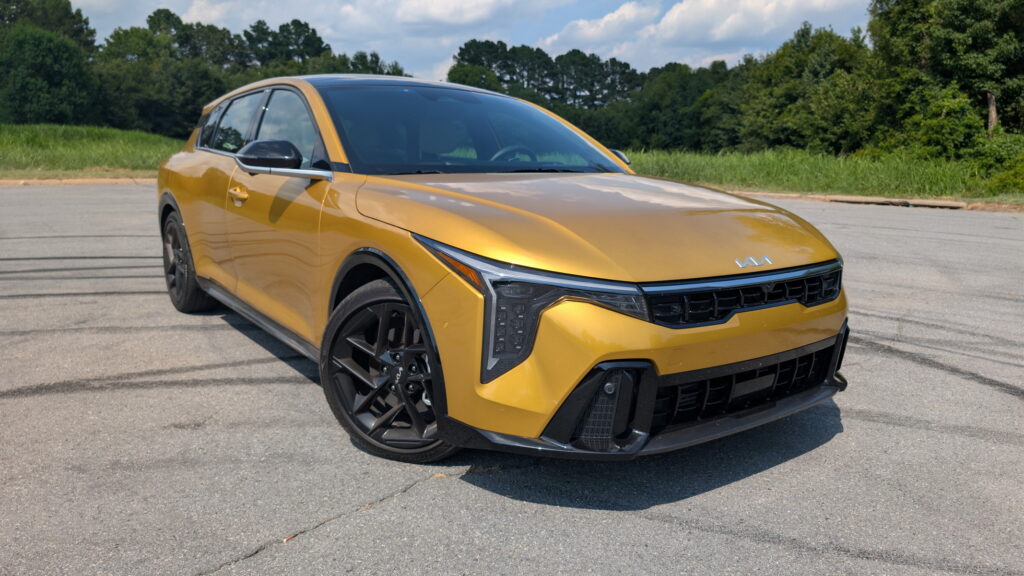
The Mazda3 sits in one of the most competitive segments in the industry. And it’s not competitive because there are dozens of compact cars on sale. It’s competitive because the few left have been distilled down to a bevy of nothing but genuinely good cars. That said, it still manages to punch above its weight.
The Honda Civic and Toyota Prius are probably better all-around cars in terms of what the ultimate goal is here. They both offer considerably better fuel economy. The Prius is the best-looking of the bunch (how things have changed), and the Civic scores top marks in cabin accoutrement and chassis dynamics.
The Volkswagen Jetta and Hyundai Elantra aren’t far behind the Mazda, but neither truly matches up as the complete package that we have here. That said, Hyundai offers a much more generous warranty. If there’s anything that really puts a damper on the Mazda3 in my mind, it’s the outstanding Kia K4 hatchback, which comes with even more space, a more engaging powertrain, a better warranty, all for the same general price.
Verdict: An Honest Car
Maybe practicality is ultimately why I came away liking the Mazda3 sedan so much. It feels honest. Mazda isn’t pretending this version is some barely contained performance monster. It isn’t an ultra-efficient hybrid. It doesn’t have three rows, 12 inches of ground clearance, or enough towing capacity to relocate a small house.
It’s simply a really well-made compact sedan. And in San Francisco, that simplicity became its greatest strength. It was quick enough. Spacious enough. Efficient enough. Comfortable enough. Practical enough. But the steering was better than it needed to be, and it didn’t stop there.
The chassis was better than it needed to be. The interior was nicer than it needed to be. And somehow, after all these years, it still looks better than it needs to. That’s the difference. There are plenty of cars that can beat the Mazda3 in individual categories. Some are faster. Some are more efficient. Some have vastly more cargo space. Some offer significantly more rear-seat room.
But most people aren’t timing laps on their commute. They aren’t carrying seven passengers. They aren’t towing 5,000 pounds. They aren’t moving refrigerators every Thursday. They’re going to work. They’re picking somebody up. They’re buying groceries. They’re driving across town for dinner. They’re trying to find somewhere to park. And every once in a while, they’re hoping the road home gives them something interesting to drive.
After 200 miles around one of America’s densest cities, the Mazda3 sedan made an unusually convincing argument that maybe we’ve spent the last decade solving problems most drivers don’t actually have. Because for an enormous number of people, this isn’t merely enough car. It’s probably all the car they actually need. And if they’re willing to give it a try, they might find it’s the best car for their actual lifestyle.