 by
by Mazda changes its position on touchscreens
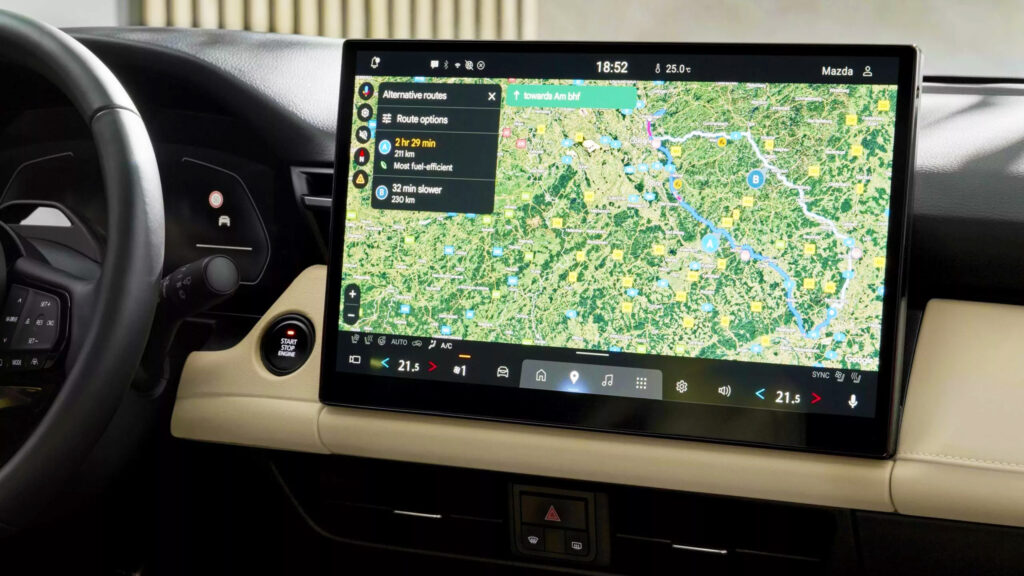
Mazda has long resisted the general trend of installing huge tablet-like displays in cars. It insisted on using modest central screens and a convenient controller on the center console, while other automakers competed to install panels stretching across the entire dashboard. However, the new generation of the CX-5 crossover put an end to this resistance. The company now claims that the large screen it opposed for so long is actually a safer choice.
Why a touchscreen is safer than physical buttons
Previously, Mazda built its identity on the belief that physical buttons and knobs help the driver focus on the road better than touchscreens. Now, this position has changed. In a conversation with the Australian publication Drive, CX-5 program manager Koichiro Yamaguchi stated that a large display actually reduces the time a driver spends distracted from the road, compared to a set of conventional controls.
“The air conditioner can be controlled with one finger, and if we install physical buttons, they will be located at the bottom. Then the driver will have to look down, and there will be 15 switches that look similar. This means you have to look down and select the right button — it actually requires the driver to take their eyes off the road. So it’s better to have this control on the screen — to minimize this change (distraction),” he explained.
How climate control is implemented in the new CX-5
Moving climate control settings to touchscreens has upset many drivers, but most automakers are now doing exactly that. In the new CX-5, the temperature and fan speed controls remain fixed at the bottom of the screen, so they are always easy to reach. This is a fairly successful solution compared to some other cars on the market. When the air conditioning controls are integrated into the lower part of the central screen, they are usually convenient to use. At the same time, Mazda has retained physical buttons for the front and rear windshield defroster settings, allowing them to be turned on and off quickly while driving.
Mazda listens to customer feedback
The company currently believes that the solution implemented in the CX-5 is the best. However, Mr. Yamaguchi noted that Mazda is ready to bring back physical buttons if it receives appropriate feedback from owners.
“Of course (we would be open to changing the layout with only touch controls), however, how customers use these things, their preferences (will influence this decision). We first need to get feedback from customers. For the CX-5, of course, as a basic policy, we are offering this, but we are collecting feedback from customers to consider (possible changes),” he added.
Thus, Mazda, which was once one of the main advocates of physical buttons, has not only switched to large touchscreens but is also actively justifying this step from a safety perspective. The company acknowledges that the physical controls familiar to many drivers may force them to be distracted from the road for longer while searching for the right button among a dozen similar ones. At the same time, Mazda reserves the option to backtrack if customers express widespread dissatisfaction with the new approach. This shows that the company is trying to find a balance between modern technology and driver convenience, but the final word still rests with consumers.