 by
by Porsche stopped producing air-cooled 911s almost three decades ago, but apparently hasn’t stopped thinking about this technology. A recently published German patent reveals an interesting cooling concept that combines classic Porsche engineering with modern performance requirements.
Hybrid Cooling System
The patent, filed with the German DPMA office in 2025, was officially published on May 7 this year. Its title translates to “Vehicle with an internal combustion engine with air and liquid cooling,” as the new system does not rely exclusively on air cooling technology.
Porsche appears to be developing a hybrid thermal management system for future high-performance sports cars, especially with rear and mid-engine layouts, something not seen since the proto-hypercar 959, which had air-cooled crankcase and water-cooled cylinder heads.
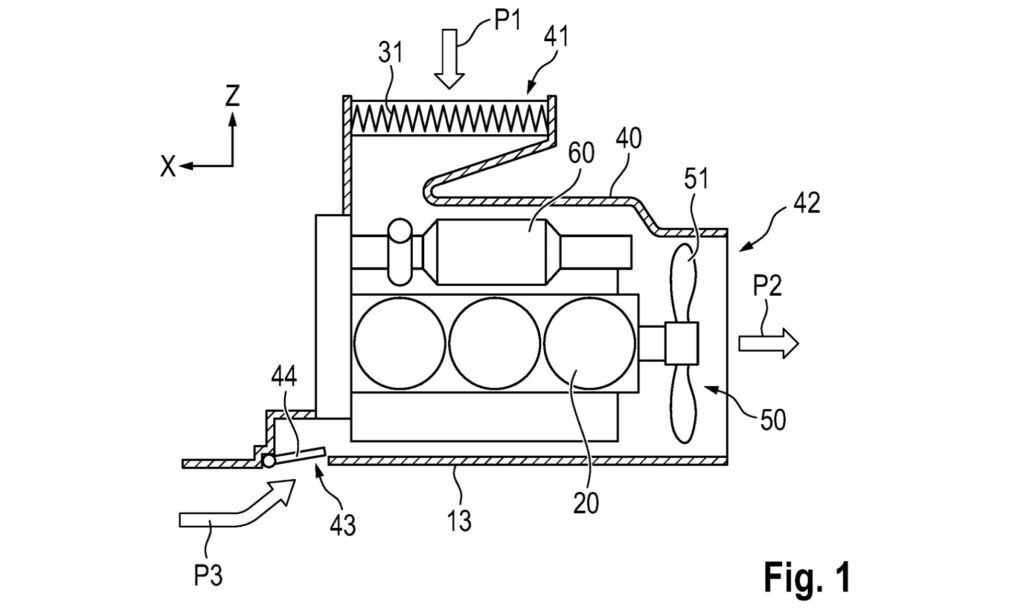
This time, the idea combines conventional liquid cooling with active air flow around the engine itself. The engine still uses coolant channels, pumps, and a radiator, but Porsche adds a system with a large fan that actively directs air around the engine block, turbocharger, and exhaust system components.
Layout Advantages
Unlike a conventional modern sports car, the engine is located in an almost completely enclosed housing that functions as a huge air duct. The air first passes through the radiator, then is directed around the engine before exiting through the rear of the car. This layout is surprisingly close to classic 911 air-cooled thinking. Porsche even mentions cooling fins on the crankcase, one of the defining visual and engineering features of old 911 engines.
The patent points to significant layout advantages. Because the radiator is located close to the engine rather than at the front, coolant lines can be shorter, lighter, and simpler. Porsche also claims this layout could improve aerodynamics, as the front would no longer require massive cooling openings.
Innovative Features
But here is where it gets really interesting. The air flow can change direction during cold starts, recirculating warm air and even exhaust heat to bring the engine up to operating temperature faster. Porsche even hints that the system could help generate additional downforce on the rear axle, giving the whole concept a serious resemblance to the GMA T.50.
Whether this technology will reach production, no one knows, and we are curious how Porsche will solve the fan noise issue, which was one reason the original air-cooled engine “died” with the 993 model. But if it happens, Porsche fans may be in for a future sports car that literally “breathes” a bit like the old models.
This patent demonstrates that Porsche continues to seek unconventional solutions, returning to its roots but using modern technologies. The hybrid approach to cooling could be a compromise between nostalgia for the classics and demands for efficiency and environmental friendliness. If engineers manage to overcome the noise problem and integrate the system into a production model, it could become a landmark event bridging the brand’s past and future. It remains to be seen whether this idea will find its embodiment in real cars or remain just an interesting technical development.