 by
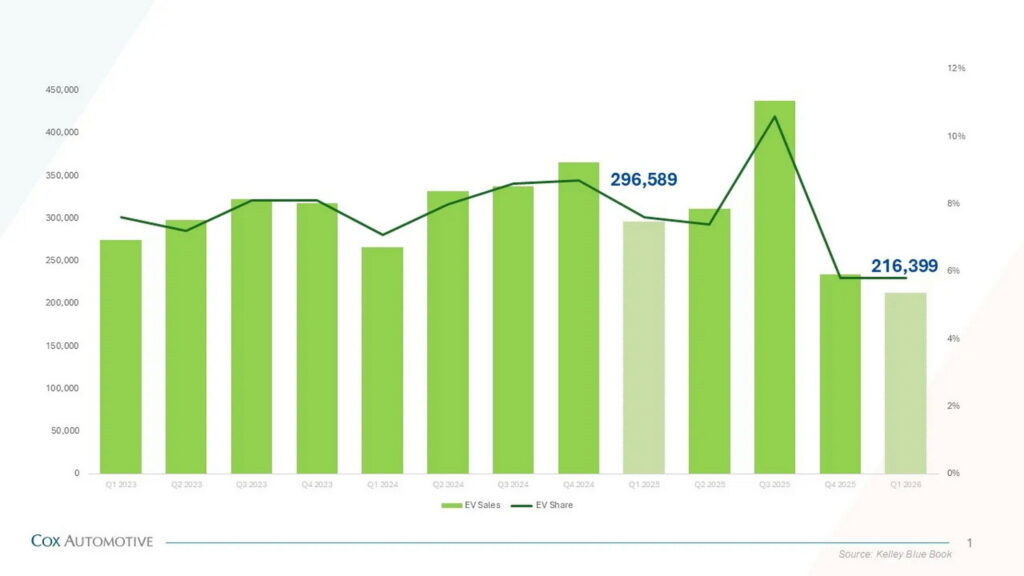
by The electric vehicle market in the United States continues to show significant cooling. While Americans are still buying electric cars, the pace of sales is significantly lower than manufacturers expected just a year ago. New data from Cox Automotive indicates a substantial decline.
Market Dynamics and Slowing Decline
Sales of 216,399 electric vehicles per quarter sound grim, and indeed they are. However, there is an important detail: the decline is slowing. Compared to the fourth quarter of 2025, EV sales decreased by only 7.8%. This is still a decline, but it is significantly smaller than the 46% quarter-over-quarter collapse the market experienced at the end of last year after federal incentives for electric vehicles were canceled.
EVs accounted for 5.8 percent of all new vehicles sold in Q1, exactly where they stood in Q4 2025. That’s well below the market’s 10.6 percent peak in Q3 2025, but at least the bleeding appears to have stopped.
The share of electric vehicles in total new car sales was 5.8%, exactly at the same level as in the fourth quarter of 2025. This is significantly below the market’s peak of 10.6% in the third quarter of 2025, but at least the decline seems to have stopped.
The Undisputed Leader Tesla
Tesla remains a giant in this segment. The brand sold 117,300 electric vehicles in the first quarter, giving it an impressive 54.2% share of the entire US EV market. This is more than all other automakers combined. As has been the case for a long time, the dominant force was the Model Y. This crossover sold 78,591 units, which is 22.7% more than a year ago, and it accounts for over one in every three electric cars sold in America.
Even more impressive is that the Model 3 took second place, despite a nearly 40% year-over-year sales decline. Tesla sold 31,672 of these cars. This shows how incredibly popular these two models remain.
Brand Ranking: Who’s Growing and Who’s Falling
Beyond Tesla, the picture looks much more modest. Chevrolet became the second-largest EV brand by sales volume with 13,359 sales, slightly ahead of Hyundai (12,662) and Rivian (10,365). Toyota was one of the biggest surprises of the quarter. Its bZ electric crossover nearly doubled sales to 10,029 units, helping the brand achieve 79% growth.
The few automakers that demonstrated year-over-year growth included Cadillac, Lexus, Rivian, Lucid, and Toyota. Lexus was particularly impressive: sales of the RZ model grew by 206.7%. Meanwhile, sales of Ford, Volkswagen, Nissan, Audi, Acura, and Jeep fell by more than 85%. Among the hardest-hit models were the VW ID.4 (-95.6%), Jeep Wagoneer S (-93.3%), and Volvo XC40 (-93.1%).
The Most Popular Electric Vehicle Models
The ranking of best-selling models confirms the leadership of the Tesla Model Y and Model 3. The top 5 for the quarter also included the Toyota bZ, Hyundai Ioniq 5, and Chevrolet Equinox. Notable growth was shown by new models such as the Rivian EDV (van), Cadillac Optiq, and Lucid Gravity, which were not on the market or were just launching a year ago.
A New Market Phase: Reality Instead of Hype
Currently, the US electric vehicle market seems to have entered a new phase. Government incentives have ended, manufacturers are cutting production, and success increasingly depends on something far less exciting than hype: accessible products and realistic pricing.
Interestingly, against the backdrop of the overall decline, individual players are demonstrating resilience or even growth. This may indicate a market redistribution process, where consumers are becoming more selective, preferring proven, reliable brands or those offering the best value for money. The success of Toyota and Lexus, traditionally known for their practicality, may be a sign of precisely such a trend. The future of electric vehicles in the US is likely to be shaped not by revolutionary technologies, but by evolutionary improvements, ease of operation, and economic feasibility for the mass buyer.