 by
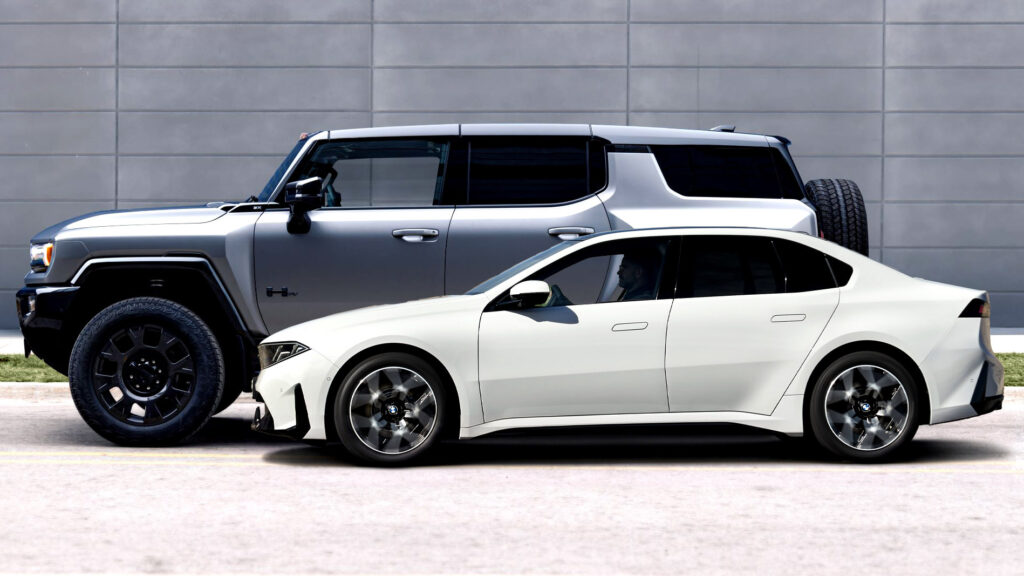
by New cars continue to become longer, wider, taller, and have greater ground clearance. Researchers warn that the increase in vehicle size could worsen road safety and exacerbate the shortage of parking spaces. The report proposes introducing taxes and regulatory norms aimed at reducing the size of future cars.
Car Growth: New Challenges for Cities
It will come as no surprise to anyone that cars are getting bigger every year. A new study claims this trend has serious consequences. Researchers state that if current growth rates continue until 2040, cities could lose parking spaces, vulnerable road users could face greater risks, and drivers will ultimately pay more to operate their vehicles.
The main question is whether politicians will try to stop the growth of cars before consumers do.
What is ‘carspreading’?
A new report from European organizations Transport & Environment (T&E) and Clean Cities examines a phenomenon they call ‘carspreading’ — the continuous increase in the dimensions of vehicles in Europe. According to the study, new cars are on average becoming 1.2 cm longer and 0.5 cm taller each year. Previous T&E research showed that width and hood height are also increasing by approximately 0.5 cm annually.
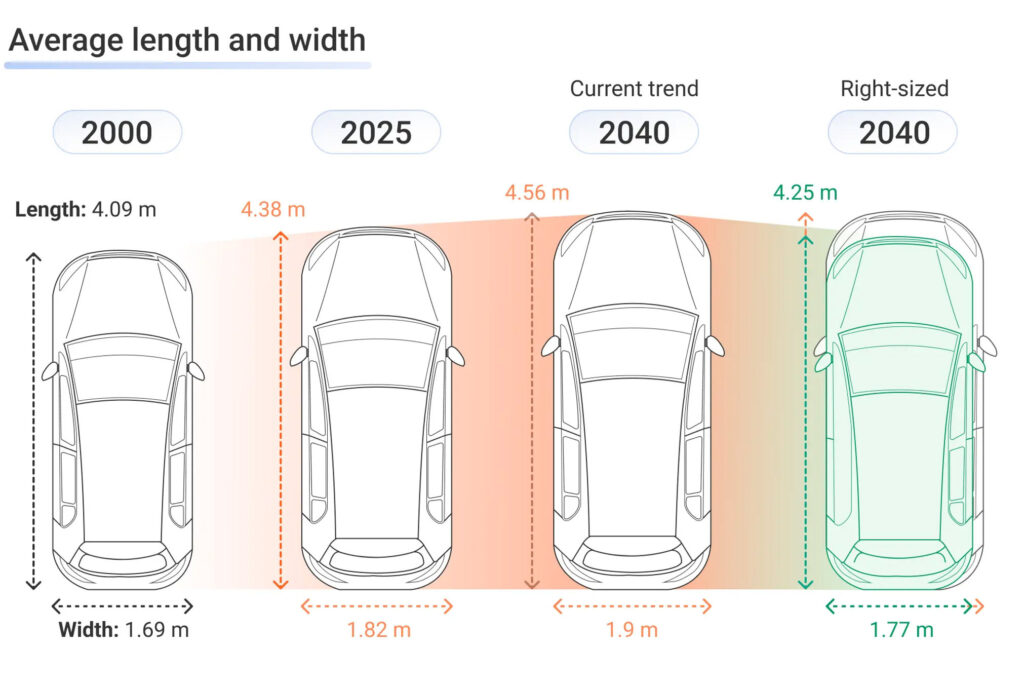
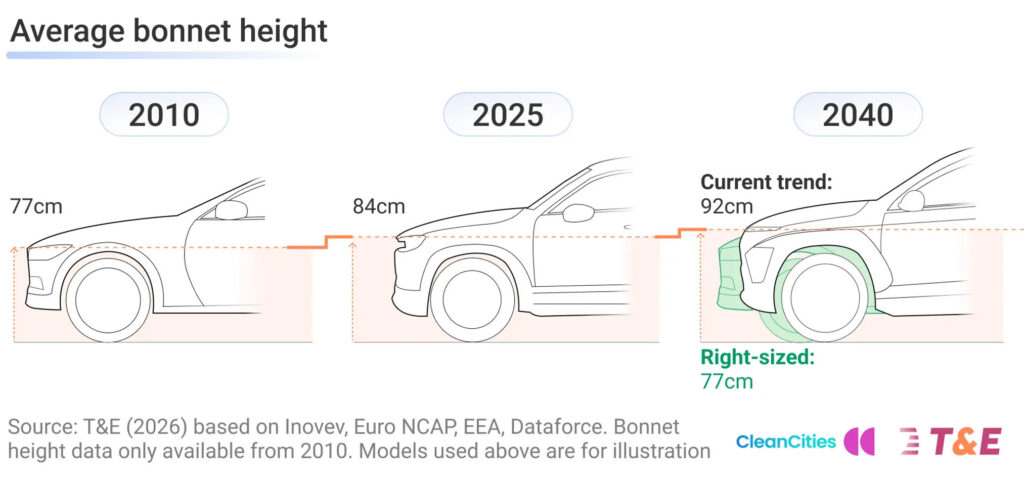
This trend has been observed since 2000 — a quarter of a century of continuous growth that has persisted even as the families buying these cars have become smaller.
The report compares two possible future scenarios. In one, manufacturers continue to follow current market trends, increasing the share of large cars and SUVs. In the other, policymakers encourage ‘right-sizing’, gradually returning the average car dimensions to the levels of 2010-2015.
Multidimensional Impact
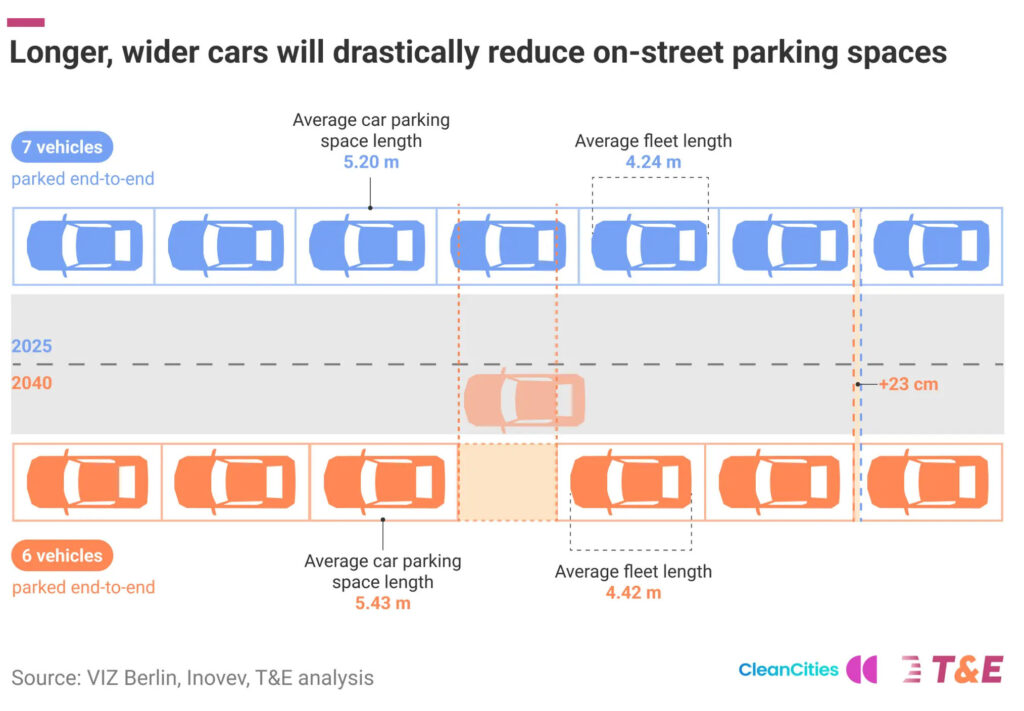
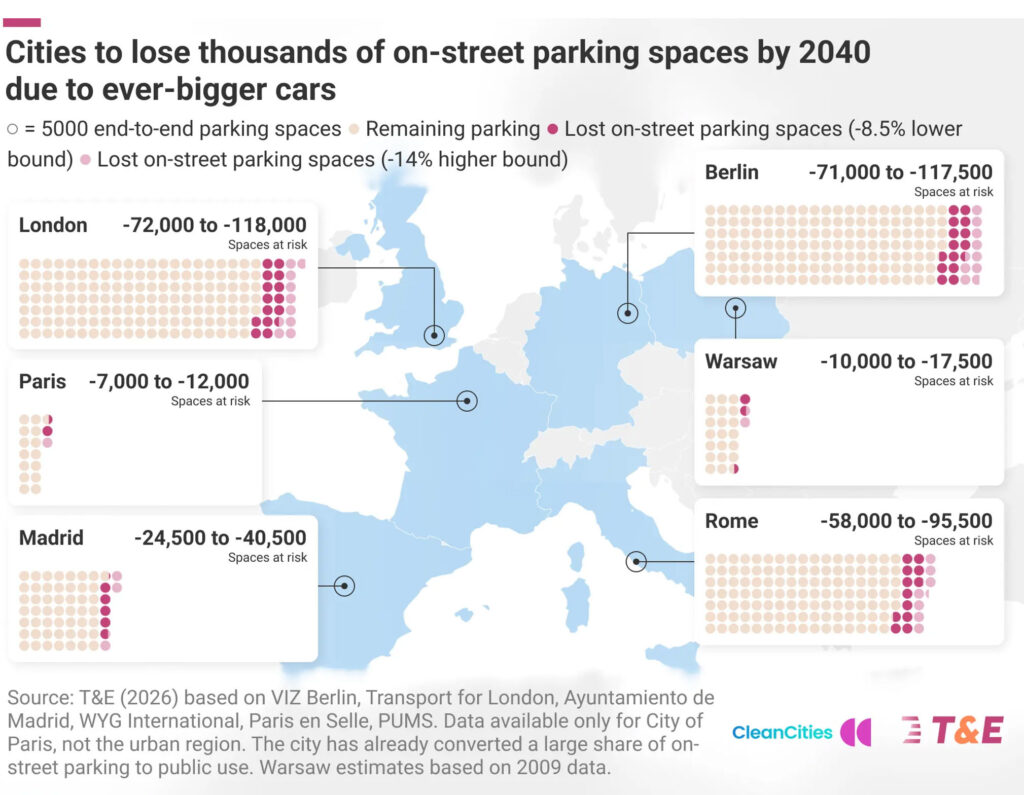
Researchers calculated that if cars continue to increase in size, the consequences will affect many areas of society. Cities could lose between 8.5 and 14 percent of on-street parking spaces by 2040. London and Berlin alone could each lose about 100,000 spaces. In some places this is not a big problem, but in densely populated cities it becomes a serious challenge worldwide.
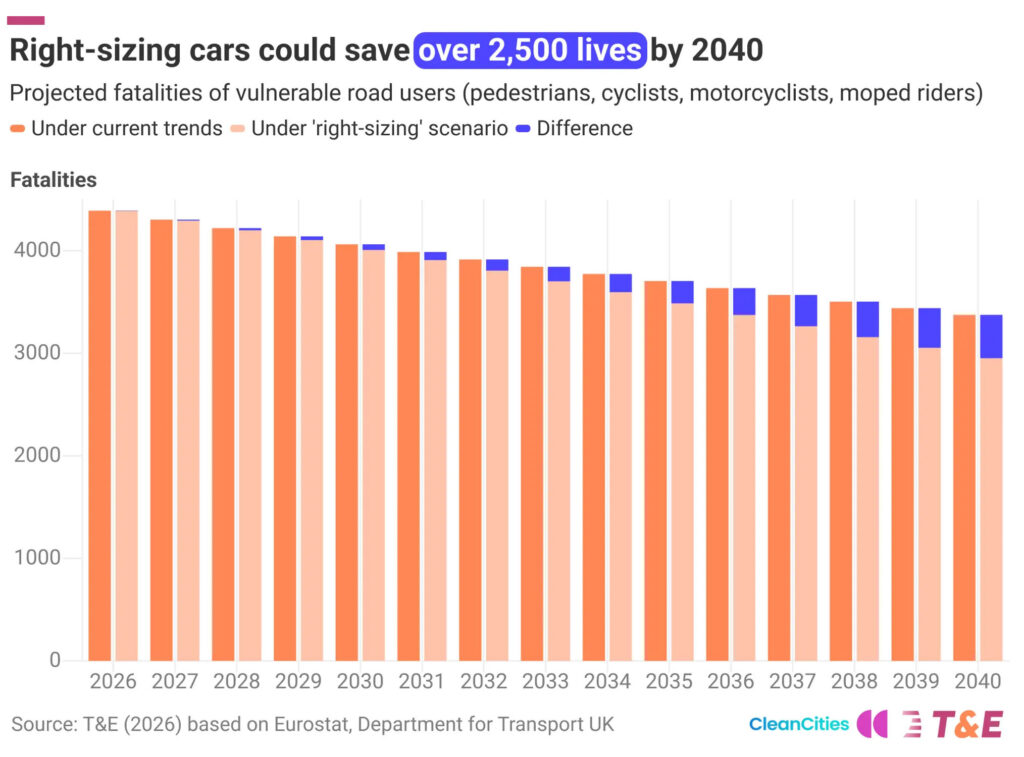
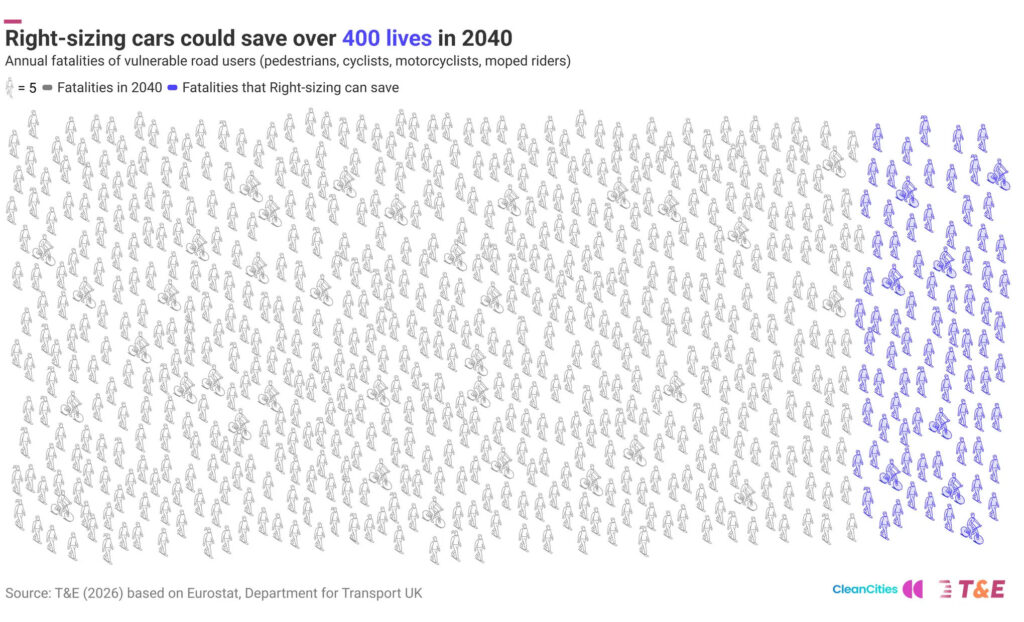
Safety is another important aspect. T&E cites previous studies linking higher hood height to more severe consequences for pedestrians and cyclists. Using this data, researchers estimate that continuing current trends could lead to approximately 2,570 additional deaths among vulnerable road users between the present and 2040 compared to the ‘right-sizing’ scenario. The report also predicts higher risks for child pedestrians, although these calculations are partly based on studies conducted in the United States.
Energy and Resource Consumption
Energy consumption also plays a significant role. Large cars typically weigh more and consume more energy, whether they run on gasoline or electricity. T&E calculated that Europe’s electric vehicle fleet would require an additional 22.5 terawatt-hours of electricity annually by 2040 under the current trend, equivalent to the output of approximately 1,500 onshore wind turbines. Consumption of over 100 million additional barrels of imported oil is also projected over the same period, as internal combustion engine vehicles remain in operation.
Researchers’ Recommendations
Unsurprisingly, the proposed solutions may seem aggressive to some. The report calls for limiting hood height to 85 cm, width to 192 cm, introducing taxes tied to vehicle dimensions, parking fees dependent on size, and regulatory incentives designed for smaller electric cars less than 4.2 meters in length.
Whether these ideas will find support is another question. Consumers have been voting with their wallets in favor of SUVs and crossovers for the last two decades. Automakers are likely more responsible for this than most people realize.
Ultimately, large cars, trucks, and SUVs yield higher profits and are usually not subject to the same stringent safety and fuel economy standards. So, while they did not create this demand in a vacuum, they are certainly capitalizing on it. This means the real battle may not be in designing smaller cars, but in convincing automakers to build them again.
It is worth noting that while the study focuses on Europe, similar trends are observed in other regions of the world, particularly North America. The issue of balancing consumer preferences, automaker profits, and societal costs such as safety and infrastructure is becoming increasingly relevant. Perhaps the future of the automotive industry will depend on the ability to find a compromise between size, functionality, and responsibility to society.