 by
by Electric cars are displacing petrol cars
Demand for battery electric vehicles across Europe (including the UK and EFTA) continues to grow. In May, they pushed petrol cars into third place among powertrain types, behind only traditional hybrids. Chinese brands also added momentum: in May, they registered 121,030 sales in Europe, almost double the amount in May 2025, and achieved a market share of 10.7% for the first time.
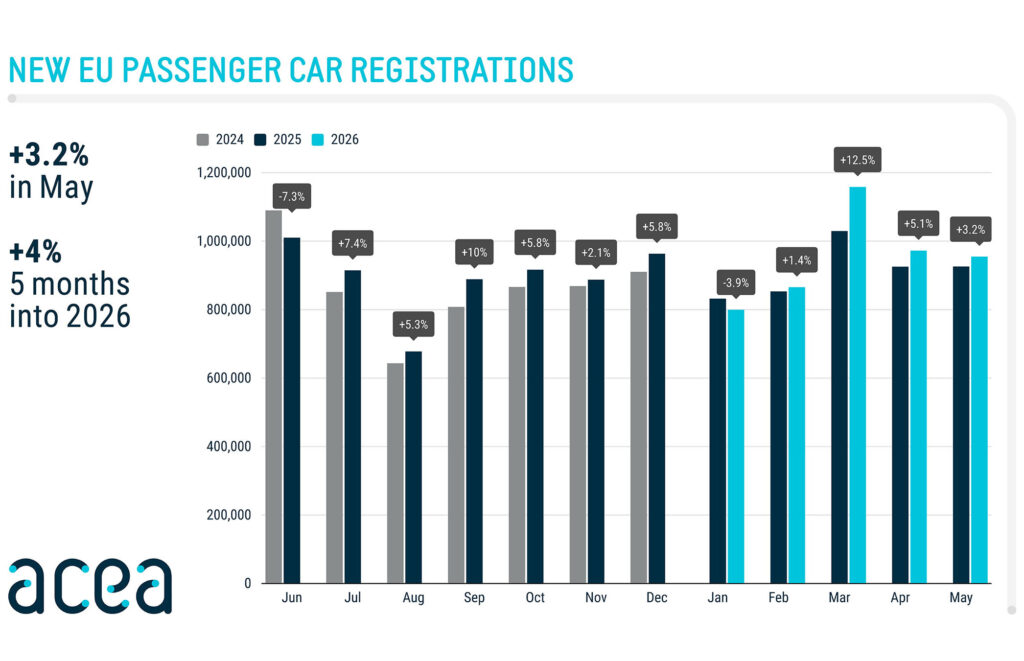
Counting the UK, EFTA countries (Iceland, Liechtenstein, Norway and Switzerland), and the European Union, total new car registrations in May rose by 3.6% to 1.15 million units. In the EU alone, the figure grew by 3.2% to 955,013 compared to May last year.
Record May for BEVs
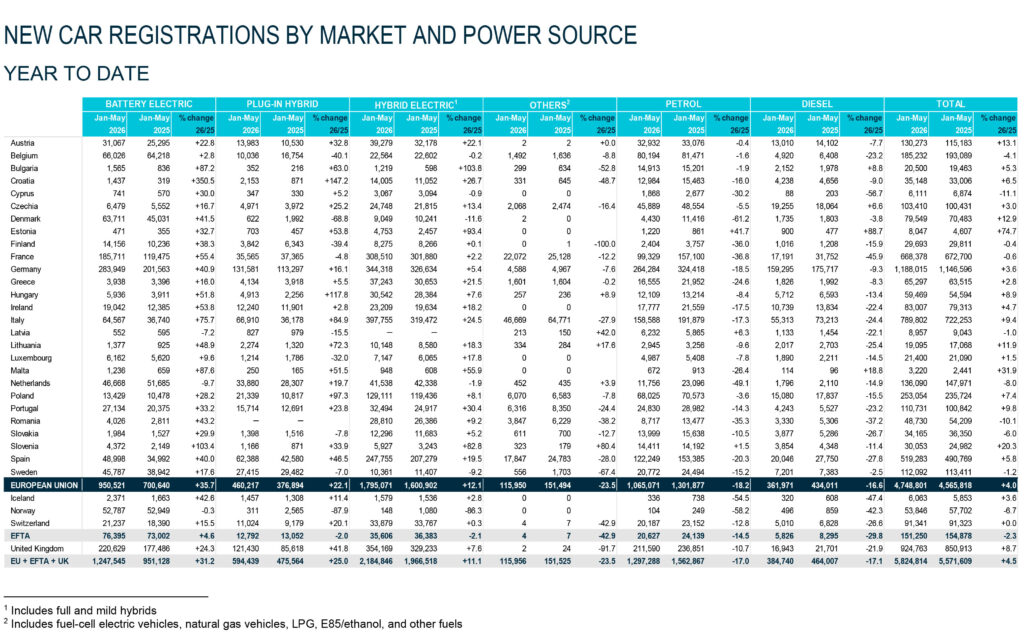
The surge in demand for electric vehicles is drawing the most attention. In EU countries, 950,521 new battery electric vehicles were registered in the first five months of the year, giving them a 20% market share, slightly behind petrol cars (22.4%) and significantly less than hybrids (37.8%).
Adding the UK and EFTA countries, the BEV share since the start of the year rises to 21.4%, just one step behind petrol cars (22.3%). Plug-in hybrids also grew: reaching 460,217 registrations in the EU for May, representing 9.7% of the market, compared to 8.3% a year earlier.
In May alone, BEVs held a 21.3% market share in the EU, slightly trailing petrol cars at 22%. Expanding the sample to the EU, EFTA and the UK, BEVs actually surpassed petrol car sales, securing 23.3% of the market versus 21.7% for petrol. This distribution is explained by the UK and Scandinavian countries, where EV adoption is most active. Excluding these markets, petrol remains the leader in the EU bloc; adding them back in, the order changes.
Growth was concentrated in several markets. BEV sales jumped 75.7% in Italy, 55.4% in France and 40.9% in Germany.
Tesla and the decline of petrol
Tesla made a significant contribution to this growth: the company’s European sales nearly doubled in May. The Model Y returned to the top of the BEV charts with 17,183 sales (up 68%), becoming the most popular electric vehicle in the region and the third best-selling car overall. Model 3 sales rose 198% to 9,566 units, allowing it to take second place among electric vehicles after nearly tripling compared to last year.
While electric vehicles gained momentum, demand for petrol fell by 18.2% by the end of May. Diesel car registrations also declined by 16.6%, leaving diesel with a 7.6% share of new car registrations in the EU.
The biggest drop was recorded in France, where registrations fell by 36.8%. Sales in Spain also decreased by 20.3%, and in Germany by 18.5%.
Chinese brands are advancing
Demand for cars from China is also growing. This year, the Geely group sold 176,676 cars in the EU, EFTA and UK, up 6.5% from the January-May period last year. SAIC sales grew by 11.6% to 141,490, while BYD sales soared by 145.2% to 135,307.
In May, BYD overtook MG’s parent company, SAIC Motor, to become the most popular Chinese car manufacturer in Europe, while Chery trailed SAIC by only a few hundred sales.
The wider lineup of Chery brands tells the same story. Combined sales under the Chery, Jaecoo, Jetour and Omoda brands grew by 316% to 122,843 units, while Leapmotor grew by 552.9% to 43,037. Other Chinese car manufacturers also showed significant growth in May, including Xpeng, which rose by 138%.
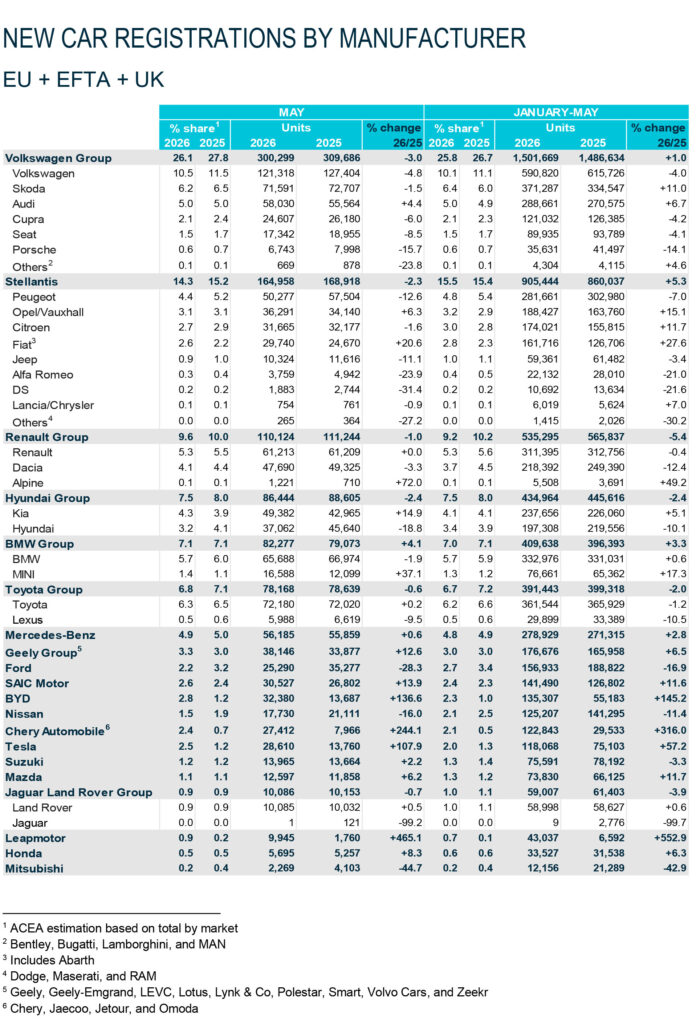
This data indicates a fundamental shift in the European automotive market, where electric vehicles are gradually becoming the dominant force, particularly thanks to active incentive policies in certain countries and growing competition from Chinese manufacturers. At the same time, the decline in demand for traditional internal combustion engines, especially diesel, points to a long-term trend that is likely to intensify with the expansion of charging infrastructure and decreasing battery costs. Chinese brands such as BYD and Chery are not only increasing volumes but are also actively displacing traditional players by offering competitive prices and technologies, which could significantly change the balance of power in the market in the coming years.